Ask the people around you how they want to grow their wealth, and the answer is usually one of two things: steady dividends or capital appreciation.
And the go-to is usually Singapore real estate investment trusts (S-REITs) for the former and US tech giants for the latter.
However, going all-in on either means taking on all of its weak spots.
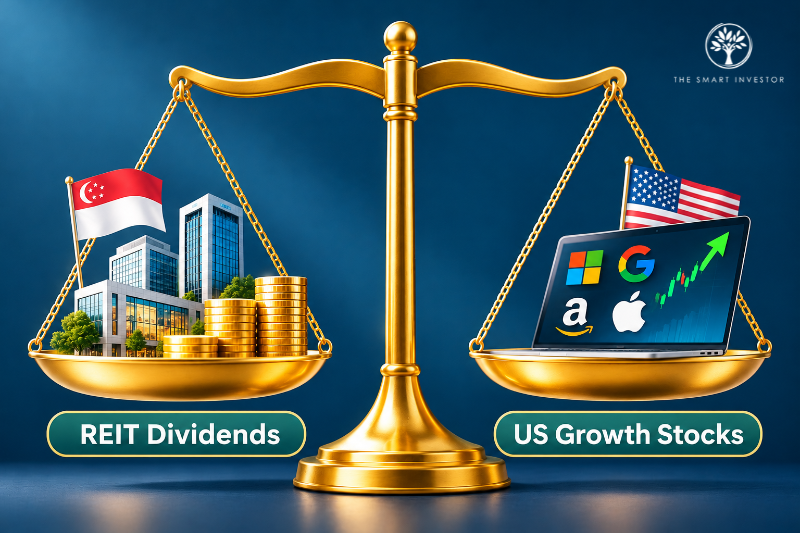
When you mix REITs with US growth stocks, you strike a balance between consistent cash flow and long-term upside.
Here’s how to make them work together.
Why Combine REITs and US Growth Stocks?
REITs own income-generating properties like malls and warehouses, collect rent, and pay out 90%+ of taxable income for corporate tax breaks.
That high payout makes them an income favourite.
Reinvest the payout, and watch your money snowball faster.
On the flip side, big tech stalwarts like Microsoft Corporation (NASDAQ: MSFT), Alphabet Inc (NASDAQ: GOOGL), and Amazon.com Inc (NASDAQ: AMZN) skip the hefty payouts and pour their cash directly into expansion, especially AI and cloud infrastructure.
They run on entirely different engines.
Blending them gives you sensible diversification, but don’t treat it like a bulletproof hedge.
When a sharp sell-off strikes, both can easily drop at the same time.
Choosing the Right Singapore REITs for Dividend Income
A fat yield means little if the payout behind it is shrinking.
So before buying a REIT, always check if its payout is growing.
CapitaLand Integrated Commercial Trust (SGX: C38U), Singapore’s largest REIT, raised its distribution per unit (DPU) by 7.1% to S$0.0602 in 1H2026.
This was driven by strong rental reversions of 4.0% in retail and 6.5% in offices, alongside a resilient occupancy rate of 95.6%.
In contrast, Mapletree Industrial Trust (SGX: ME8U)’s 1HFY2026/2027 DPU slipped 5.7% to S$0.0608 after property sales and weaker occupancy at its North American portfolio.
A headline yield above 6% is definitely juicy, but a declining payout quickly erodes that initial appeal.
Balance sheet strength also plays a critical role.
When interest rates stay elevated, a REIT’s gearing directly impacts the bottom line.
CICT maintains a gearing ratio of 37.4% with an average cost of debt at 2.9%.
Healthcare pure-play Parkway Life REIT (SGX: C2PU) runs even leaner at 33.8% gearing, helping power a 14.6% jump in its 1H2026 DPU on the back of rising Singapore hospital rents.
That’s why sector diversification matters too!
Malls, offices, hospitals, and warehouses all answer to different tenants, so a slump in one won’t sink your payouts.
Selecting US Growth Stocks for Long-Term Capital Appreciation
For a growth company to stay great, it needs something special, something rivals find hard to copy.
Companies like Microsoft, Alphabet and Amazon have that kind of edge.
Microsoft reported 19.0% year-on-year (YoY) growth in revenue to US$92.3 billion for 1QFY2027, with its Azure cloud business up 48.0%.
Alphabet’s 3Q2026 revenue climbed 25.0% YoY to US$127.6 billion as Google Cloud revenue soared 103.0%.
Similarly, Amazon posted 12.0% YoY growth to US$201.9 billion for 3Q2026, as AWS sales were up 39.0%.
However, growth only counts if it eventually becomes free cash flow.
And here’s where the picture splits.
Over the past 12 months, Microsoft generated US$60.0 billion of free cash flow and Alphabet US$19.4 billion, although Alphabet’s quarterly free cash flow has dipped below zero in each of the last two quarters.
Meanwhile, Amazon swung to a negative US$42.4 billion as its AI spending ballooned.
That said, negative cash flow is not necessarily bad if those data centres pay off, but it is still a risk to watch.
How Much Should You Allocate to REITs vs US Growth Stocks?
There’s no perfect asset split for everyone.
It simply comes down to your age, goals, and how many ups and downs you can stomach.
If you’re close to retiring, locking in consistent cash flow and capital preservation takes priority.
But if you have decades ahead, you can ride out bigger swings for more growth.
Here is a hypothetical S$100,000 split.
| Portfolio Style | S-REITs | US Growth Stocks | Rough Yearly Payout | Suits |
|---|---|---|---|---|
| Income-focused | 70% | 30% | S$3,920 | Near or in retirement |
| Balanced | 50% | 50% | S$2,900 | Mid-career |
| Growth-focused | 30% | 70% | S$1,880 | Young, long horizon |
Assumes average distribution yields of 5.45% for S-REIT and dividend yields of 0.35% for US growth stocks.
The income-focused mix pays the most today and swings the least, but grows more slowly.
The growth-focused mix pays little now but has the most upside, and bumpiest ride.
Remember, this two-asset combo is just a baseline model, not a complete portfolio.
You’ll still want an emergency cash cushion, some bond allocation for ballast, and broad-market shares outside of property and tech.
How Dividends and Growth Can Work Together
While you are building wealth, reinvest your REIT distributions into more units, or into growth stocks when their valuations look reasonable.
That helps rebalance your portfolio without selling anything.
As retirement nears, gradually shift towards income.
Let your stage of life drive the change and not the latest headlines.
What Are the Risks of Combining REITs and US Growth Stocks?
Interest rates are one of the most important risks to watch, as they cut both ways.
Higher rates raise REIT borrowing costs and tend to drag down growth-stock prices too.
Currency is another.
As US stocks are priced in US dollars, if the greenback weakens against the Singapore dollar, your returns shrink when converted back.
Also, watch out for concentration.
Having three technology giants or five shopping malls is not diversification.
Lastly, volatility.
Both can drop 20% or more, so keep an emergency fund and you’ll never be forced to sell at the bottom.
How to Measure Whether Your Portfolio Is Working
Watch your total return – payouts plus price changes.
A 7% yielder whose unit price falls 10% has still lost you money.
Check that your REITs’ DPU rises over time and review your portfolio at least once a year.
If your mix drifts off target, rebalance based on business fundamentals, not price swings.
Get Smart: Balance Income Today with Growth Tomorrow
REITs pay you now while growth stocks build wealth for later.
Whatever the mix, judge each holding on payout quality, debt, and cash flow, not just its yield.
That goal is never to buy the biggest yield or hottest stock.
It’s simply to build a portfolio that delivers solid total returns and fits your life.
Not all AI “winners” will survive this cycle.
But a few companies already have the scale, cash flow, and edge to pull ahead. We highlight what to look for in our FREE volatile market report. Download it here.
Follow us on Facebook, Instagram, Telegram and YouTube for the latest investing news and analyses!
Disclosure: Si-Fan T. owns shares in Amazon and Alphabet.