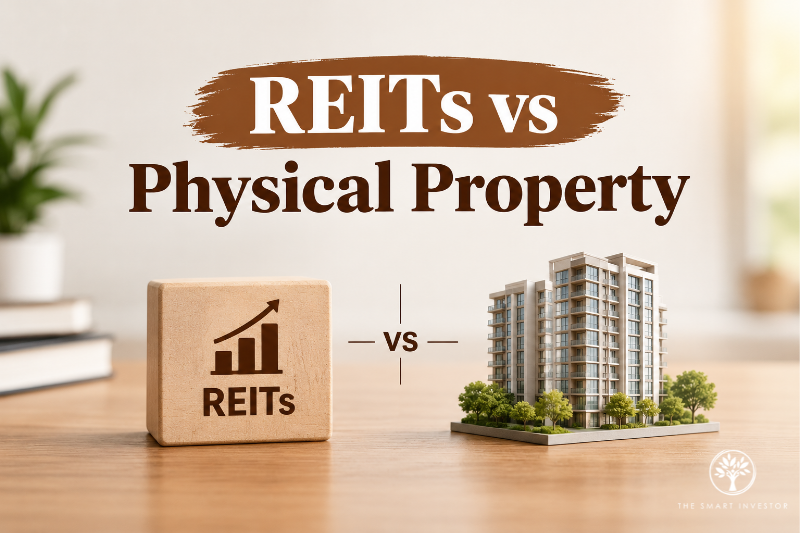
Buying a condominium in Singapore requires a large upfront commitment.
Real estate investment trusts (REITs) offer another way to gain exposure to income-producing property without buying a physical property.
For this comparison, let’s evaluate two options for a S$1 million allocation: buying a Singapore condo versus building a diversified portfolio across five local REITs.
The question is not simply which option can rise more in value.
It is whether owning a physical condo actually delivers better financial returns after accounting for financing costs, rental income and ongoing expenses.
The True Cost of Owning a Singapore Condo
A S$1 million condo does not really cost S$1 million upfront, nor is that the total amount you pay.
Assuming a 75% mortgage, an investor must put down S$250,000 in cash and CPF.
Adding roughly S$24,600 in buyer’s stamp duty and about S$3,000 in legal fees brings the initial cash commitment to roughly S$277,600.
Then come the ongoing holding costs.
Beyond mortgage interest, the property owner remains responsible for property tax, maintenance fees and periodic repairs.
If the unit is rented out, agent commissions and potential vacancy periods further erode income.
REITs: A Different Way to Own Property
Instead of buying a single residential unit, an investor can split S$1 million of capital equally across five Singapore REITs at S$200,000 each.
The following are the five REITs I would pick:
| REIT | Sector | Trailing 12-month (TTM) Distribution Yield | Latest DPU | Gearing |
| CapitaLand Integrated Commercial Trust (SGX: C38U), or CICT | Retail / office | 5.2% | S$0.0602 | 37.4% |
| CapitaLand Ascendas REIT (SGX: A17U), or CLAR | Business / industrial | 6.8% | S$0.07482 | 39.7% |
| Mapletree Industrial Trust (SGX: ME8U), or MIT | Industrial / data centres | 6.8% | S$0.0311 | 37.5% |
| Mapletree Logistics Trust (SGX: M44U), or MLT | Logistics | 6.6% | S$0.01816 | 40.5% |
| Parkway Life REIT (SGX: C2PU) | Healthcare | 3.8% | S$0.0877 | 33.8% |
*The figures are based on the latest earnings results and TTM distribution yields as at 8 October 2026.
This spread provides immediate exposure across retail, commercial, industrial, logistics and healthcare assets.
Instead of collecting rent directly, investors receive distributions from the REITs.
These five REITs are chosen not because they offer attractive yields, but because they cover a mix of property types and businesses, with distribution growth, high occupancy and moderate gearing.
CICT’s large portfolio offers exposure to both retail and office properties.
In contrast, CLAR’s portfolio is concentrated in the industrial segment, with the REIT having exposure across business parks, logistics facilities, industrial properties, and data centres.
Unlike CICT, which is concentrated in Singapore, CLAR adopts a more diversified approach, with the US, Australia, and the UK / Europe making up 33% of its portfolio value.
CLAR’s distributable income grew 8.6% in 1H2026.
Meanwhile, MIT owns an S$8.3 billion portfolio of 135 properties across Singapore, North America, and Japan, with global data centres making up 57.2% of assets under management – its growth closely tied to the demand for AI infrastructure.
MLT’s broad tenant base of 987 customers spans 16 sectors, none accounting for more than 17% of revenue, thereby reducing concentration risk.
Finally, Parkway Life REIT offers exposure to the healthcare sector, and is the defensive play in the portfolio.
Its comparatively low gearing, plus a reliable and steady distribution history, makes it a favourite among more conservative investors.
Based on trailing 12-month distribution yields, our S$1 million portfolio would generate about S$58,400 a year.
How the Income Differs
Rental income from a condo looks attractive at first.
At a 3.5% gross rental yield, a S$1 million condo generates about S$35,000 a year.
However, that gross figure does not represent net cash in hand.
Property taxes, maintenance fees, agent fees, and vacancy gaps take a sizeable slice out of that S$35,000.
By contrast, REIT distributions represent net income generated by professionally managed property portfolios after operating expenses and borrowing costs have already been deducted at the trust level.
Why REITs Can Be More Flexible
A REIT portfolio provides more flexibility as investors are not tied to one property.
REITs are also easier to buy and sell than a physical property.
The trade-off is that REIT unit prices can move with the stock market, and distributions are not guaranteed.
| Factor | Singapore Condo | REITs |
| Initial capital | High | Flexible (Any amount) |
| Leverage | Direct bank mortgage | Trust-level debt management |
| Income type | Direct rental income | Quarterly/Half-yearly distributions |
| Diversification | Single property, single tenant | Multiple sectors and hundreds of tenants |
| Liquidity | Low | High |
| Transaction costs | High (Stamp duties, legal fees) | Low (Standard brokerage fees) |
| Management effort | High (Handling tenants and repairs) | Hands-off (Managed by professional REIT managers) |
| Primary risks | Vacancy, local market shifts, interest rates | Gearing levels, unit price volatility, interest rates |
Running the 10-Year Numbers
A S$1 million property growing to S$1.28 million in 10 years sounds like an easy S$280,000 profit.
But that headline number leaves out interest costs and hidden holding costs.
Assuming a 2.5% rate for both property price growth and home loan interest, here is how the numbers stack up over a decade:
| 10-Year Breakdown | S$1 million Condo (75% Mortgage) | S$1 million REIT Portfolio |
| Upfront Cash Needed | S$277,600 (Down payment, stamp duty, legal fees) | S$1,000,000 |
| Property / Portfolio Value | S$1,280,000 | S$1,000,000 (Assuming unit prices stay flat) |
| Gross Gain in Value | +S$280,000 | S$0 |
| Loan Remaining at Year 10 | S$505,000 | S$0 |
| Total Loan Interest Paid | S$158,000 | S$0 |
| 10-Year Income Collected | S$220,000 (Estimated net rent after taxes and repairs) | S$584,000 (S$58,400 a year in distributions) |
While the condo lets you use bank leverage to control a S$1 million property with less upfront cash, interest costs alone swallow up over half of the property’s S$280,000 price gain.
Meanwhile, the REIT portfolio generates about 2.7 times as much net cash income over the same period, without any mortgage stress or landlord effort.
Where Physical Property Still Has an Advantage
Physical residential real estate offers benefits that REITs cannot match.
Direct leverage allows investors to control a S$1 million asset with a fraction of the capital upfront.
If property prices appreciate well beyond inflation, that leverage amplifies the return on the initial equity.
Physical property also offers utility – an owner can choose to live in the unit or pass it down to family.
The trade-off is that higher potential leveraged returns come with concentration risk, ongoing property maintenance and significant liquidity lock-ups.
Get Smart: Look Beyond the Headline Purchase Price
A S$1 million property growing to S$1.28 million in 10 years sounds like a straightforward windfall on paper, but real estate returns are defined by friction: interest rates, holding costs, taxes, and illiquidity.
REITs have their own risks.
But I can spread S$1 million across several property portfolios without buying and managing a physical property.
For me, the question is how much leverage, cost and concentration I am comfortable taking on for the potential return.
If the market falls further, will you be ready… or fully invested?
This is where most investors get it wrong. Our FREE report shows how to stay prepared for what comes next. Get it free here.
Follow us on Facebook, Instagram, Telegram and YouTube for the latest investing news and analyses!
Disclosure: Darien C. does not own units in any of the REITs mentioned.