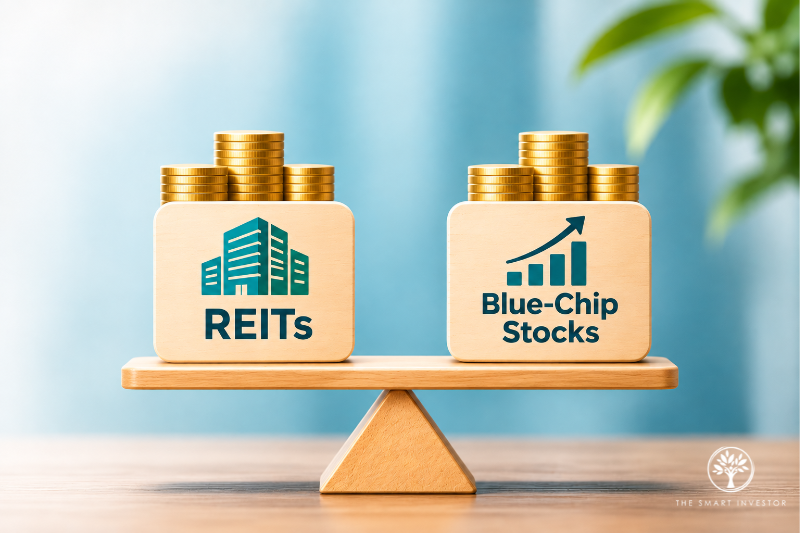
In our first article, “What Is a Dividend? A Beginner’s Guide to Passive Income in Singapore”, we learnt what a dividend was and showed you how dividend investing turns your savings into a steady stream of passive income.
On the Singapore Exchange (SGX), two types of dividend payers pop up the most: real estate investment trusts (REITs) and blue-chip stocks.
Both can deposit regular cash straight into your bank account, yet they play by completely different rules.
So, which one is actually better for passive income?
Let’s break down how they work so you can figure out what suits your investing style best.
What Are REITs and How Do They Generate Income?
Think of REITs as collective property ownership.
Instead of saving up millions to buy a shopfront or a warehouse on your own, a REIT lets you buy units in a massive portfolio of income-producing real estate.
These properties collect rent from corporate tenants.
Once the REIT pays for maintenance, property taxes, and loan interest, the leftover cash is handed out to you – the unitholder – as a distribution per unit (DPU).
Singapore offers a wide variety of REITs:
- Retail & Commercial: CapitaLand Integrated Commercial Trust (SGX: C38U), or CICT, owns household names like Plaza Singapura and Paragon, while Frasers Centrepoint Trust (SGX: J69U) dominates the heartlands with suburban malls like NEX and Causeway Point.
- Industrial & Logistics: Mapletree Logistics Trust (SGX: M44U) owns logistics parks and warehouses across the Asia Pacific.
- Healthcare: Parkway Life REIT (SGX: C2PU) owns private hospitals and medical facilities, including Mount Elizabeth and Gleneagles.
To qualify for tax transparency treatment here, Singapore REITs (S-REITs) must distribute at least 90% of their taxable income to unitholders.
That rule is the exact reason REITs are beloved by income hunters.
Still, payouts aren’t guaranteed – if tenants move out or borrowing costs spike, your DPU can take a hit.
What Are Blue-Chip Stocks?
Blue-chip stocks are the heavyweights of the market – large, household-name businesses with proven track records and deep pockets.
Our blue chips on the Straits Times Index (SGX: ^STI) span the industries that keep Singapore running day to day:
- Banking: Singapore’s trio of local banks – DBS Group Holdings Ltd (SGX: D05), Oversea-Chinese Banking Corporation Limited (SGX: O39), or OCBC, and United Overseas Bank Limited (SGX: U11), also referred to as UOB, – form the cornerstone of the local market, bringing in profits from mortgages, business loans, credit cards, and wealth management.
- Market Infrastructure: Singapore Exchange Limited (SGX: S68) isn’t just where you buy stocks; it’s a listed company itself. As Singapore’s only securities exchange, it enjoys a natural monopoly, collecting steady listing and trading fees whenever markets are active.
- Aviation & Engineering: Singapore Airlines (SGX: C6L) and Singapore Technologies Engineering Ltd (SGX: S63), or ST Engineering, earn their keep from global air travel, aerospace maintenance, and defence technology.
- Hospitality & Telecoms: Genting Singapore Limited (SGX: G13) runs Resorts World Sentosa, while Singapore Telecommunications Limited (SGX: Z74), or Singtel, provides regional telecommunications services.
Unlike S-REITs, blue chips aren’t bound by any 90% payout rule.
Management can freely decide how much profit to reinvest into growing the business, paying down debt, or returning to shareholders as a dividend per share (DPS).
That gives them plenty of room to grow, though your dividends generally track the company’s actual profits.
REITs vs. Blue-Chip Stocks: How Do They Compare?
Weighing REITs vs. blue-chip stocks side-by-side makes their trade-offs much easier to spot:
| Feature | Singapore REITs | Blue-Chip Stocks |
|---|---|---|
| Primary Income Source | Property rental income | Commercial business profits |
| Payout Type | Distribution Per Unit (DPU) | Dividend Per Share (DPS) |
| Income Focus | Generally higher yields due to 90% payout rule | Varies depending on business growth plans |
| Growth Potential | Rental increases and property acquisitions | Expanding operations, pricing power, and rising earnings |
| Main Risks | High interest rates and tenant vacancies | Market competition and economic shifts |
One trap many new investors fall into is chasing the highest yield on the screen.
Remember that your total return comes from both the dividends you pocket and how the share price moves over time.
A juicy 8% yield won’t feel like much of a win if the underlying business is struggling and its share price drops by 20%.
Which Is Better for Passive Income?
It really comes down to what you want your money to do for you right now:
- Go with REITs if you want higher, property-backed payouts today without dealing with tenants, leaky roofs, or mortgage paperwork.
- Choose blue chips if you’re happy with a slightly lower starting yield in exchange for stronger business growth and the potential for long-term capital gains.
But here is something most seasoned dividend investors figure out sooner rather than later: you don’t actually have to pick a side.
Think of REITs and blue chips like teammates playing different positions.
S-REITs do the heavy lifting for immediate rental cash flow, while STI blue chips bring earnings power across banking, telecoms and aviation.
Holding a mix of both keeps your passive income from leaning too heavily on one sector.
If high interest rates squeeze property trusts for a year or two, strong bank dividends can help pick up the slack – and vice versa.
Spreading your capital across property rentals, regional telecommunications, and financial services helps keep your passive income stream steady even if a single industry faces temporary headwinds.
Get Smart: Sustainable Income Wins the Race
Both S-REITs and blue-chip stocks play essential roles in building a reliable stream of cash flow.
The secret to building lasting passive income isn’t about hunting down the single highest yield on the SGX today.
It’s about owning sturdy, reliable businesses that can keep paying you – and ideally raising those payouts – year after year.
Ready to put this into practice?
In the next article of this series, “How to Start Dividend Investing in Singapore: A Step-by-Step Beginner’s Guide”, we’ll walk through how to make your very first investment on the SGX.
First-time investors: We’ve finally released our Beginner’s Guide. Read it in an afternoon, follow the principles, pick an investing style and buy your first SGX stocks within the next few hours! Click here to download it for free.
Follow us on Facebook, Instagram, Telegram and YouTube for the latest investing news and analyses!
Disclosure: Calvina L. owns shares/units in DBS, OCBC, SGX and CICT.