Income investors adore the Singapore stock market for its strong pool of established dividend-paying companies, from blue chips to real estate investment trusts (REITs).
However, building an entire portfolio around dividends can be risky, as future growth may be limited.
This is where US growth stocks come in handy.
Why Singapore Dividend Stocks Are So Popular
No one can fight the lure of regular income.
Dividend payments provide cash that can cover living expenses or support reinvestment.
By reinvesting dividends, investors compound wealth over time without adding fresh capital.
Moreover, dividend stocks are generally familiar businesses – such as the banks where you save your cash and malls where you shop.
For example, Singapore’s three big local banks – DBS Group (SGX: D05), UOB (SGX: U11) and OCBC (SGX: O39) – are steady payers with long track records.
In 1H2026, DBS declared dividends of S$1.62 per share, up 8% year-on-year (YoY).
That figure includes a S$0.30 capital return dividend, distinct from its ordinary payout of S$1.32.
Singapore REITs are legally required to distribute 90% of their taxable income for tax transparency, making names like CapitaLand Integrated Commercial Trust (SGX: C38U), or CICT, and Parkway Life REIT (SGX: C2PU) great additions alongside blue chips.
For 1H2026, CICT paid S$0.0602 while Parkeway Life REIT paid S$0.0877 in distributions per unit (DPU), up 7.1% and 14.6%, respectively.
But Dividend Income Alone Has Its Limitations
With heavy exposure to mature industries, the Singapore market offers great income, but lacks large listed companies in high-growth sectors.
Crucially, high yield does not equal high total returns.
Income is also vulnerable to changing business cycles: companies can trim payouts under margin pressure, while REIT distributions can be squeezed by higher financing costs.
Capital appreciation is essential when evaluating overall performance.
Why US Growth Stocks Can Fill the Gap
Companies like Microsoft Corp (NASDAQ: MSFT), Alphabet Inc (NASDAQ: GOOGL), and NVIDIA (NASDAQ: NVDA) can give Singapore investors access to major global growth themes like artificial intelligence (AI), semiconductors, and enterprise software that simply don’t have a local equivalent.
Adding carefully selected US stocks provides greater diversification and faster earnings expansion.
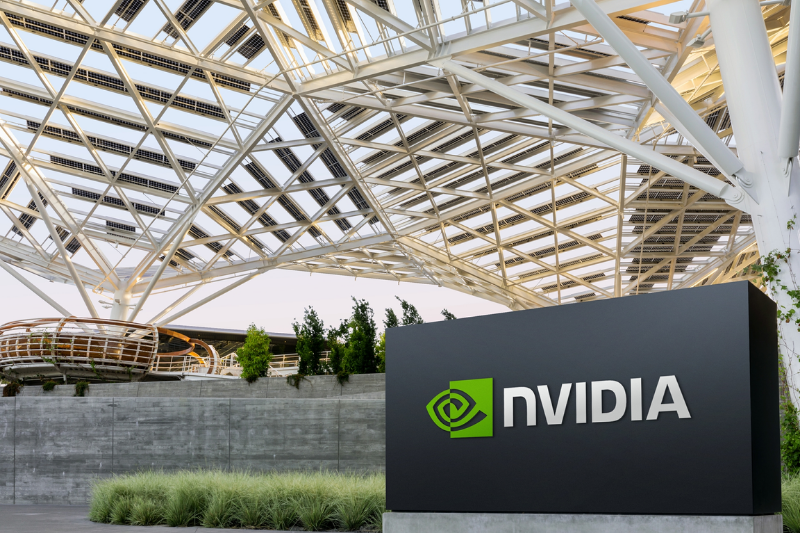
NVIDIA, for example, is the world leader in graphics processing units (GPUs), essential in AI infrastructure.
In the first quarter ended 26 April 2026, revenue surged 85% YoY to a record US$81.6 billion – a scale unseen among local companies.
Why a Singapore Investor Should Think Globally
Singapore represents only a small part of the global equity markets.
Limiting your portfolio to domestic companies leaves you heavily reliant on a single economy and currency.
Conversely, US-listed multinationals generate revenue worldwide.
However, holding foreign assets brings currency risk: exchange rates fluctuate, and a strengthening Singapore dollar can erode US capital gains.
Growth + Income: Why the Combination Makes Sense
Combining Singapore dividend stocks for reliable yield with US growth stocks for capital appreciation captures both immediate cash flow and long-term expansion.
Reinvesting local dividends further compounds wealth over time.
Investors must find an allocation mix that best suits them based on their goals, risk tolerance, and investment horizon.
An income-focused investor may allocate 60-70% of their portfolio to local blue chips and REITs for dividends.
Conversely, a younger, growth-oriented investor may assign 70% to global growth stocks for potential growth while keeping a small mix of Singapore stocks for income.
Remember to keep 10% to 20% as cash or short-term bonds for liquidity, allowing you to buy when good opportunities pop up unexpectedly.
Risks of Adding US Growth Stocks
US growth stocks can offer significant long-term opportunities, but investors should be aware of the risks that come with them.
Popular growth companies can trade at demanding valuations, increasing valuation risks.
If earnings miss elevated expectations, share prices can drop sharply.
Owning multiple US technology stocks is not true diversification if they all depend on the same catalysts, such as AI spending or interest rate movements.
Additionally, investors should recognise the dividend trade-off.
Many growth companies pay little or no dividend because they retain cash to fund expansion.
Furthermore, Singapore investors are subject to a 30% US dividend withholding tax on distributions from US-listed companies, which directly reduces the net income received compared to tax-free Singapore dividends.
Finally, a stronger Singapore dollar can also reduce the value of US investments even when the underlying shares perform well.
Common Mistakes Investors Make
A costly mistake is confusing dividend yield with total return.
Being overly concentrated in banks and REITs simply because these sectors are familiar and offer income is another common folly.
Some investors also buy US growth stocks purely because they have performed well recently while ignoring valuation.
Remember, strong past performance does not guarantee strong future returns.
Instead, look for companies with strong underlying fundamentals such as sustainable revenue growth, strong free cash flow, expanding margins, and durable competitive moats.
Get Smart: Don’t Make Your Portfolio Choose Between Income and Growth
Singapore dividend stocks can form an excellent bedrock for your portfolio.
Adding quality US growth companies provides access to global tailwinds that drive wealth accumulation over time.
The goal is not to choose between income and growth, but to build a balanced strategy that delivers reliable income today while compounding capital for tomorrow.
The headlines feel worse than the market itself.
So what are experienced investors actually doing right now? Our FREE report reveals how to position your portfolio amid volatility. Download it for free here.
Follow us on Facebook, Instagram, Telegram and YouTube for the latest investing news and analyses!
Disclosure: Wenting A. does not own any of the stocks mentioned.