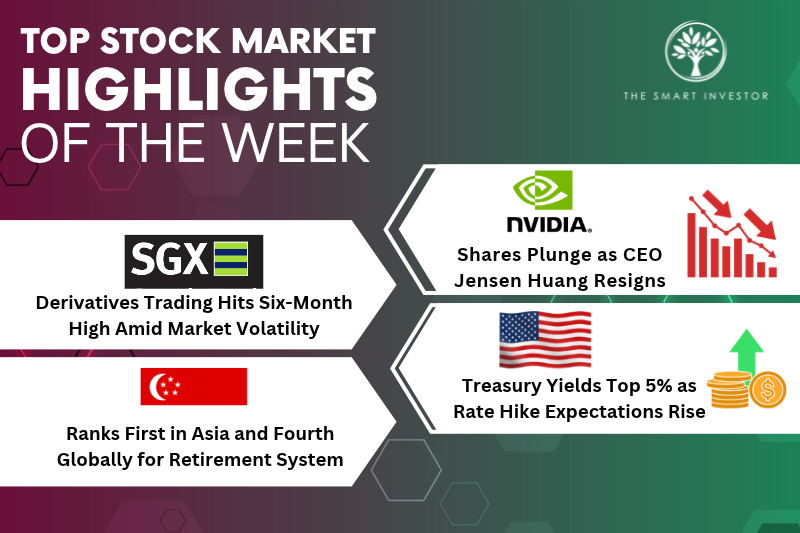
Welcome to this week’s edition of top stock market highlights.
A chipmaker that was the world’s most valuable company just weeks ago lost its long-time leader this week, and its shares tumbled.
Closer to home, market volatility lifted the local bourse’s derivatives trading volume to a six-month high in October.
Meanwhile, US bond yields climbed back above 5% as investors braced for more interest rate hikes.
And in a bright spot for Singapore, a global pension index ranked the country’s retirement system the best in Asia.
Nvidia’s CEO resigns as scandal deepens
Nvidia (NASDAQ: NVDA) announced on 12 November 2026 that co-founder and CEO Jensen Huang had resigned following reports of two affairs.
Scrutiny began after Huang admitted to a relationship with a former executive at Singapore-based data centre firm Megaspeed International.
US authorities suspect her of spying for China, a claim Beijing has denied.
A later report said Huang had also had a relationship with a senior Nvidia executive who reported to him.
Chief financial officer Colette Kress will serve as interim CEO while the board searches for a permanent successor.
Board member Harvey Jones has been appointed Nvidia’s first-ever chair.
Huang, who owns about 3.6% of the company, will also leave the board.
The shares fell as much as 14% at the open, pushing Nvidia’s market capitalisation below US$4 trillion for the first time since 2025.
The stock is now roughly 35% below its early-October record, and at least seven Wall Street firms have downgraded it over the past week.
Investors will look to Nvidia’s 3QFY2027 results, due on 17 November 2026, for clarity.
Market volatility lifts SGX’s trading volumes
Singapore Exchange (SGX: S68) reported on 12 November 2026 that its derivatives daily average volume climbed to a six-month high in October, as volatile markets drove demand for hedging.
Daily average derivatives volume rose 8% year on year and 17% month on month to 1.6 million contracts. FTSE China A50 Index Futures recorded a 24-month high in daily average volume.
Open interest (the value of contracts still outstanding) in GIFT Nifty 50 contracts topped US$20 billion.
Securities market turnover also rose, climbing 32% year on year to S$44.8 billion.
Daily average value reached S$2 billion, driven by trading in index stocks and REITs.
The pick-up came as Singapore shares weakened in October.
The Straits Times Index (SGX: ^STI) fell about 5% to 5,376.74, while the FTSE ST Technology Index dropped 17%.
Even so, the STI ended the month 21% higher than a year earlier.
US bond yields climb as bets on rate hikes grow
US Treasury yields rose sharply on 12 November 2026, with the benchmark 10-year yield climbing back above 5% to 5.068%.
The two-year yield, which is more sensitive to Federal Reserve policy, jumped more than 11 basis points (0.11 percentage point) to 4.843%.
Hotter-than-expected consumer price index (CPI) data earlier in the week strengthened expectations of further rate hikes.
Traders are now fully pricing in a hike in December, and Goldman Sachs (NYSE: GS) added another quarter-point hike in March 2027 to its forecast.
Oil added to inflation worries after President Donald Trump said the US does not need a deal with Iran.
That raised concerns the war in the Middle East could drag on, and Brent crude rose about 1% to US$93.60 a barrel.
Higher rates are already weighing on rate-sensitive sectors.
US existing home sales fell to their lowest level in more than 16 years in October.
For Singapore investors, rising rates could mean higher borrowing costs for REITs.
The impact on local banks is more mixed, as the 3Q2026 results for DBS Group Holdings Ltd (SGX: D05), Oversea-Chinese Banking Corporation Limited (SGX: O39) and United Overseas Bank Limited (SGX: U11) showed.
Singapore’s retirement system ranks first in Asia
Singapore’s retirement system ranked fourth in the world and first in Asia in the Marsh CFA Institute Global Pension Index 2026, released on 20 October 2026.
Singapore scored 82.0 out of 100, earning an A grade alongside just five other systems.
The Netherlands topped the index with 85.8, followed by Denmark (84.1) and Iceland (84.0). Israel and Australia completed the A-grade group.
The index assessed 55 retirement income systems on three measures:
- Adequacy (40% weighting)
- Sustainability (35%)
- Integrity (25%)
It measures the overall strength of each system rather than comparing individual pension payouts.
Singapore finished well ahead of its regional peers.
Hong Kong ranked 17th, Malaysia 35th and Japan 39th, while Thailand, Indonesia and the Philippines were all in the bottom 10.
The US placed 33rd.
A strong national system does not guarantee every individual a comfortable retirement, however. Depending on their goals, investors may still need their own savings and investments.
Big Tech is spending hundreds of billions on AI, and the ripple effects are just beginning. Our new investor guide shows how AI is changing the way companies generate revenue, structure their business models, and gain an edge. Even if you already know the major players, this report reveals something far MORE important: The why and how behind their moves, and what it means for your portfolio. Download your free report now.
Follow us on Facebook, Instagram, Telegram and YouTube for the latest investing news and analyses!