Many parents tend to save the money their child receives from red packets into savings accounts for their future.
While it is safe to keep it as cash, these savings can accumulate into a meaningful sum over time with the right investments.
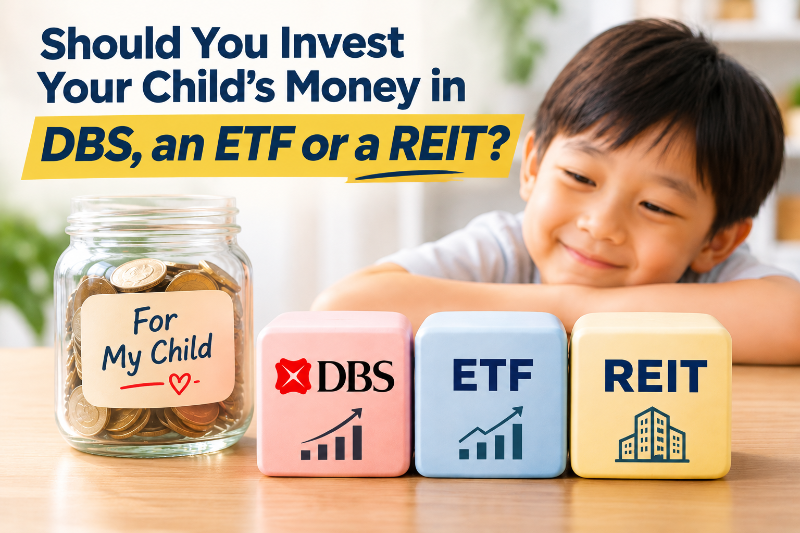
The harder question is choosing where to invest it: In DBS Group Holdings Ltd (SGX: D05), a broad-market exchange-traded fund (ETF), or a quality Singapore real estate investment trust (S-REIT)?
A Snapshot: DBS vs ETF vs REIT
| DBS | ETF | REIT | |
|---|---|---|---|
| Diversification | Low | High | Moderate |
| Income | Dividends | Depends on ETF | Distributions |
| Growth potential | Business-dependent | Market-driven | Property and rental growth |
| Key risk | Single company/banking exposure | Broad market declines | Rates, debt and property cycles |
| Effort required | Higher | Lower | Higher |
| Learning opportunity | Business ownership | Diversification | Passive income/property |
Option #1: DBS
As Singapore’s largest bank, DBS is a familiar blue-chip business with an established track record of both profitability and shareholder returns.
That record has held up even as interest rates fell.
DBS’s total income for the first nine months of 2026 (9M2026) rose 2% year on year (YoY) to a new high of S$17.9 billion, and net profit climbed 2% YoY to a record S$8.82 billion.
Total income for 3Q2026 slipped 1% YoY to S$5.85 billion and net profit fell 5% YoY to S$2.81 billion, mainly because of lower markets trading income.
Net interest income, the bank’s core lending earnings, still grew 4% YoY to S$3.71 billion.
The bank declared a 3Q2026 ordinary dividend of S$0.66 per share, plus a capital return dividend of S$0.15 per share.
Reinvesting the dividend can buy more shares, generating more payouts for your child in the future.
With DBS, parents can also easily introduce the idea of owning part of a real business to their child.
However, putting a large portion of your child’s money into a single stock, even one as strong as DBS Group, can be risky.
If anything happens to the bank or the banking sector in general, the investment could fall sharply in value.
Option #2: A Broad-Market ETF
With a broad-market exchange-traded fund (ETF), your child’s money enjoys diversification from the very first dollar.
For example, Vanguard S&P 500 ETF (NYSEARCA: VOO) tracks 500 large-cap U.S. companies, offering access to technology and scalable global sectors absent from the Singapore market.
With one investment, the money gains exposure to 500 companies, without parents analysing and attempting to pick the biggest winner.
With a broad-market ETF, poor performance from an individual company has less impact on the overall portfolio.
That said, returns will broadly follow the underlying market.
As at 31 October 2026, the Vanguard S&P 500 ETF has returned 11.76% year-to-date and an average 12.04% a year over the past five years.
In comparison, the share price of Apple Inc (NASDAQ: AAPL), maker of the iPhone, rose by an average of about 18.1% a year over the same five years, and it is up around 26.8% so far in 2026.
By owning the whole market, investors give up the chance to significantly outperform it through a single standout stock.
When investing in ETFs, Singapore investors need to consider ETFs’ expense ratios, management fees, and any foreign exchange risk.
Option #3: A Singapore REIT
S-REITs turn your child’s savings into property income, without buying physical real estate.
A favourite amongst Singapore investors, S-REITs typically pay out at least 90% of their taxable income to enjoy tax transparency.
Defensive REITs like CapitaLand Integrated Commercial Trust (SGX: C38U), or CICT, generate steady cash flows through regular distributions, which can be reinvested to accelerate growth.
However, a REIT’s income is highly dependent on factors like occupancy levels, rental growth, and interest rates.
Gearing, interest costs and debt maturities can affect the distribution per unit (DPU) and its sustainability.
You might be in for a shock if you focus solely on headline yield without analysing the underlying business.
Why Time Changes the Answer
A five-year-old gives you a powerful 15- to 20-year runway for compounding growth.
Short-term market volatility matters less when the investment has decades to grow.
And with the long investment horizon, compounding becomes the true force.
Imagine you invest S$10,000 for your child, reinvesting the dividends and keeping the investment over the next decade or two:
| 10 years | 15 years | 20 years | |
|---|---|---|---|
| 3% returns | S$13,439.16 | S$15,579.67 | S$18,061.11 |
| 4% returns | S$14,802.44 | S$18,009.44 | S$21,911.23 |
| 5% returns | S$16,288.95 | S$20,789.28 | S$26,532.98 |
| 6% returns | S$17,908.48 | S$23,965.58 | S$32,071.35 |
Your S$10,000 more than tripled in 20 years with a 6% annual return, with dividends reinvested.
And then, there is capital appreciation.
Take DBS as an example.
On 16 October 2006, DBS shares traded at S$19.00
By 12 November 2026, they had closed at S$71, nearly four times the earlier price.
That’s a gain of about 274% before counting dividends or the bonus shares DBS has since issued to shareholders.
Do You Actually Have to Pick Just One?
Instead of an either-or choice, you can easily combine all three to minimise concentration risk while giving your child’s portfolio a chance to outperform the market.
With an initial investment of S$10,000, you can split it into:
- S$5,000: A broad-market ETF as a diversified core
- S$2,500: DBS Group for capital appreciation and dividends
- S$2,500: CICT for distributions and property exposure
Instead of 20 different stocks, keep it simple for your child’s portfolio.
This makes it easier to teach them what they own and why these investments are chosen.
The Most Important Investment May Not Be the Stock
Rather than focusing only on which stock is making money, show your child how you chose each investment, which companies they indirectly own and how payouts arrive.
Through this, you teach them ownership, not speculation.
This portfolio becomes an important financial education tool.
Your child can understand how underlying businesses earn, rather than focusing on daily share-price movements.
By the time they take over the portfolio, they will have a better understanding of investing and will not be going into the market blind.
Get Smart: Give Your Child Time and Ownership
DBS, ETFs, and REITs each offer something different.
A combination of all three can provide growth, income, and diversification.
Choosing that one winner today should not be a parent’s main aim, especially as a child has a long investment horizon that allows their investments to compound.
The ultimate aim is not simply handing over the money to their child when they grow up but to offer an early understanding of how investment works and how to use it to build long-term wealth.
We’ve found 5 SGX-listed dividend stocks with strong track records in turbulent markets. If you want consistency in an uncertain world, start here.
Follow us on Facebook, Instagram, Telegram and YouTube for the latest investing news and analyses!
Disclosure: Wenting A. does not own any of the stocks mentioned.