You’re 35, earning well, and you’ve finally started investing seriously.
A colleague swears by DBS Group (SGX: D05) dividends: steady, reliable, pays out every quarter.
Meanwhile, your friend in tech keeps raving about NVIDIA Corporation (NASDAQ: NVDA), up over 1,200% in five years.
Both sound compelling.
So who’s right?
The answer might surprise you: both of them are.
I see this come up a lot with investors.
The real question isn’t which market to invest in.
It’s how to combine them so your money works harder by generating income today while building wealth for tomorrow.
Understanding the Two Worlds
Singapore dividend stocks are, at their core, built for income.
Most operate in stable, cash-generating industries like banking, real estate, and healthcare.
They return a meaningful portion of earnings to shareholders, making them ideal for investors who want consistent cash flow.
DBS, for instance, has steadily grown its dividends alongside earnings over the years.
REITs like Mapletree Industrial Trust (SGX: ME8U) and Parkway Life REIT (SGX: C2PU) generate income backed by tangible assets such as data centres and hospitals.
Historically, quality Singapore REITs have yielded between 5–7% annually.
That’s a meaningful income stream in most market environments.
As its name suggests, US growth stocks are built for expansion.
Companies like NVIDIA, Alphabet (NASDAQ: GOOGL), and Amazon (NASDAQ: AMZN) typically reinvest profits back into the business rather than paying a large dividend.
The bet is on future earnings, and when it pays off, the returns can be significant.
The former pays you today while the latter is meant to compound over time.
Why You Don’t Have To Choose
Some investors treat this as a binary decision: income or growth. But it doesn’t have to be that way. The most resilient portfolios are built with both.
Think of it this way: Singapore dividend stocks act as your cash flow engine, while US growth stocks act as your wealth-building engine.
They serve different purposes, and that’s exactly the point.
Dividend stocks provide a steady income stream that can be reinvested or used to support your lifestyle. Growth stocks build long-term wealth through capital appreciation.
Together, they create a system with multiple ways to win.
There’s also a hidden benefit, which is currency diversification. By investing in both SGD and USD assets, you reduce concentration risk in a single economy, protecting your portfolio without any extra effort.
How to Build a Balanced Portfolio: Which Type Are You?
A simple way to think about it is this: every dollar in your portfolio has a job.
Some of your money is there to grow and compound over time. Some of it is there to pay you by generating income you can reinvest or use today.
The balance between those two jobs isn’t fixed. It shifts as your life does.
If you’re earlier in your investing journey and don’t need income yet, more of your portfolio will naturally lean towards growth. The focus here is on compounding over time.
As you move into mid-career, the balance often starts to shift. Growth still matters, but having a growing stream of income becomes more meaningful, whether for reinvestment or simply for stability.
And as you get closer to retirement, income and capital preservation tend to take priority. At this stage, reliable cash flow might matter more than maximising returns.
There’s no fixed split that works for everyone. The right balance is the one that fits your goals, your timeline, and how comfortable you are with market ups and downs.
If you’re unsure where you stand, a simple way to think it through is to ask yourself a few questions:
Do I need this money to generate income in the next few years? If yes, dividend stocks should play a bigger role. If not, you have more room to let growth stocks compound.
How would I feel if my portfolio dropped 30% overnight? Growth stocks can swing hard. If that would cause you to sell in a panic, a higher allocation to more stable, income-generating stocks can help you stay invested.
Am I still actively adding to my investments? If you’re in an accumulation phase, time is your biggest asset. Growth compounds best when given a long runway.
Your answers will usually point you towards a mix that fits your life, not someone else’s.
This isn’t about finding the best stocks. It’s about combining income and growth in a deliberate way that matches where you are in life.
The Risk Realities
No strategy is without risk, and this one is no exception.
In 2022, the NASDAQ dropped nearly 33%. Investors who held Singapore dividend stocks alongside their US growth positions felt the pain significantly less. While their growth stocks fell, their dividends kept arriving every quarter, providing both income and the psychological stability to stay invested.
That said, Singapore dividend stocks are not bulletproof.
During periods of economic stress, companies can reduce or suspend dividends, as many did during the COVID-19 pandemic. There is also sector concentration risk, with heavy exposure to financials and REITs.
The balance itself is the hedge. When growth stocks are volatile, dividend income cushions the fall. When dividend stocks lag, capital appreciation from US equities drives overall returns forward.
Get Smart: Putting It All Together
Building a balanced portfolio isn’t about chasing the highest yield or the fastest-growing stock.
It’s about aligning your investments with what your money needs to do for you: right now, and ten years from now.
Some parts of your portfolio should generate income. Others should compound over time. Together, they create a system built for different market conditions, different life stages, and different definitions of success.
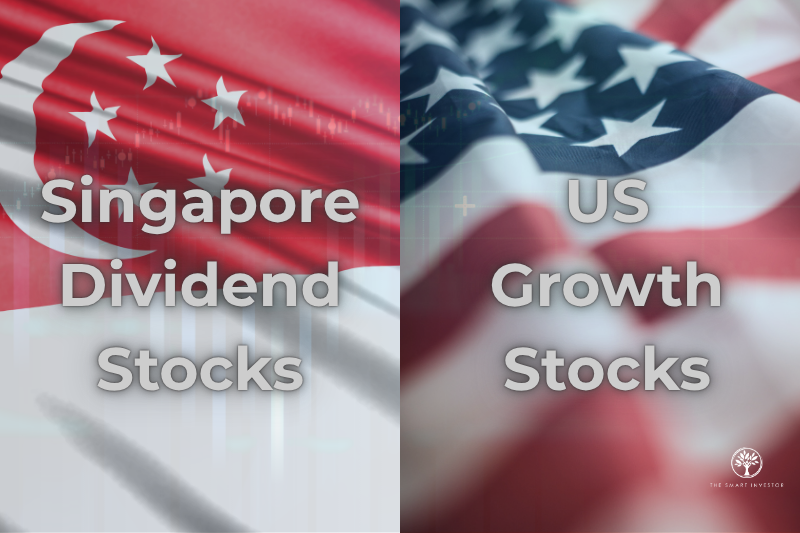
You don’t have to choose between Singapore dividend stocks and US growth stocks.
You just have to know how to combine them.
If the market falls further, will you be ready… or fully invested?
This is where most investors get it wrong. Our FREE report shows how to stay prepared for what comes next. Get it free here.
Follow us on Facebook, Instagram and Telegram for the latest investing news and analyses!
Disclosure: Joanna Sng owns shares of all the companies mentioned.