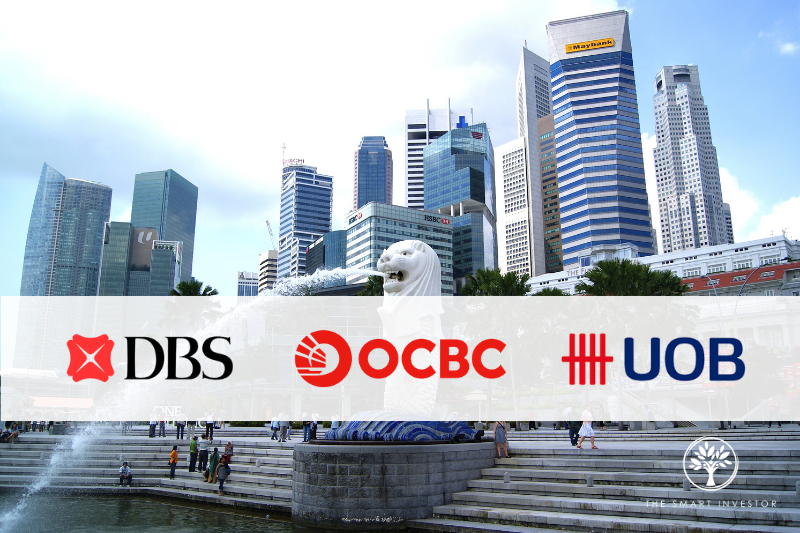
DBS Group Holdings Ltd (SGX: D05), Oversea-Chinese Banking Corporation Limited (SGX: O39), or OCBC, and United Overseas Bank Limited (SGX: U11), or UOB, are off their recent highs.
With this pullback, let’s find out which bank looks best for a risk-adjusted buy today.
How Have DBS, OCBC and UOB Performed Recently?
| Key Metrics | DBS | OCBC | UOB |
|---|---|---|---|
| Total income (S$ billion) | 12.0 | 8.00 | 7.02 |
| Total income growth, year on year (YoY) | +3% | +11% | -1% |
| Net profit (S$ billion) | 6.01 | 4.20 | 2.92 |
| Net profit growth (YoY) | +5% | +13% | +3% |
| Net interest income growth (YoY) | -3% | -3% | -3% |
| Net fee income growth (YoY) | +20% | +26% | -2% |
Data from 1H2026 results (six months ended 30 June 2026).
As the table shows, OCBC grew the fastest.
DBS made a record S$6.01 billion, while UOB’s profit rose 3% on income that slipped 1%.
Lower interest rates in 1H2026 than in 1H2025 explain most of the slowdown.
Although growth in loans helped, net interest income (NII) still fell by roughly 3% across all three banks.
Fees helped cushion softer NII at DBS and OCBC.
Which Bank Has the Strongest Business Fundamentals?
DBS is the local heavyweight, with a larger loan book than either rival.
Its profitability, measured by return on equity (ROE), is stellar at 17.9%.
Its fee-income segments have done well recently, with wealth management standing out.
Continued growth in fee-based income, alongside a pickup in interest rates, could help sustain DBS’ strong profitability moving forward.
OCBC’s main diversifying factor is its strong insurance exposure through ownership of Great Eastern Holdings (SGX: G07).
OCBC reported non-interest income growth for 1H2026, helped by insurance contribution and 39% YoY growth in wealth management income.
With diversified earnings streams and further regional growth opportunities (Indonesia), OCBC could continue its recent profit growth trajectory.
Finally, UOB’s strong regional presence in ASEAN offers investors exposure to the growth of our neighbouring economies like Malaysia, Indonesia, Thailand and Vietnam.
However, its ROE of 9.2%, the lowest of the three, suggests its large ASEAN acquisition has yet to lift results.
Which Bank Offers the Most Attractive Dividends?
| DBS | OCBC | UOB | |
|---|---|---|---|
| Latest single ordinary dividend (S$ per share) | 0.66 (quarterly) | 0.47 (interim) | 0.88 (interim) |
| Trailing 12-months (TTM) Ordinary dividends (S$ per share) | 2.58 | 0.89 | 1.59 |
| TTM Special / Capital Return dividends (S$ per share) | 0.60 | 0.16 | None |
| TTM Yield on ordinary dividends | 3.5% | 3.1% | 3.8% |
| TTM Yield including specials | 4.3% | 3.6% | 3.8% |
| Payout ratio (Ordinary dividends only) | 65% | 50% | 50% |
DBS wins on headline yield at 4.3%.
But S$0.60 of its dividends come from the Capital Return dividend, a S$0.15 quarterly top-up the board plans to pay for FY2026 and FY2027 only.
Without it, DBS yields 3.5%, behind UOB’s 3.8% and ahead of OCBC’s 3.1%.
OCBC’s S$0.16 special is also temporary, part of a S$2.5 billion capital return due to finish by FY2026.
Ordinary dividends show who is growing.
DBS lifted its ordinary payout from S$2.22 for FY2024 to S$2.46 for FY2025.
UOB’s final dividend fell from S$0.92 to S$0.71 when FY2025 profit dropped 23%.
Profitability and capital decide how long a dividend lasts.
DBS earns a 17.9% return on equity, so its 65% ordinary payout is well covered.
UOB earns 9.2% and pays out 50%, leaving less room when profit slips.
OCBC’s capital cushion fell from 15.2% to 14.0% in three months as it handed money back.
DBS pays out roughly 80% of earnings with the Capital Return included, so plan on the 3.5%.
UOB’s 3.8% is the highest, but it comes with slower earnings growth and a dividend that has fallen before.
OCBC’s 3.1% is the lowest, yet its profit is growing the fastest.
Which Bank Has the Strongest Balance Sheet?
| Balance Sheet Metrics | DBS | OCBC | UOB |
|---|---|---|---|
| Non-performing loans (NPL) ratio | 1.0% | 0.9% | 1.6% |
| Credit costs, 1H2026 | 0.15% | 0.18% | 0.34% |
| CET1 ratio, fully phased-in | 14.6% | 14.0% | 15.4% |
OCBC has the cleanest loan book, with 0.9% of loans in trouble against 1.0% at DBS and 1.6% at UOB.
A single Greater China property account pushed UOB’s figure up.
UOB’s credit costs were more than double DBS’s in 1H2026, and it expects 0.25% to 0.30% for the full year.
The Common Equity Tier 1 (CET1) ratio measures the cushion of top-quality capital against losses.
OCBC’s is the thinnest of the three.
In a weaker economy, DBS looks best placed: it earns the most, sets aside the least and still holds a 14.6% CET1 ratio.
DBS vs OCBC vs UOB: Which Offers the Best Valuation?
| Metrics | DBS | OCBC | UOB |
|---|---|---|---|
| Share Price as of 23 October 2026 (S$) | 74.44 | 29.00 | 41.59 |
| Price-to-book (P/B) | 3.0x | 1.8x | 1.3x |
| LTM Price-to-earnings (P/E) | 16.7x | 14.2x | 14.0x |
| Return on Equity (ROE) | 17.9% | 14.4% | 9.2% |
None is a bargain.
DBS trades at 3.0x book, OCBC is at 1.8x and UOB at 1.3x.
P/B is what you pay for each dollar of net assets, and ROE is what that dollar earns, so look at them together.
DBS’s ROE is nearly twice UOB’s, but it trades at 2.3 times UOB’s P/B.
OCBC’s ROE is 1.6 times UOB’s, and its P/B is 1.4 times UOB’s.
UOB’s price asks for the least per point of return.
Growth matters too.
OCBC’s profit grew 13% against 5% at DBS and 3% at UOB.
At 14.2x P/E, OCBC is priced modestly for that growth, though trading and insurance income drove much of it and can reverse.
UOB’s 14.0x looks cheapest, but its growth is the slowest.
Its past-12-month profit also includes a weak 2H2025.
So UOB is best priced for what it earns, OCBC for how fast it’s growing, and DBS carries a premium for quality.
What Could Drive Their Performance Going Forward?
The US Federal Reserve raised rates in September 2026, its first rise since 2023.
UOB gains the most, since NII makes up a greater part of its operations.
Beyond Singapore, DBS has Hong Kong, OCBC has Greater China and Malaysia, and UOB has ASEAN.
The risks are familiar.
Credit costs could rise, deposit competition could squeeze margins, and valuations leave little room for disappointment.
We’ll see what happens as all three report results soon.
Get Smart: Which Singapore Bank Stock Is the Best Buy Today?
The choice of which bank to buy depends on your preference.
Best profitability? DBS is your horse given its leading 17.9% ROE.
Want insurance exposure? OCBC, through its ownership of Great Eastern.
Finally, for those seeking ASEAN exposure, UOB stands out with its undemanding 1.3x P/B value.
On dividends, DBS yields the most but its yield is propped up by Capital Return dividends; on ordinary dividends, UOB offers the highest yield.
Size and yield alone don’t make the best bank stock.
Look for the mix of quality, income, growth and valuation that best suits your goals.
Disclosure: Wilson H. does not own shares in any of the companies mentioned.