Just when you thought the rate hikes of 2022 to 2023 were over, persistent inflation and resilient economic data brought them back, with the Federal Reserve (Fed) announcing a 25-basis-point increase to a target range of 3.75% to 4%.
With inflation remaining elevated and economic activity expanding at a solid pace – fuelled in part by surging energy costs and large-scale AI-related capital spending, according to market observers – the hike isn’t unexpected.
For Singapore investors, the focus is on how the latest rate hike will affect the Singapore Overnight Rate Average (SORA) – the primary benchmark for local floating-rate loans.
Since SORA directionally mirrors Federal Funds Rate (FFR) movements, with only a short lag of a few months, the impact on businesses is inevitable, though the observable effects could be delayed.
Still, it’s not all doom and gloom.
We check out specific companies that thrive in this heightened interest rate environment.
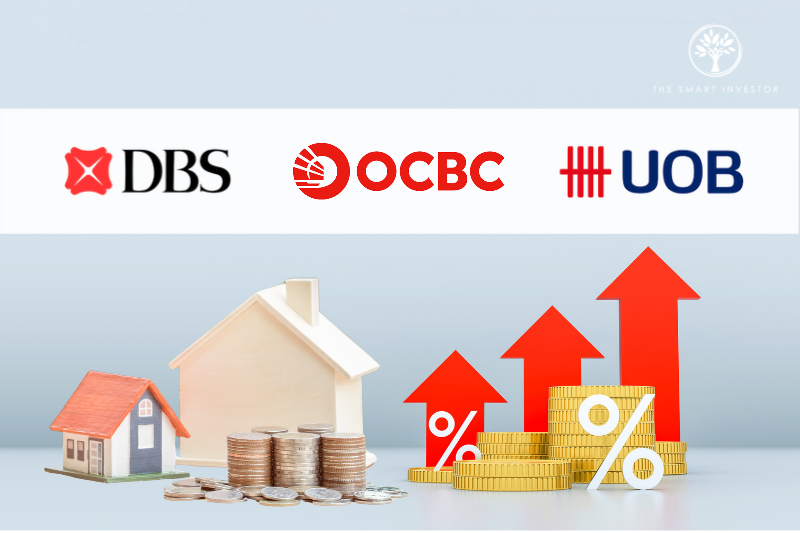
The Big Three Local Banks: Direct Winners of Expanding Margins
For banks, net interest margin (NIM) represents the interest spread between the interest collected from loans and the interest payments on customer deposits.
Hence, when FFR and SORA drive up borrowing costs, floating-rate loans and mortgages reprice upwards faster than fixed deposit interest rates, swelling the interest spread and thus supporting NIM.
To be sure, all three banks saw NIM compress by 17 to 25 basis points year on year in the first half of 2026, reflecting the effects of the previous easing cycle.
But the latest rate hike could help arrest — and eventually reverse — that decline as floating-rate loans begin repricing higher.
The implications?
Even with their premium valuations, especially for DBS Group Holdings (SGX: D05) and Oversea-Chinese Banking Corporation (SGX: O39), all three banks, including United Overseas Bank (SGX: U11), could still enrich shareholders even further.
Notably, with the banks’ direct positive exposure to rising interest rates that bump up core operating profits, this could fundamentally support further price appreciation and/or greater dividend payouts.
Crucially, while NIM is a bread-and-butter revenue stream for all the local banks, they are not dependent on it.
The banks also earn significant revenue from wealth management services and their regional expansions across ASEAN, giving them a diversified set of revenue streams.
Even before the latest rate hikes, their balance sheets are robust – less than 2% non-performing loans (NPLs) and a Common Equity Tier 1 (CET1) ratio above the required 6.5%.
However, despite rising net profits supporting their extraordinary price appreciation, especially over the last two years, the banking trio’s trailing dividend yields are now 4.1% or less, making these yields less attractive than what many REITs can offer.
S-REITs – Identify Potential Hedged Winners and Vulnerable Losers
Real estate investment trusts (REITs) are highly leveraged and susceptible to the recent interest rate hikes.
Despite the headwinds, smart investors resist the knee-jerk reactions of panic selling and seek to understand the nuances.
Specifically, the type of debt the REIT holds matters.
So do their operational fundamentals and balance sheet strengths.
To this end, a few REITs stand out as potential winners and losers:
| REIT | Aggregate Leverage | Interest Coverage Ratio (ICR) | Fixed-Rate Borrowings | Distribution Yield |
| CapitaLand Integrated Commercial Trust (SGX: C38U), or CICT | 37.40% | 3.9x | 78% | 4.7% |
| Mapletree Industrial Trust (SGX: ME8U), or MIT | 37.50% | 4.0x | 73.30% | 6.6% |
| CapitaLand Ascendas REIT (SGX: A17U), or CLAR | 39.70% | 3.5x | 70.10% | 6.5% |
| Suntec REIT (SGX: T82U) | 43.00% | 2.2x | Around 57% | 5.7% |
For example, with a relatively low leverage of less than 40% and ICR of 3.5x or more, CICT, MIT, and CLAR could be potential winners.
Crucially, more than 70% of their borrowings are on fixed interest rates, meaning only a small portion of their loans are exposed to the surge in floating-rate interest rates, insulating the REITs from immediate rate hikes.
To sweeten the deal, MIT and CLAR also offer a superior yield of 6.6% and 6.5%, respectively – well above the pack in the list.
In contrast, Suntec REIT looks potentially vulnerable, with its comparatively higher 43.0% leverage, low 2.2x interest coverage and significantly lower fixed-rate borrowings of around 57.0%.
Get Smart: Strengthening Your Portfolio with a Barbell Strategy
Some investors are drawn to the banking trio for the potential NIM recovery that the latest rate hike could bring.
Others prefer the more attractive distribution yields that selected S-REITs are currently offering.
But the two are not mutually exclusive.
On the one hand, the banking trio could see core operating profits improve if the rate hike feeds through to wider lending spreads over the coming quarters.
On the other hand, S-REITs with strong balance sheets offer investors the chance to lock in superior yields while waiting for potential capital gains if the rate cycle eventually reverses.
Rate-driven volatility tends to be temporary, but its duration is hard to predict.
In this environment, investors may want to think carefully before retreating to the sidelines.
Parking funds in cash may feel safe, but inflation can quietly erode purchasing power over time.
2008. 2020. 2022. Three of the toughest stretches for Singapore markets in a generation. We found 6 SGX companies that paid a dividend every single year through all three. Our free report reveals the six companies and what allowed them to keep paying when others couldn’t. Click here to download now.
Follow us on Facebook, Instagram, Telegram and YouTube for the latest investing news and analyses!
Disclosure: Larry L. owns shares of DBS, OCBC, UOB, CICT, CLAR, MIT.