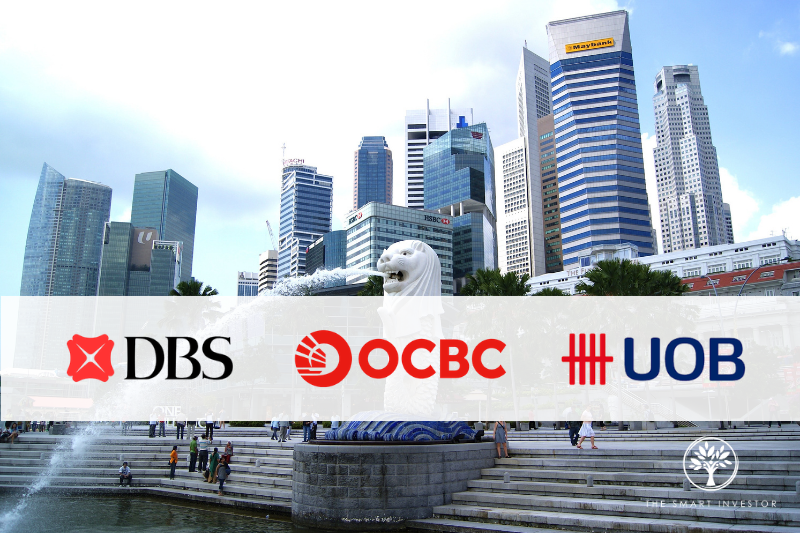
Most people invest in the shares of Singapore’s banking trio – DBS Group Holdings Ltd (SGX: D05), OCBC Ltd (SGX: O39), and UOB Ltd (SGX: U11) – with the humble expectation of beating inflation with their juicy dividend payouts.
But, lo and behold, over the last two years, their returns look more like those of high-growth tech stocks.
Despite the intoxicating euphoria, the hard question remains: Have the local banks become too expensive?
Instead of letting prices control your emotions, let’s dig into their business to find out whether the upsides at current prices are still bankable.
Local Banks, Different Strengths
Each of the banks pursues growth with unique approaches.
In the first half of 2026 (1H2026), DBS’s wealth management fee income surged 33% year on year (YoY) to S$1.83 billion, accompanied by growth in its AUM (assets under management) to S$516 billion, above the half-trillion mark.
That’s a new AUM-peak for Singapore’s largest bank by market capitalisation, cementing its dominance in regional wealth management.
The second-largest bank, OCBC, operates a more diversified financial services business with its major insurance subsidiary, Great Eastern Holdings Limited (SGX: G07), or GEH.
Although OCBC’s 1H2026 insurance income from GEH jumped 49% to S$791 million, its net wealth management fees and commissions also climbed 39% to S$892 million, driving its net profit up 13% to a record S$4.19 billion for the period.
UOB? It’s the smallest of the trio. But its ambitions aren’t limited by its size.
Although DBS is taking on Asia-Pacific and OCBC boasts a wealth-and-insurance business, UOB is spreading its wings within the ASEAN region to deepen its consumer and trade connectivity presence.
The results?
UOB’s 1H2026 ASEAN-4 (Malaysia, Indonesia, Thailand, and Vietnam) wealth management income was up 30% YoY, led by Malaysia and Thailand, while trade loans within this region increased 14%, demonstrating the bank’s cross-border traction.
Red Flags Investors Should Know
The high-interest-rate environment has been great for the banks’ margins.
However, the net interest margin (NIM) compression of between 17 and 25 basis points from a year ago for all three banks in 1H2026 is a reminder of the transitory nature of this tailwind.
Yes, proactive hedging and robust loan and deposit growth cushioned the impact, but further rate cuts can still drive NIM even lower.
Rapid growth is great, but with a much larger market capitalisation, the speed bump could be right ahead as the “law of large numbers” kicks in.
Diversification into non-interest income streams helps. But sustaining the momentum in an uncertain global market plagued with geopolitical tensions and elevated inflation risks? These challenges are real.
Despite their rock-solid balance sheets, as evidenced by their ultra-low non-performing loan (NPL) ratio of less than 2% and a Common Equity Tier 1 (CET1) ratio that’s well above the required 6.5%, credit risks do exist.
Not convinced?
Look no further than UOB’s second quarter of 2026 (2Q2026), which saw a 90% YoY surge in non-performing assets (NPA) because of one real-estate account in Greater China. This is a cautionary tale for investors to stay vigilant.
Should You Sell (Or Buy)?
The banks’ fortress-like balance sheets and exceptionally favourable CET1 ratios make them local banking champions.
For current investors, selling these banking champions means letting go of rare high-quality assets with the potential to compound rapidly – not the wisest choice if you haven’t got a better investment opportunity to rotate to.
Moreover, you should already be sitting on enormous capital gains while collecting regular dividend payouts with yields still above risk-free T-bills.
Despite the costly stock prices, the mistake of selling could be costlier in the long run.
For new investors, the decision-making could be trickier.
If you are torn between entering at historically high valuations and waiting for a pullback that may not happen, a “middle-ground” approach could make more sense: enter at the current valuation but with a much smaller position.
This ensures you still have the financial ammunition to average down during market pullbacks.
If a pullback doesn’t materialise, you are still minimally exposed to these banking champions.
Get Smart: Compounding Matters More Than Timing
Singapore’s business environment doesn’t mint global movers and shakers like the US’s Magnificent Seven.
Yet, her banking trio offers reliable regional banking businesses supported by highly stable balance sheets.
The recent bear market in 2023 that saw companies with weak financials being hit the hardest demonstrated the importance of investing in businesses with high-quality balance sheets and growth.
The good news is that these quality compounders often exhibit multiple bull runs in the long run.
Yes, in hindsight, missing the boat on the latest banking bull runs is unfortunate.
But you don’t have to make it worse by missing the next one.
Just ensure your positions are sized appropriately.
Still, don’t mindlessly chase the highs – keep an eye on notable risks such as credit quality, among other growth signals.
2008. 2020. 2022. Three of the toughest stretches for Singapore markets in a generation. We found 6 SGX companies that paid a dividend every single year through all three. Our free report reveals the six companies and what allowed them to keep paying when others couldn’t. Click here to download now.
Follow us on Facebook, Instagram, Telegram and YouTube for the latest investing news and analyses!
Disclosure: Larry L. owns shares of DBS, UOB, and OCBC.