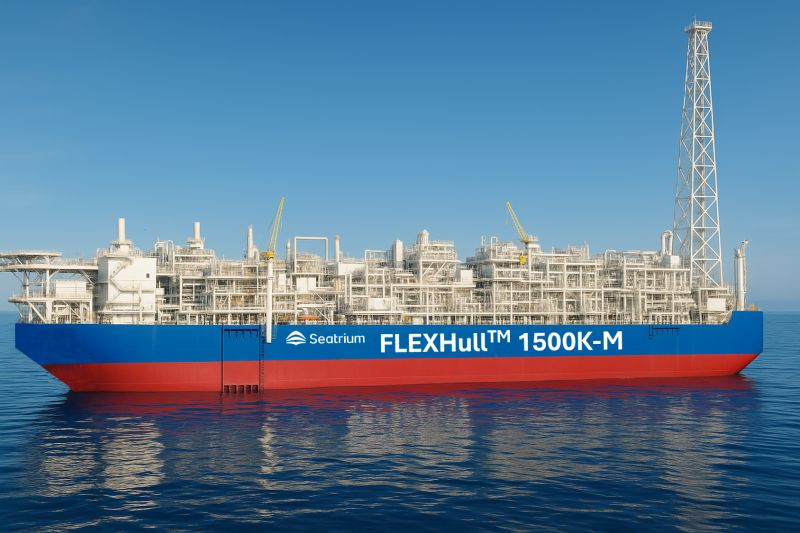
Seatrium Limited (SGX: 5E2) has announced a new S$200 million share buyback programme, doubling its latest buyback programme (completed on 1 September 2026), and funded from existing cash.
This latest announcement continues the buybacks Seatrium has already undertaken, making it more important than a one-off announcement.
With shares currently trading around S$2, is this just a capital-return exercise or part of the investment case?
| Metric / Area | Summary |
| Stock Name & Ticker | Seatrium Limited (SGX: 5E2) |
| Share Buyback | S$200 million programme funded by cash Current 2% mandate limits repurchases to ~68 million shares (~S$136 million at S$2/share) |
| Financial Performance | 1H2026 revenue up 5% YoY to to S$5.6 billion Net profit up 158% to S$373 million (up 54% to S$212 million excluding divestment gains) Gross margin expanded to 8.6% |
| Order Book Pipeline | Net order book of of S$13.3 billion across 24 projects through 2033; chasing a pipeline of >S$32 billion |
| Balance Sheet & Cash Flow | S$3.4 billion liquidity Net leverage at 0.5x Gross debt of S$2.4 billion Underlying 1H2026 free cash flow was -S$11 million excluding asset sales and settlements |
| Valuation | S$2.00 share price (~S$7.1 billion market cap) Forward P/E: 13.9x P/B: 0.9x |
What Exactly Has Seatrium Announced?
The buyback’s pace will depend on Seatrium’s share price, market conditions and capital priorities.
This programme runs under a shareholder mandate that allows repurchases of up to 2% of issued shares and requires approval at each annual general meeting.
The first programme launched in April 2024 took about 28 months to complete.
Under that earlier programme, repurchased shares were held as treasury shares.
These treasury shares can be used for employee share plans and directors’ fees, or cancelled against share capital.
This new programme is described as supporting both shareholder returns and employee incentives.
In the first nine months of 2026, Seatrium’s purchases averaged about S$2.12 a share, compared with about S$1.77 for the first repurchase in June 2024.
Why Do Companies Buy Back Their Own Shares?
A buyback enhances shareholder returns alongside dividends.
By reducing the shares outstanding, each remaining shareholder owns a bigger slice of the company and earnings per share (EPS) rise if profit holds steady.
It can also signal that management thinks the shares are worth more than the market price, though this is not proof.
Buybacks only create value if the price paid is sensible and the cash isn’t required elsewhere.
What Has Been Happening at Seatrium?
Beyond its buyback, what has Seatrium been reporting?
For the six months ended 30 June 2026 (1H2026), revenue rose 5% year on year (YoY) to S$5.6 billion.
Net profit was S$373 million, up 158%, but this figure includes divestment gains.
Excluding divestment gains, net profit rose 54% YoY to S$212 million, helped by gross margin widening from 7.4% to 8.6% on a higher-margin project mix and lower costs.
EBITDA excluding divestments rose 20% YoY to S$479 million.
As of 30 June 2026, Seatrium’s net order book was S$13.3 billion, spanning 24 projects through 2033.
This represents a softening from S$17.8 billion as at 31 December 2025, as work done on existing projects outpaced new orders.
The group is chasing a pipeline of more than S$32 billion and holds a letter of intent from Golar LNG Limited (NASDAQ: GLNG) for a third floating LNG conversion, with a contract expected to be signed in 2H2026.
Seatrium’s balance sheet looks healthy, supported by S$3.4 billion in liquidity.
From December 2025, gross debt fell 5% to S$2.4 billion, while net debt held steady at S$680 million.
Net finance costs dropped 20% YoY to S$43 million, while net leverage improved to 0.5x (from 0.8x as at 31 December 2025).
Operationally, it completed its seventh conversion of an LNG carrier into a floating storage regasification unit (FSRU) for Karpowership in September and is pursuing energy-transition work such as offshore wind.
Is the S$200 Million Buyback Material?
S$200 million equals about 2.8% of Seatrium’s S$7.1 billion market value.
At S$2 a share, S$200 million would buy roughly 100 million shares, about 2.9% of the 3.39 billion outstanding.
But the current mandate caps buybacks at 2% of issued shares, roughly 68 million shares or about S$136 million at today’s price.
Spending the rest depends on shareholders renewing the mandate at future AGMs.
If the repurchased shares were cancelled, EPS would rise by a similar percentage, all else being equal.
Shares reissued to employees, however, would not shrink the share count.
Ultimately, a buyback does not guarantee share price appreciation, nor does it replace the need for sustained earnings and cash flow growth.
The Biggest Question: Can Seatrium Generate Enough Cash?
This is the real test.
Excluding a one-off S$73 million legal settlement, operating cash flow for 1H2026 was S$114 million, still thin compared to underlying profit.
Capital expenditure (capex) was S$52 million, mainly on project needs and safety requirements.
Subtracting capex leaves free cash flow (FCF) of roughly negative S$11 million.
Seatrium reported a headline FCF of S$237 million, that figure relied on S$167 million in asset sales.
How Does Seatrium’s Stock Move From Here?
Seatrium must convert new and existing orders into revenue and cash flows while maintaining execution margins.
Watch buyback activity and improving sentiment towards Seatrium’s offshore and marine operations.
The buyback is a reason to look at the stock, not the reason to own it.
What Could Go Wrong?
If projects overrun or are delayed, Seatrium’s margins would take a direct hit.
Large projects also absorb working capital before payments arrive, which could pressure cash flows.
Higher interest rates would raise Seatrium’s financing costs, though the impact would be limited: 64% of its debt was at fixed rates as of 30 June 2026.
Offshore spending is also highly cyclical, which could derail Seatrium’s financial results.
If earnings falter, shares repurchased today could prove to have been expensive.
Is Seatrium’s Stock Cheap After the Buyback Announcement?
As of 9 October 2026, Seatrium’s shares closed at S$2, giving it a market capitalisation of S$7.1 billion.
That values the company at roughly 13.9x forward earnings, with a price-to-book (P/B) ratio at roughly 0.9x.
These valuations are within historical ranges.
By comparison, Yangzijiang Shipbuilding (Holdings) Ltd. (SGX: BS6) trades at about 2.1x book value.
On these measures, Seatrium’s valuation looks reasonable rather than cheap.
Get Smart: A Buyback Is a Signal, Not the Investment Case
The S$200 million programme is a bigger commitment than the last and could lift EPS.
But the headline figure is larger than the mandate can deliver at today’s price; first-half free cash flow leaned on asset sales.
The turnaround is real in margins and profit, but still has to show up in operating cash flow and new orders.
The buyback is a reason to look at the stock, not the reason to own it.
It almost feels like the government is paying companies to make you wealthier. Singapore’s new S$5 billion market boost could send fresh money into local stocks. We identified 5 companies positioned to benefit, including familiar names with surprising wealth potential. Our free report reveals these hidden opportunities before the money flows in. Download it now before it’s too late.
Follow us on Facebook, Instagram, Telegram and YouTube for the latest investing news and analyses!
Disclosure: Wilson H. does not own shares of any of the companies mentioned.