SGX-listed companies repurchased a combined S$2.09 billion of their own shares on the open market in the first eight months of 2026 (8M26).
That represents a sharp 33% surge from the S$1.57 billion bought back in 8M25, and a massive 144% leap from S$855 million in 8M24.
Driving the vast majority of this activity were three Temasek-backed blue chips: Singapore Telecommunications (SGX: Z74), Keppel Ltd (SGX: BN4), and ST Engineering Ltd (SGX: S63).
Together, they spent a total of S$1.34 billion on buybacks over the period – accounting for roughly 64% of all repurchases on the local exchange.
As of 31 March 2026, Temasek Holdings holds a 52% stake in Singtel, 51% in ST Engineering, and 21% in Keppel.
Here is a closer look at what is driving these buybacks and whether their underlying businesses can sustain the momentum.
What is driving Singtel’s near-billion-dollar buyback?
Singtel alone accounted for S$948.6 million of the total – representing nearly 45% of all on-market buybacks on the SGX in 8M26.
The telecom giant is executing these repurchases under its Value Realisation Share Buyback (VRSB) programme, which aims to return up to S$2 billion to shareholders over three years.
Management reiterated its commitment to the initiative during the annual general meeting on 29 July 2026.
Once Singtel completes the programme and cancels the repurchased shares, the group expects a permanent 3% boost to earnings per share (EPS), paving the way for a higher dividend per share (DPS) trajectory.
Recent financial results back up the move.
In the first quarter of its fiscal year ending 31 March 2027 (1QFY2027), revenue rose nearly 5% year on year (YoY) to S$3.6 billion, while underlying net profit jumped 21% to S$831 million.
Operating profit also climbed 10% to S$462 million, outpacing management’s full-year guidance of low-to-mid single-digit growth.
Performance across its business units remained mostly solid.
NCS grew operating profit 29% YoY to S$102 million on better delivery margins.
Optus added 14% to A$152 million on stronger mobile pricing.
Digital InfraCo lifted operating profit 10% to S$26 million as DC Tuas ramped up.
Singtel Singapore’s operating profit dipped 2% to S$230 million amid price competition.
Regional associates contributed S$543 million, up 16% YoY, with Airtel and AIS accounting for the bulk of that gain.
For FY2026, Singtel raised its total dividend to S$0.185 from S$0.170 a year ago.
Crucially for investors, this buyback programme sits right on top of a growing dividend, rather than replacing it.
Can ST Engineering’s cash generation sustain its buyback?
ST Engineering deployed S$91.5 million on buybacks in 8M26.
While that figure is smaller than Singtel’s, it is fully supported by healthy cash generation.
Free cash flow remains the lifeblood of sustainable dividends, and for 1H2026, ST Engineering generated S$591.6 million in free cash flow, up from S$484.6 million a year ago.
That covered its share repurchases comfortably while leaving plenty of room for higher payouts.
Total dividends for the first half reached S$0.09 (up from S$0.08 a year ago), with management earmarking a further S$0.05 for 3Q2026.
Revenue grew 11.1% YoY to S$6.6 billion, pushing net profit up 27.1% to S$512.1 million as earnings grew faster than revenue across all three operating segments.
Commercial Aerospace revenue advanced 15% YoY, and Urban Solutions & Satcom matched that pace.
Defence & Public Security added 7%.
Net finance costs fell 14.9% YoY.
The group’s order book hit a record S$35.7 billion, with management expecting to deliver roughly S$5.7 billion of that backlog over the remainder of 2026.
That clear revenue visibility provides strong support for both future dividends and buybacks.
How does Keppel fund a S$301 million buyback amid mixed results?
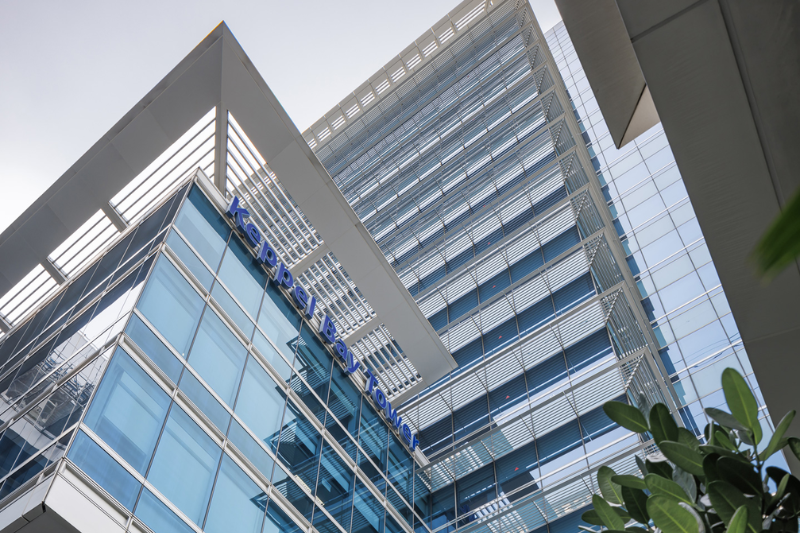
Keppel spent S$301.1 million on buybacks in 8M26, placing it second among the three blue chips.
Headline numbers looked weak at first glance, with net profit falling 59.0% YoY to S$154.7 million in 1H2026.
However, that decline was primarily driven by a S$375 million non-core portfolio loss tied to legacy rig impairments and the terminated M1 Telco sale.
Strip out that portfolio, and net profit rose 25% to S$530 million.
Recurring income grew 13% YoY to S$467 million.
Revenue climbed 24.6% to S$3.8 billion, with infrastructure revenue rising 27% as the Keppel Sakra Cogen Plant began commercial operations.
The ADG acquisition and Bifrost cable commercialisation boosted Connectivity revenue.
Asset management progress also remained on track.
Funds under management reached S$106 billion as of 30 July 2026, surpassing Keppel’s end-2026 target ahead of schedule.
The group generated S$570 million in free cash flow, supported by S$1.1 billion in divestment proceeds and dividends received.
Year to date, Keppel has monetised roughly S$1.7 billion in assets, keeping it on track toward its full-year target of S$2 billion to S$3 billion.
Reflecting confidence in its cash position, Keppel declared an interim dividend of S$0.150, unchanged from a year ago.
Get Smart: The Hidden Power of Share Buybacks
Dividends put cash directly into your bank account, but share buybacks work behind the scenes.
By reducing the overall share count, future earnings are divided among fewer shares – lifting EPS and setting the stage for higher dividends down the road.
Singtel’s VRSB programme illustrates this clearly, with its planned buybacks targeting a permanent 3% EPS lift.
Ultimately, each company’s free cash flow and operational execution will decide whether this dual engine of dividends and buybacks can maintain its current pace.
Find out which three other Temasek-backed giants also shared the top spots for the most aggresive share buybacks in the same period.
Imagine receiving steady rent increases for more than two decades. It sounds unusual, but one healthcare REIT already has rental escalations locked in until around 2042. Income visibility like this is hard to find today. We break down how this REIT built such dependable cash flow in our FREE dividend report and how it could strengthen a retirement portfolio. Get the free report here.
Follow us on Facebook, Instagram, Telegram and YouTube for the latest investing news and analyses!
Disclosure: The Smart Investor does not own shares of any companies mentioned.