“If you want my future, forget my past.” So sang the Spice Girls on their breakout hit, Wannabe.
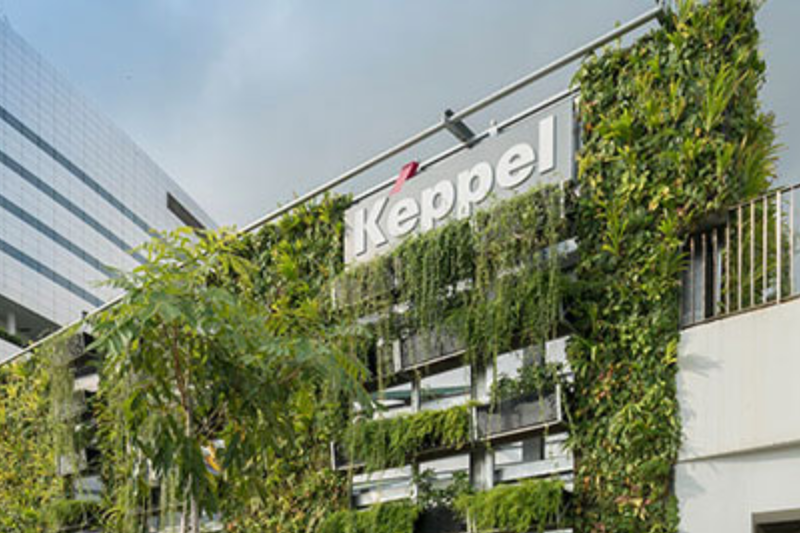
This might well apply to Keppel Corp (SGX: BN4).
Keppel’s past was closely linked to the offshore and marine (O&M) industry, which in 2015, still accounted for 60% of its overall revenue.
The company’s earnings were thus tied to the cyclical oil and gas industry, resulting in swings in profit and a lower valuation.
Between 2015 and 2023, its price-to-earnings (PE) ratio ranged from 2.8 to 28.0, with an average of just 6.1.
Under Construction
In 2023, Keppel underwent a major restructuring.
It exited the O&M sector by effectively selling its O&M business to Sembcorp Marine, which later renamed itself Seatrium (SGX: 5E2).
Today, Keppel has three main segments: infrastructure, real estate and connectivity.
Its legacy O&M assets are now parked with other assets as part of a non-core portfolio, which accounted for just 12% of overall revenue in 2025.
However, the transformation is still a work-in-progress.
Revenue from Keppel’s continuing operations grew just 3% in 2025, even as operating profit from continuing operations fell by 2%.
Many investors still value Keppel as an O&M company, not the global asset manager and operator it wants to be known as.
Is the market overlooking Keppel’s transformation, and can long-term investors take advantage of this to score a good deal on its shares?
Why the Market May Be Undervaluing Keppel
Old habits die hard.
Investors have assigned Keppel a price-to-earnings (P/E) ratio of 19.5x as of 27 July 2026, which is even lower than Seatrium’s 24.4x.
By comparison, Brookfield Asset Management (NYSE: BAM), a US-listed manager with a similar presence in infrastructure, renewable energy and real estate, has a P/E ratio of 33.7x.
However, Keppel’s transformation is real.
With an asset-light business model, “New Keppel”, which excludes the non-core portfolio, had S$941 million in recurring income in 2025, compared to S$1.1 billion in net profit.
This includes asset management fees and fees from operations and maintenance.
By end-2025, Keppel had S$95 billion in funds under management (FUM) and asset management fees of S$453 million, both compounding at 20% annually over the last five years.
What Could Unlock Further Value?
Keppel should be able to unlock further value by executing on its Vision 2030 strategy – the firm is targeting S$200 billion in FUM by 2030, which should result in higher asset-light, recurring fee income.
This should contribute to a higher return on equity (ROE) over time – management expects Keppel’s asset-light model to deliver an ROE “significantly above 15%” in the long run.
With its business model shift, Keppel is well-positioned to take advantage of rising demand for clean energy and digital infrastructure.
For example, US$1.3 trillion is projected to be invested in renewable energy in Asia Pacific between 2020 and 2030, while global demand for data centre capacity is expected to triple between 2025 and 2030, with 70% of this coming from AI workloads.
This should benefit Keppel’s power and clean energy business, as well as its data centre developer and operator business.
It is also one of the developers of the Bifrost Cable System, the world’s first subsea cable system directly linking Singapore to the US West Coast, which will further increase its revenue from operations and maintenance fees.
Keppel also has an asset monetisation strategy of recycling mature assets and sharing these returns with shareholders, while also deploying capital into higher-return opportunities.
Between October 2020 and end-2025, the company has announced S$14.5 billion in asset monetisation, which compares to its market capitalisation of S$20.6 billion (as at 27 July 2026).
Over the next five years to 2030, management intends to monetise a further S$13.5 billion from Keppel’s non-core assets.
The Risks Investors Should Consider
One of the main risks to Keppel is execution: slip-ups could shake investor confidence.
A recent speed bump was Keppel’s planned sale of telco M1, which was supposed to net S$1 billion.
The regulator assessing the deal threw a spanner in the works by announcing that it was suspending the process because of potential regulatory breaches by Simba, the telco that was supposed to buy M1.
In response, Keppel said that it would undertake a 90-day plan to drive M1’s efficiency, which included reducing costs, using more AI, and rationalising products.
Although this wasn’t exactly the fault of Keppel, its shares fell by 3.5% in the two days after the news broke.
After delivering total shareholder returns of 58.5% in 2025, Keppel is up by just 9.5% year-to-date (27 July).
Other potential risks include a bursting of the AI bubble, which could reduce investment in data centres, clean energy, and other digital infrastructure.
A rising interest rate environment may also present Keppel with headwinds by driving up borrowing costs for its various projects, as well as the costs of fundraising for its investment business.
Still, Keppel should appeal to long-term investors, including dividend investors looking for both income and growth.
It increased its dividend by 38% in 2025, while net profit (excluding non-core and discontinued operations) went up by 39%.
Get Smart: Looking Beyond Today’s Earnings
Keppel’s transformation has already fundamentally changed the business, but market perceptions may not have fully caught up.
As asset management and digital infrastructure become larger contributors, the company’s earnings profile could become more resilient and valuable.
For long-term investors, the opportunity may lie in recognising what Keppel is and could become before the wider market does.
Don’t let market uncertainty hijack your financial dreams. While headlines scream gloom, 5 Singapore companies have been quietly building wealth and paying reliable dividends. You’re probably overlooking them. Discover these resilient giants and their secrets to sustained income, even through global storms. Click here to download your free report now and secure your financial future!
Follow us on Facebook, Instagram and Telegram for the latest investing news and analyses!
Disclosure: Silas H. owns shares in Seatrium.