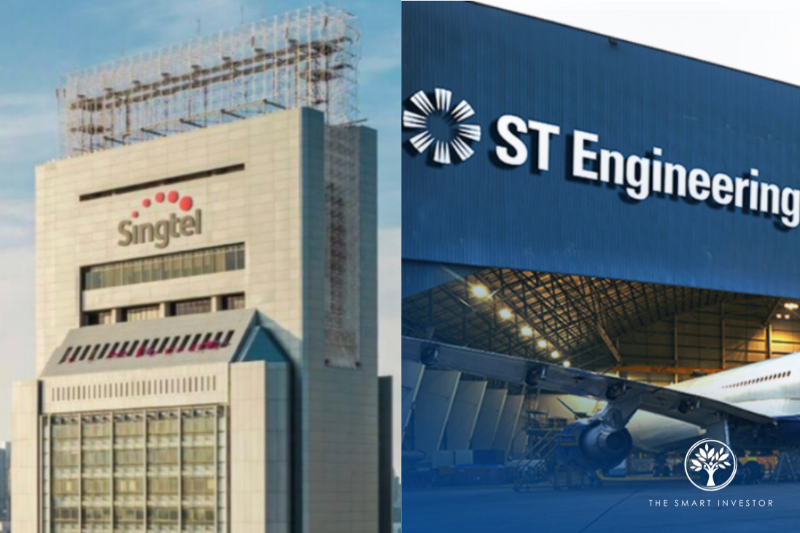
Singapore Telecommunications Ltd (SGX: Z74), or Singtel, is a telecom giant reinventing itself around digital infrastructure, while Singapore Technologies Engineering Ltd (SGX: S63), also known as ST Engineering, is a diversified aerospace-and-defence group riding structural global tailwinds.
Both pay solid dividends.
The real question for a decade-long holder isn’t today’s yield; it is which business can keep growing earnings, cash flow and dividends sustainably, over a long period of time.
Singtel: The Case for a Long-Term Dividend Investor
Other than Singtel’s core telecom businesses in Singapore and Australia (Optus), it also owns stakes in regional telecom associates.
Additionally, Singtel has a burgeoning digital arm spanning IT services (NCS) and data centres (Nxera).
An important component of Singtel’s future growth is likely to come from rising dividend contributions from its regional associates — these payments can swing Singtel’s earnings and cash flow disproportionately.
Nxera and NCS are riding strong cloud and AI demand, which should feed through to both the top and bottom lines.
Finally, management’s continued divestments are freeing up cash to repay debt, fund NCS’s and Nxera’s expansion and still return money to shareholders.
ST Engineering: The Case for a Long-Term Dividend Investor
ST Engineering’s business spans three arms: commercial aerospace (CA), defence and public security (DPS), and urban/smart-city solutions.
Its growth drivers are likely to be the CA and DPS segments.
CA benefits from global aviation passenger and cargo volume growth, and an ageing fleet needing ever more maintenance.
Meanwhile, DPS is riding a trend of rising government spending worldwide, under long-term, recurring revenue contracts.
Finally, the urban/smart-city solutions segment is tapping into the digitalisation trend, but its earnings contribution remains sparse for now.
Dividend Showdown: Which Stock Pays More?
At a share price of around S$4.49, and with its annual dividend of S$0.185 per share (S$0.051 coming from asset disposals) for its financial year ended 31 March 2026 (FY2026), Singtel has a trailing yield of 4.1%.
ST Engineering’s share price is near S$10.50 and yields 2.3% with its trailing dividend of S$0.24 per share.
Its yield is much lower than Singtel’s, but its dividend is growing faster.
Its latest interim of S$0.05 per share for the second quarter of 2026 is a 25% increase from a year ago.
Since 2017, Singtel’s total dividend has grown by just 6% while ST Engineering’s has grown by 53%.
A higher yield today doesn’t make it the better decade-long holding; yield on cost matters more than the starting yield.
If ST Engineering keeps raising its payouts at this pace, a buyer today could earn a materially higher effective yield on their original outlay within five years.
Free Cash Flow: Which Company Has the Stronger Dividend Engine?
This matters most because cash (not accounting profit) funds a dividend.
Singtel’s FY2026 operating cash flow (OCF) was S$4.9 billion (including S$1.2 billion of associate dividends).
After S$2.4 billion of capital expenditure, Singtel’s free cash flow (FCF) was S$2.5 billion, which was short of the S$2.9 billion in dividends paid out.
The shortfall is covered by Singtel’s S$3.9 billion recycled from asset sales.
ST Engineering’s FCF for 1H2026 (ended 30 June 2026) tells a stronger story: OCF was S$959.8 million and capex was S$368 million, leaving FCF of S$591.8 million to fund dividends of S$470 million.
FCF also represents a cash conversion ratio of ~156% against net profit.
Can each company fund its dividend from recurring cash while investing for growth?
Singtel: not quite – hence the need for capital recycling.
ST Engineering: comfortably and organically with real headroom to spare.
Earnings Growth: Which Business Has More Room to Compound?
Singtel’s underlying earnings growth is real – 27% for the quarter ended 30 June 2026 (1QFY2027), excluding currency movements.
But a meaningful slice of reported profit came from one-off gains on stake sales, not recurring operations; organic growth is more modest than the headline at 21%.
ST Engineering’s growth looks more repeatable: CA and DPS both grew EBIT (earnings before interest and taxes) by double digits, and its order book is at a record of S$35.7 billion as of 30 June 2026.
The order book gives years of revenue visibility, removing much of the “will orders show up” uncertainty.
Balance Sheet and Financial Strength
Singtel has been actively deleveraging.
Its net debt to EBITDA ratio has declined from 1.5 to 1.3 over the past year, helped by asset sales, giving flexibility for further investment or returns.
ST Engineering is more levered than Singtel with S$4.7 billion of borrowings against cash of just S$293 million on the balance sheet.
But the interest coverage ratio (ICR) remains decent at around 9x.
ST Engineering’s balance sheet seems more levered compared to Singtel, which could constrain the former’s dividend growth if rates stay elevated or a large acquisition arrives.
Which Dividend Is More Sustainable?
Judge both on four tests.
Payout ratio: Singtel’s core payout ratio stands at 80% of underlying earnings; ST Engineering’s is lower, with more room.
FCF payout: Singtel’s dividend exceeds FCF, as shown above, leaning on divestments; ST Engineering’s dividend tracks its FCF more conservatively.
Balance sheet resilience: Singtel is deleveraging; ST Engineering has thinner headroom.
Reinvestment: Singtel’s heavy capex funds real growth; ST Engineering reinvests continually in capability and bolt-ons.
Singtel’s dividend seems less sustainable (reliance on asset sales) compared to ST Engineering.
Growth vs Income: The Two Stocks Offer Different Trade-Offs
Singtel’s strengths include an attractive yield, deep regional exposure to the telecoms industry, a burgeoning growth angle from digital infrastructure, and potential benefits from continued asset realisation.
Its main weaknesses include operating in a mature, competitive telecom industry, heavy capital intensity, and earnings that lean on associates it doesn’t fully control.
ST Engineering’s strengths include the structural CA and DPS tailwinds, good diversification, and strong order book visibility.
Its main weaknesses are its higher valuation, potential execution risks, alongside exposure to government spending cycles.
Valuation: Which Stock Offers Better Value Today?
ST Engineering trades near 30x forward earnings, which is already pricing in years of flawless execution.
Singtel, at roughly 21x forward earnings and a 4.1% yield, looks cheaper on paper; the question is whether that yield compensates for a slower-growing business.
Neither screams cheap compared to its historical average.
Could Investors Own Both?
Genuinely, yes.
The two provide different exposures – Singtel to telecom, associates and digital infrastructure; ST Engineering to aerospace, defence and technology – so holding both diversifies an income portfolio across different industries and cycles.
Just weigh that against your total exposure to Singapore equities and what else you already hold.
However, monitor key factors that could change each investment thesis:
- For Singtel: Associate earnings, core telecom performance, digital-infrastructure growth, capital-recycling pace, net debt, and dividend policy.
- For ST Engineering: Order book, aerospace margins, defence contract wins, free cash flow, and large acquisitions that could reset leverage.
Get Smart: Look Beyond the Yield
Singtel and ST Engineering offer two genuinely different routes to long-term dividend investing.
Singtel suits an investor wanting more income today and a stake in its regional and digital-infrastructure turnaround; ST Engineering suits one betting on structural aerospace, defence and tech growth, trading a smaller yield now for faster compounding later.
The better 10-year holding hinges on dividend sustainability, earnings growth and valuation playing out well – not on which pays more this year.
Chasing the higher yield is the wrong question; finding the business that can keep growing its payout is the right one.
One of these six companies is the only one legally allowed to operate in Singapore. It has increased its dividend for 16 consecutive years. Discover which one it is in our free report here.
Follow us on Facebook, Instagram, Telegram and YouTube for the latest investing news and analyses!
Disclosure: Wilson H. does not own shares of any companies mentioned.