Earlier this month, Citi downgraded Oversea-Chinese Banking Corporation (SGX: O39), or OCBC, from Neutral to Sell, with a target price of S$27.50.
In response, investors hit the sell button.
OCBC shares tumbled 5.9% in a single session.
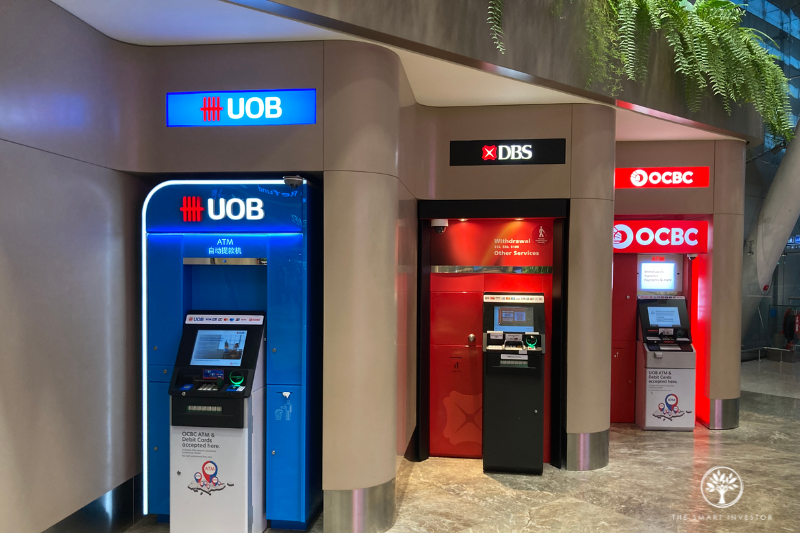
DBS Group (SGX: D05) and United Overseas Bank (SGX: U11), or UOB, slid alongside it.
The message was simple: sell OCBC.
But here’s what most investors missed.
Divide Citi’s target price by OCBC’s book value (as at 30 June 2026) of S$13.73 per share, and you get a surprising ratio: two times book.
Let me put that in perspective.
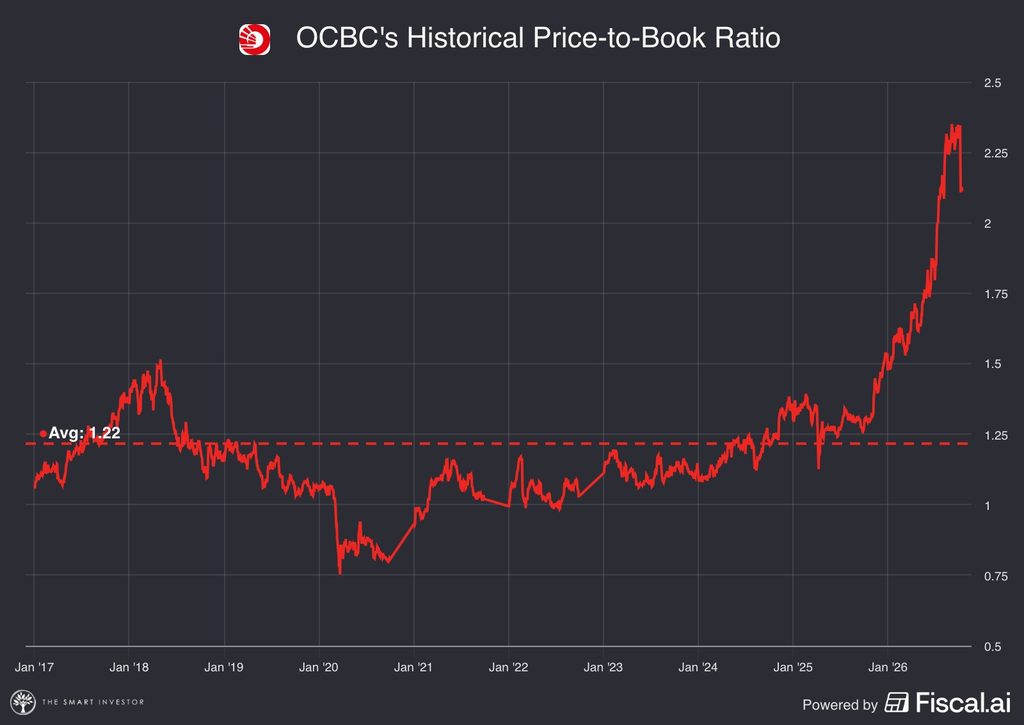
Over the past decade, OCBC shares have traded at an average of 1.22 times book value.
Between 2017 and 2025, the ratio was below 1.5 times most of the time.
In other words, Citi’s bearish target still values OCBC at more than 60% above its long-term average multiple.
Not long ago, a target like that would have read as wildly optimistic.
So if even the Sell call looks expensive by historical standards, what does that tell you about Singapore’s banks today?
The answer is: bank shares are indeed cheaper.
But they are still not cheap.
A lower share price does not make a bargain.
When shares are trading at higher multiples, the banks have more to live up to.
And that hasn’t changed.
Cheaper, but not cheap
Let’s start with the numbers.
| OCBC | Now | 10-year average |
| Price-to-book ratio | 2.1x | 1.22x |
| Dividend yield | 3.6% (3.1% ordinary only) | 4.5% |
Source: Company filings, Fiscal.ai, author’s calculations. Based on OCBC’s share price of S$29.00 as at 16 October 2026 and book value of S$13.73 as at 30 June 2026. The current yield includes OCBC’s special dividend; the figure in brackets excludes it.
OCBC, even after its recent tumble, sits at about 2.1 times book.
That’s over 70% above its long-term average.
For most of the past decade, OCBC traded close to its average, marked by the dashed red line.
That changed from late 2024 onwards, when the shares broke well clear of their historical range.
Notice the deep dip in 2020 as well.
The dividend yield points the same way.
At S$29, OCBC yields 3.6%, below its 10-year average of 4.5%.
But that figure includes a special dividend.
Count only the ordinary dividend, and the yield falls to 3.1%.
Even at Citi’s S$27.50 target, OCBC would yield 3.8%, still below its long-term average.
The price of a bargain
For a bank to trade at a truly cheap valuation, there’s a trade-off you have to accept.
Something bad usually has to happen first.
If you’re a deep value investor, you would wait for OCBC to trade at or below its book value of S$13.73.
But you won’t know when that will be.
It has happened only around three times in the past 20 years.
The sharpest dip of the past decade came during the COVID-19 pandemic in 2020.
That’s the dip you saw in the chart earlier.
Get Smart: Optimise for a calm mind
Let’s return to where we started.
Citi’s Sell call on OCBC sent the shares tumbling.
Yet behind the headline was a model whose target still valued OCBC at two times book.
If you sold on the headline alone, you acted on someone else’s assumptions.
Here’s what I’d suggest instead.
First, know what you’re paying for.
At today’s prices, there’s still a fair bit of optimism built into bank shares.
In other words, the business has to live up to it.
Second, decide what kind of investor you are, then work out your price from there.
A deep value investor, an income investor, and an analyst can all arrive at different prices for the same bank.
And finally, do not optimise for performance.
Optimise for a calm mind.
Genuinely cheap bank shares only show up when the news is frightening.
When that day comes again, as it did in March 2020, a calm mind is the best strategy you can have.
Don’t let market uncertainty hijack your financial dreams. While headlines scream gloom, 5 Singapore companies have been quietly building wealth and paying reliable dividends. You’re probably overlooking them. Discover these resilient giants and their secrets to sustained income, even through global storms. Click here to download your free report now and secure your financial future!
Follow us on Facebook, Instagram, Telegram and YouTube for the latest investing news and analyses!
Disclosure: Chin Hui Leong owns shares of DBS Group, OCBC and UOB.