A bigger dividend feels like a reward.
But the size of the increase, on its own, tells you very little.
What matters is where the extra cash came from.
A payout funded by rising profits can repeat, while one funded by a one-off gain or a timing quirk may not.
The three SGX stocks below all lifted their dividends by a third or more in their latest results.
Their reasons differ, and so do the odds of a repeat.
| Company | Period | Dividend per share | Change (YoY) |
|---|---|---|---|
| Tiong Woon Corporation Holding Ltd (SGX: BQM) | FY2026 final (full year to 30 June 2026) | S$0.025 | +43% |
| Boustead Singapore Limited (SGX: F9D) | 1HFY2027 interim (six months to 30 September 2026) | S$0.02 | +33% |
| Valuetronics Holdings Limited (SGX: BN2) | 1HFY2027 interim (six months to 30 September 2026) | Ordinary HK$0.08; special HK$0.06 | Ordinary +100%; special +50% |
Note: periods differ. Tiong Woon reports a full-year final dividend; Boustead and Valuetronics report six-month interims.
Is Tiong Woon’s bigger dividend backed by cash?
Tiong Woon Corporation Holding Ltd (SGX: BQM) is an integrated heavy lift specialist.
For the financial year ended 30 June 2026 (FY2026), the board proposed a final dividend of S$0.025 per share, up from S$0.0175 a year ago – an increase of 43%.
Profits paid for it.
Revenue rose 15% year on year (YoY) to S$187.7 million, and profit attributable to shareholders climbed 24% to S$23.9 million.
Gross margin widened to 40.7% from 37.6% as the heavy lift segment earned higher margins.
Free cash flow is the lifeblood of dividends, and Tiong Woon’s improved sharply.
The group generated S$43.7 million in free cash flow, up from S$6.3 million.
Part of that improvement came from lower spending.
Cash spent on equipment fell 47%, yet total asset additions fell only 18%.
Over the same period, other secured borrowings rose to S$64.6 million from S$53.8 million.
The group carries S$108.0 million in debt against S$86.6 million in cash and bank deposits.
Management plans to keep renewing and expanding its fleet, so spending could climb again.
The dividend also grew faster than profit this year, but that gap cannot keep widening.
Can Boustead Singapore’s dividend outgrow a profit dip?
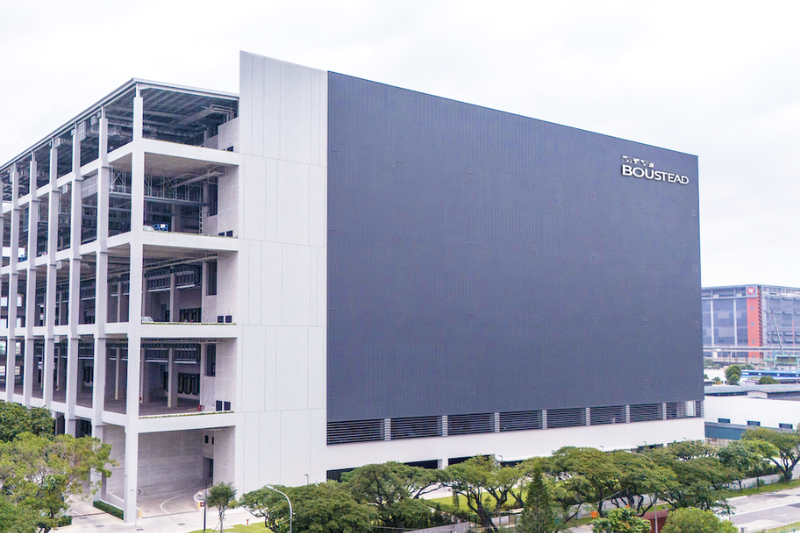
As Singapore’s oldest continuous business organisation, Boustead Singapore Limited (SGX: F9D) runs four divisions spanning real estate solutions, geospatial technology, energy engineering and healthcare.
For the six months ended 30 September 2026 (1HFY2027), the board declared an interim dividend of S$0.02 per share, 0.5 cents higher than a year ago.
That works out to an increase of 33%.
Reported profit moved the other way.
Revenue rose 38% YoY to S$406.6 million, while profit attributable to equity holders fell 10% to S$31.5 million.
Gross margin slipped to 32% from 38%, and a higher effective income tax rate weighed on earnings.
Boustead also booked an S$8.4 million reversal of its share of net asset value after opting out of a committed capital contribution to its associate, UIB Holdings; the move diluted its stake.
Adjusted for other gains and losses, impairments and other exceptional items, net profit rose 41% to S$39.5 million.
The order book offers support.
Real Estate Solutions revenue rose 83% to S$175.1 million, and the engineering order backlog stands at about S$720 million.
Its net liquid position reached S$313.0 million.
Geospatial is the part to watch.
Revenue there grew 26% to S$150.0 million, helped by the upfront recognition of most of its largest Enterprise Agreement renewal.
Boustead attributed this to the renewal’s licence terms, so the boost may not recur next half.
Why did Valuetronics double its interim dividend while profit fell?
Valuetronics Holdings Limited (SGX: BN2) is an electronics manufacturing services provider.
For 1HFY2027, it declared an ordinary interim dividend of HK$0.08 per share, double the HK$0.04 paid a year ago.
Separately, it declared a special dividend of HK$0.06, up from HK$0.04.
The bigger payout follows a policy change.
In May 2026, Valuetronics raised its ordinary dividend target to 50% to 70% of net profit, from 30% to 50% previously, and set aside HK$300 million to return to shareholders over FY2027 and FY2028 through special dividends and share buybacks.
Revenue grew, but profit did not.
Revenue rose 7.3% YoY to HK$897.3 million as Industrial and Commercial Electronics (ICE) sales climbed 18.6% to HK$837.9 million.
Consumer Electronics revenue fell 54.3% to HK$59.4 million after the company phased out traditional consumer lifestyle products.
Profit attributable to owners declined 3.5% to HK$89.8 million.
Gross margin narrowed to 18.7% from 19.7% on higher component costs.
Income tax expense rose 50.9% after a Vietnam subsidiary moved from a full tax exemption to a 50% tax reduction.
Management expects ICE revenue to keep growing in FY2027, but that is subject to uncertainty over US trade and economic policies.
Still, the group expects to remain profitable.
A company that doubles its ordinary dividend while profit slips leaves itself less room for error.
That said, it held HK$1.15 billion in net cash as at 30 September 2026.
Get Smart: Sort the growth before you count it
A dividend increase is only as durable as its source.
Before you celebrate a higher payout, split it into two piles.
The first pile holds growth the business earned through higher profits and wider margins.
The second holds timing effects and one-offs, such as upfront revenue or a special dividend.
Tiong Woon’s increase sits mostly in the first pile, though its capex needs watching.
Boustead’s sits across both.
Valuetronics paid more while earning less.
So here is the question for you: if next year’s profit only matches this year’s, which of these dividends would still grow?
You walk past million-dollar opportunities every single day. Your coffee shop. Your commute. Your grocery run. But these “boring” Singapore companies are quietly building fortunes while everyone chases crypto and overpriced tech stocks. Our latest report reveals 5 small-cap goldmines hiding in plain sight. Click here to download for free now before prices catch up.
Follow us on Facebook, Instagram, Telegram and YouTube for the latest investing news and analyses!
Disclosure: Calvina L. does not own shares in any of the companies mentioned. Chin Hui Leong contributed to this article and owns shares in Boustead Singapore.