S$50,000 is enough to form a meaningful foundation for an income-focused portfolio, and Singapore real estate investment trusts (REITs) are a natural place to put it.
They’re popular because they pass on recurring distributions backed by real rental income, not just a promise.
But how much income that S$50,000 actually generates depends on more than finding high-yielding names.
Distribution sustainability, debt costs, occupancy, rental reversions and the quality of the underlying properties all shape whether today’s yield survives next year.
How Much Passive Income Can S$50,000 Generate?
The maths is simple: a 4% yield pays S$2,000 a year, a 6% yield pays S$3,000; the higher the yield, the higher the income and vice versa.
However, these numbers are illustrative only – actual income depends on the price you actually pay and on distributions that can rise or fall, and REITs don’t necessarily pay the same distribution per unit (DPU) each quarter.
CapitaLand Integrated Commercial Trust (SGX: C38U), or CICT – The Core Income Anchor
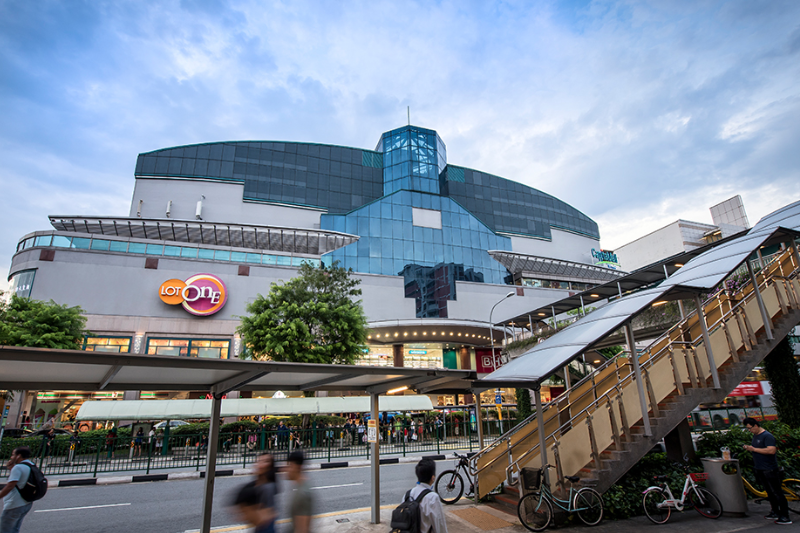
Singapore’s largest REIT owns retail and office assets in prime locations such as Raffles City, Plaza Singapura and Capital Tower.
As of 30 September 2026, overall portfolio occupancy was resilient at 96.1%, with rental reversions of 4.6% (retail) and 7.1% (office).
The balance sheet is healthy, with gearing at a manageable 39.7%, while its interest coverage ratio (ICR) is comfortable at 3.8x.
For the first half ended 30 June 2026 (1H2026), DPU grew 7.1% year on year (YoY) to S$0.0602, even after a dilutive placement of new units; last 12 months (LTM) annualised yield works out to roughly 5.1%.
CICT’s latest DPU growth continues a solid trend of generally increasing DPU over the past five years.
S$12,500 allocated to this name could generate annual income of S$637.50; since 2021, CICT has typically paid distributions twice or three times a year.
Keppel DC REIT (SGX: AJBU), or KDCREIT – The Growth REIT
Next, Singapore’s largest pure-play data centre REIT offers income investors exposure to the secular growth trend of cloud computing and AI.
With 27 data centres spanning 10 countries and a proven appetite for accretive acquisitions, the growth runway for KDCREIT looks bright.
For the nine months ended 30 September 2026 (9M2026), distributable income rose 16.7% YoY to S$228.0 million, and DPU grew 11.7% YoY to S$0.08571.
The data centre REIT’s performance was aided by resilient occupancy of 93.0% and positive rental reversions of about 14% in 9M2026.
Having Keppel Ltd (SGX: BN4) as a sponsor also affords KDCREIT a healthy pipeline of potential new data centres to acquire.
Importantly, the debt profile appears relatively well-staggered, with a weighted average debt tenor of 3.1 years.
At an LTM distribution yield of 4.9%, S$12,500 brings you S$612.50 in annual income.
Given we are just in the early innings of AI, there is plenty of room for KDCREIT to grow its DPU and your income over time.
Parkway Life REIT (SGX: C2PU), or PLife REIT – The Defensive REIT
PLife REIT offers some defensiveness to a REIT portfolio.
Owning hospitals and nursing homes across Singapore, Japan and France, this REIT stands out for its uninterrupted DPU growth every year since its 2007 IPO.
This feat is only possible due to its long-term lease contracts, backed by assets that enjoy resilient demand no matter what the economy is doing.
Do note that its top tenant, Parkway Hospitals Singapore, contributes about 68% of gross revenue.
3Q2026 numbers confirm the story: as at 30 September 2026, committed occupancy stood at 100% in Singapore and France and 94.3% in Japan, with a weighted average lease to expiry (WALE) of 14.43 years.
Finally, the balance sheet is rock-solid, with a gearing of 34.8% and an ICR of 7.9x.
9M2026 DPU rose 13.4% YoY to S$0.1310.
Parkway Life’s LTM yield sits at 3.9%, providing S$487.50 in annual income, and its record suggests that income has been reliable.
Sasseur REIT (SGX: CRPU), or Sasseur – The Higher-Yield REIT
Sasseur operates four outlet malls in China – two in Chongqing and one each in Hefei and Kunming – with rent partly linked to tenant sales.
Portfolio tenant sales rose 4.4% YoY to RMB3.39 billion in 9M2026, with Chongqing Liangjiang posting record nine-month sales.
At roughly 9.7% (LTM), the yield is well above the other three – yet the balance sheet is unusually strong for that yield: gearing of 25.3%, cost of debt down to 3.6%, weighted average debt maturity extended to 4.6 years and an ICR of 6.8x.
Its assets seem stable, with an occupancy rate of 98.6% as at 30 September 2026.
The yield is partly explained by a shorter WALE (1.9 years by net lettable area and 1.1 years by gross revenue), a “China discount” and the fear of a slowdown in overall consumption in China.
A 10.2% yield generates S$1,275 in annual income, but the China-related risks are something to be weighed against.
What Could S$50,000 Generate Across the Four REITs?
Assume an equal S$12,500 in each:
| REIT | Allocation | Indicative Yield | Estimated Annual Income |
|---|---|---|---|
| CICT | S$12,500 | 5.1% | S$637.50 |
| KDCREIT | S$12,500 | 4.9% | S$612.50 |
| Parkway Life REIT | S$12,500 | 3.9% | S$487.50 |
| Sasseur REIT | S$12,500 | 10.2% | S$1,275 |
| Total | S$50,000 | 6% blended | S$3,012.50 |
This portfolio works out to roughly S$251 a month on average, though actual distributions vary given the REITs’ different distribution schedules.
The blended yield here matters more than any single REIT’s number: Sasseur’s high yield lifts the average and supplies about 42% of the income, so the portfolio leans on its highest-risk REIT; the other three provide the steadier base.
Could the Income Grow Over Time?
Portfolio income can grow in two ways.
The first is DPU growth from positive rental reversions, rising occupancy, acquisitions or falling borrowing costs, which Keppel DC REIT and Parkway Life REIT are already delivering.
The second is reinvesting distributions, which buys more units that generate their own payouts.
Consider this: if the portfolio’s 6% yield were fully reinvested every year at unchanged unit prices, S$50,000 could grow to about S$89,500 after 10 years, generating around S$5,400 a year in income.
Any DPU growth would add to that.
This is hypothetical, but it shows why growth and reinvestment matter more than chasing today’s highest single yield.
What Could Reduce the S$50,000 Income Stream?
DPU cuts, higher rates pushing up refinancing costs, falling occupancy, negative reversions, declining asset values, a dilutive rights issue or weakening tenant demand could pressure income generation.
Also, do note that REIT distributions are never guaranteed; income investors need to keep checking the portfolio and balance sheet, not just collect the cheque.
Get Smart: Build Income, Not Just Yield
S$50,000 spread across these four REITs could generate roughly S$3,000 a year today – a solid, diversified starting income.
But the headline number is only the starting point. What actually matters is whether each REIT can maintain its DPU, manage its debt and keep growing rental income through changing conditions.
Over time, DPU growth and reinvestment can turn a modest initial stake into a meaningfully larger income-producing portfolio.
If you want to retire with a constant stream of dividends, these 5 stocks might be all you need. We’ve found 5 SG stocks that have kept paying (and growing) through inflation, rate hikes, and recessions. See what they are with our latest free report for SGX dividend investors. Click here to get instant access.
Follow us on Facebook, Instagram, Telegram and YouTube for the latest investing news and analyses!
Disclosure: Wilson H. does not own shares in any of the companies mentioned.