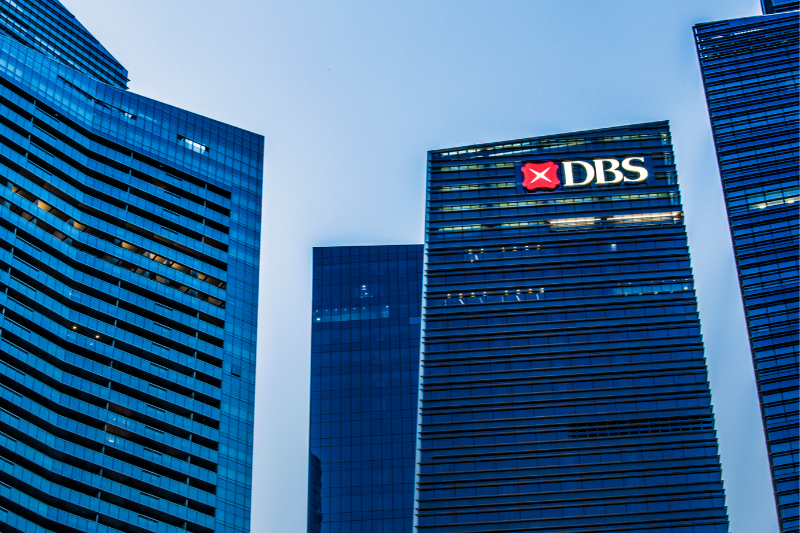
In January, DBS was trading at around S$59 and investors were already asking whether it was time to take some profits off the table.
Today, DBS Group Holdings Ltd (SGX: D05) opened at S$77.60.
That’s roughly another 32% higher.
If you sold because S$59 looked expensive, the awkward question isn’t whether you were wrong.
It’s what you do now.
To be clear, I didn’t know DBS would rise to S$77. Nobody did.
That’s precisely the point.
A rising share price, by itself, is not a good reason to sell a good business. Investors should look instead at its fundamentals, valuation, and the role it plays in their portfolio.
The problem with “I’ll buy it back cheaper”
Put yourself back in January.
You’ve owned DBS for years. The shares have done well and the position is now one of your biggest winners.
So you think: I’ve made enough. I’ll lock in some profits. If DBS falls, I can always buy it back.
It sounds sensible.
But selling doesn’t end the decision. It creates another one.
Would you buy DBS back today at S$76.15 after selling it at S$59?
That’s psychologically difficult.
Paying substantially more for something you recently sold feels like admitting you made a mistake. So instead, you wait for a pullback.
And sometimes it never comes.
That’s why “I’ll buy it back when it’s cheaper” isn’t much of an exit strategy unless you already know what “cheaper” means.
Has DBS actually become a worse business?
This is the more useful question.
Something has gone against DBS.
In the second quarter of 2026, net interest income fell 2% year on year to S$3.58 billion. Net interest margin narrowed 18 basis points to 1.87% as lower interest rates fed through.
For a bank, that matters.
But one weaker number doesn’t tell you the whole story.
DBS’s total income still rose 6% to a record S$6.09 billion.
Net fee income jumped 25% to S$1.46 billion, helped by a 42% surge in wealth management fees to S$919 million.
Commercial book other non-interest income rose 30% to a record S$681 million.
Loans grew 8% to S$469 billion while asset quality remained resilient, with the non-performing loan ratio unchanged at 1.0%.
Net profit rose 9% to a record S$3.08 billion.
Shareholders also received an interim dividend of S$0.66 per share and a S$0.15 capital return dividend, bringing the quarterly payout to S$0.81.
In other words, lower interest rates hurt one important part of DBS’s business.
But growth elsewhere more than compensated for it.
That’s very different from saying the investment case has deteriorated.
Buying DBS today isn’t the same as holding DBS today
This distinction matters.
At S$77.60, DBS is clearly more expensive than it was in January. Investors buying today should ask whether the current valuation still offers an attractive long-term return.
But an existing shareholder faces a different decision.
Selling means exchanging a profitable, dividend-paying business for cash. You then need somewhere better to put that money.
So it’s perfectly reasonable to say:
“I wouldn’t buy more DBS at this price, but I’m happy to keep the shares I already own.”
Those two views aren’t contradictory.
Why investors sell winners too early
Selling after a big gain feels prudent.
A profit on paper feels temporary. Cash feels safe.
There’s also anchoring. If you bought DBS at S$30 or S$40, S$77 can feel absurdly high simply because you’re comparing today’s price with your purchase price.
But the market doesn’t know what you paid.
Your purchase price says nothing about what DBS is worth today.
Instead, ask what has changed in the business and what return you can reasonably expect from here.
When should you actually sell a winning stock?
There are perfectly good reasons to sell.
Consider selling if:
- The company’s long-term fundamentals have deteriorated.
- Its balance sheet or asset quality has weakened materially.
- Its dividend is no longer supported by the business.
- The valuation has become impossible to justify against realistic future growth.
- The position has become too large for your portfolio.
- Your own financial needs or circumstances have changed.
Notice what’s missing.
“The share price has gone up a lot.”
That’s an observation, not an investment thesis.
Get Smart: Know what would make you buy it back
Before selling a winner, ask yourself two questions.
What has changed in the business?
And then the harder one:
What would make me buy this stock back?
If your answer is simply “when it’s cheaper”, you don’t yet have a plan.
Define the valuation, price or business development that would make you reconsider.
Otherwise, you may discover what many investors do after selling a winner: getting out was easy.
Getting back in is much harder.
Selling isn’t the mistake.
Selling for the wrong reason is.
If you’re looking for the best value buys in the stock market, read Get Smart. It will help you spot opportunities most investors overlook. Each issue gives you the context you need to recognise bargains and act confidently. Join for free and enjoy the advantage of deep investing insight delivered straight to your inbox every week.
Follow us on Facebook, Instagram, Telegram and YouTube for the latest investing news and analyses!
Disclosure: Joanna Sng owns shares of DBS Group Holdings Ltd.