Ask most people which Singapore bank pays the best dividend, and they’ll quote you a yield.
But a yield in isolation can be misleading – a bank with a lower yield but a bigger growing payout might serve you better.
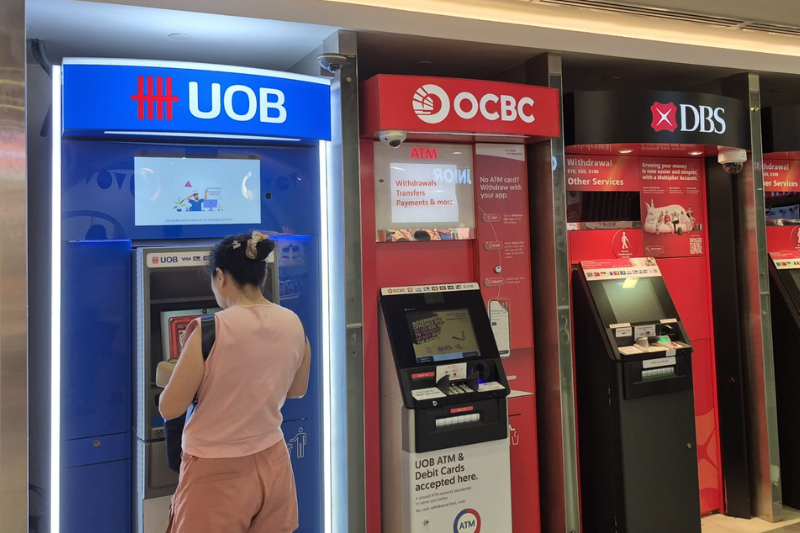
So, let’s make it concrete: put exactly S$10,000 into each of DBS Group Holdings Limited (SGX: D05), Oversea-Chinese Banking Corporation Limited (SGX: O39), or OCBC, and United Overseas Bank Limited (SGX: U11), or UOB, and see how much annual dividend income each one throws off.
First, How Much Would S$10,000 Buy You?
Some caveats here: the share prices taken are as of 17 September 2026, with only whole-share purchases (no fractional shares), and the latest annualised dividend per share as of 17 August 2026 as well.
| Metric | DBS | OCBC | UOB |
| Share Price (17 August 2026) | S$76.85 | S$31.28 | S$41.98 |
| Number of shares S$10,000 buys you (rounded down to nearest share) | 130 | 319 | 238 |
| Annualised dividend per share (17 August 2026) | S$3.24* | S$1.05* | S$1.59 |
| Estimated annual dividend income | S$421.20 | S$334.95 | S$378.42 |
| Average monthly equivalent | S$35.10 | S$27.91 | S$31.54 |
| Effective dividend yield | 4.2% | 3.3% | 3.8% |
* Includes special/capital return dividends that may not recur annually
Bank #1: DBS
Investors buy DBS for its sheer earnings power – the bank posted a record profit of S$3.08 billion for the quarter ending 30 June 2026 (2Q2026).
This resulting strength in earnings is doled out to shareholders with a generous dividend of S$0.81 per share (S$0.66 in core, S$0.15 in capital return).
After a brief, MAS-mandated cap during the pandemic, DBS has grown its dividend steadily since 2021.
Last but not least, the bank does this with a healthy balance sheet with a low non-performing loan (NPL) ratio of 1.0%, accompanied by a decent fully phased-in common equity tier one (CET1) ratio of 14.6%.
As seen in the table above, a S$10,000 investment today would lead to an ownership of 130 shares and yield an annual dividend income of S$421.20.
Future dividend growth is likely to come from further earnings growth, with more loans disbursed and an expansion of the bank’s wealth management arm.
Possible factors that could derail DBS would be further compression of net interest margins (NIMs) and a pickup in loan defaults due to a softer economy.
Bank #2: OCBC
OCBC’s pitch is diversification: you get a bank, a wealth management arm, and an insurer (Great Eastern) under one roof, across Singapore, Malaysia, and Greater China.
Like DBS, OCBC has an established dividend track record, with annual payments stretching back decades.
With a share price of S$31.28, you get 319 shares for S$10,000, with an annual income of S$334.95 (see table above).
Further expansion in its insurance and wealth management arms would likely see the bank pay a greater dividend moving forward.
Further growth in its regional banking business, combined with continued strength in capital generation, would improve the odds of a higher payout.
Pay attention to lower interest rates and a slowing economy, which would hamper OCBC’s burgeoning business.
Bank #3: UOB
UOB is favoured by investors seeking a strong ASEAN presence; of the three banks, it has the most direct leverage to Southeast Asia’s long-term growth via its established corporate and retail banking franchises.
A S$10,000 investment would garner you 238 shares, alongside an annual income of S$378.42.
Dividend growth likely rests on the fortunes of the ASEAN economies; watch for loan growth and the performance of its wealth management, which would have a direct impact on UOB’s earnings.
Other than rates and economic conditions, UOB also faces the risk of being unable to sufficiently cut operating costs and smoothly integrate its ASEAN franchise into its existing operations.
Which Bank Pays the Most?
As seen in the table above, given our established assumptions, DBS pays the highest annual income, followed by UOB and OCBC.
Compared to OCBC, DBS’ annual dividend comes in higher by roughly S$86 – not a meaningful difference.
It can be tempting to just assume DBS is the best investment given it offers the highest payout; however, both DBS and OCBC’s dividends are padded by special dividends.
Meanwhile, UOB’s dividend payment is not too shabby given it represents the core dividend payment offered by the bank.
But What If You Reinvest the Dividends?
Here’s where it gets interesting.
Plough each dividend payment back into more shares ,and those shares earn dividends too.
Snowball that over a decade or two, and it lends a serious boost to your annual dividends.
Do also note the role of dividend growth, not starting yield: a bank raising its payout 10% a year will, given time, overtake a higher yielder growing its own by 3%.
With that, DBS takes the cake for having grown its dividend fastest of late.
Which Bank Has the Safest Dividend?
Income you can’t rely on isn’t worth much, so check the foundations.
All three cover their dividends comfortably – payout ratios near 50% of core earnings for OCBC and UOB, higher for DBS once the capital return is included.
All three hold fully phased-in CET1 ratios ranging from 14% to 15%, with low NPL ratios (0.9% to 1.6%), providing ample headroom to sustain their dividend payments.
Common Mistakes Investors Make
Usual mistakes flow from ignoring special dividends and comparing yields without accounting for share prices.
Finally, ignoring dividend growth and failing to consider valuation alongside business quality can be costly.
Get Smart: Don’t Just Chase the Biggest Payout
A S$10,000 investment in any of the three local banks throws off real annual income – S$331.80 to S$421.20.
DBS generates the most income today, but it might not be that way five to ten years down the road.
So don’t just chase the biggest cheque; back the one most likely to sustain earnings growth and dividend payout.
Imagine owning businesses that continued paying shareholders even when markets were falling. That’s the appeal of dividend investing done well. Our FREE report reveals 6 SGX companies that paid dividends every single year for two decades, through the Global Financial Crisis, COVID-19, and 2022’s rate shock. Start building the kind of income stream that could fund a more comfortable retirement. Get your free report here.
Follow us on Facebook, Instagram, Telegram and YouTube for the latest investing news and analyses!
Disclosure: Wilson H. does not own shares of any companies mentioned.