Singapore real estate investment trusts (REITs) have had a frustrating couple of years.
The iEdge S-REIT Index (SGX: SRU) was down about 14.1% year to date as at 13 November 2026 against the Straits Times Index’s (SGX: ^STI) 12.3% gain.
Yet, some REITs are quietly growing their distributions again.
So, is this the start of a proper recovery or just a pause before the next leg down?
The answer depends on more than interest rates.
Why Singapore REITs Have Struggled and What’s Different Now
Higher interest rates did most of the damage.
When rates went up, REITs had to refinance their loans at higher costs, leaving less to pay out as distributions per unit (DPU).
Meanwhile, income investors could earn a decent return from T-bills and fixed deposits without taking any risk.
Some REITs also struggled with falling property values or weak overseas performance, while banks and growth stocks pulled money away.
Some of that pressure is lifting.
Local interest rates have eased, so older loans are being refinanced more cheaply.
Singapore offices and malls are signing leases at higher rents, occupancy rates are still firm, and many REITs still trade below their net asset value (NAV).
If these trends hold, the three REITs below could benefit.
How the Three REITs Compare
| REIT | Yield | DPU Trend | Gearing | Rental Reversion | Recovery Catalyst |
|---|---|---|---|---|---|
| Suntec REIT (SGX: T82U) | 6.0% | Increasing | 43.0% | Overall Positive | Divestment of Australian assets |
| NTT DC REIT (SGX: NTDU) | 5.9%* | Maiden DPU | 31.0% | Overall Positive | Rental growth, acquisitions |
| Stoneweg Europe Stapled Trust (SGX: SET) | 9.0% | Increasing | 43.6% | Overall Positive | Office segment to stabilise |
*Note: Not annualised; 261-day period.
Suntec looks the most defensive, NTT DC REIT has the clearest growth, and SET offers the highest yield for those willing to take on more risk.
Suntec REIT (SGX: T82U) – Strong Rents That Benefit From Lower Rates
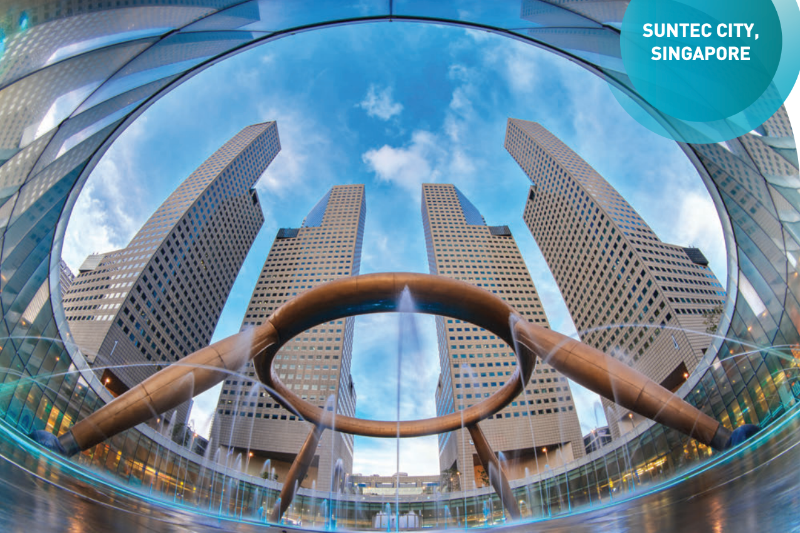
Suntec REIT is best known for Suntec City, and it also owns stakes in One Raffles Quay and Marina Bay Financial Centre.
Outside Singapore, it has offices in Australia and the UK.
Business at home is going well.
As at 30 September 2026 (3Q2026), its Singapore offices were 99.6% occupied and its malls 98.6%.
In 3Q2026, rental reversions were 7.3% for its Singapore offices and 11.2% for its malls.
DPU for the first nine months (9M2026) rose 20.7% year on year (YoY), helped by lower interest costs.
At a unit price of S$1.35 as at 13 November 2026, Suntec REIT offers a trailing distribution yield of 6.0% and trades at about 0.66x its net asset value (NAV) of S$2.04 per unit.
The main weakness is debt.
Gearing climbed to 43.0%, and an interest coverage ratio (ICR) of 2.3x.
Its all-in financing cost has fallen to 3.57%, from 3.71% at 31 December 2025.
Should Suntec manage to sell its three Australian assets, gearing could improve from current levels.
Management expects future DPU growth to be from higher Singapore rents and lower financing costs.
The main risks for Suntec would likely be from its overseas holdings and higher financing costs.
NTT DC REIT (SGX: NTDU) – The Growth Recovery Play
This data centre REIT owns six properties in the US, Austria, and Singapore.
That’s a rare corner of property where rents are still climbing at a healthy clip.
Its maiden DPU, ending 31 March 2026 (FY2025/2026), came in at US$0.0556.
At a unit price of US$0.945 as at 13 November 2026, this works out to an estimated distribution yield of 5.9%.
Do note this distribution covered less than a full year.
For the first quarter ended 30 June 2026 (1QFY2026/2027), portfolio occupancy was 95.9% (rising to 99.2% once signed leases start), and renewals were signed at rents 13.4% higher.
The balance sheet leaves plenty of room for acquisition-fuelled growth.
Gearing is at 31%, while its ICR stands at 4.7x.
No loans fall due for two years, and the REIT has US$261 million of debt headroom before it reaches its 40% gearing limit.
The main risks include rising power costs, 14% of rent that’s up for renewal in this financial year, and a concentrated tenant base where the top 10 pay 74.5% of rent.
Stoneweg Europe Stapled Trust (SGX: SET) – The High-Yield Opportunity
Stoneweg Europe, or SET, owns mostly logistics and office properties across Europe.
At a unit price of €1.50 as at 13 November 2026, it yields about 9.0% and trades at roughly 0.74x NAV.
The distribution looks steady for now.
Distribution per stapled security (DPS) rose 1.4% to €0.0664 in 1H2026 (ended 30 June 2026), and management expects the full-year figure to be broadly in line with FY2025.
Logistics rental reversion was 9.6%, with a healthy occupancy rate of 95.2%, so why are the units trading near 52-week lows?
Offices are the drag.
Occupancy is only at 90.3%, and office rental reversion was down 4.1%.
Gearing looks manageable at 41.9%, with an ICR of 3.0x.
Crucially, 90% of its debt is hedged, and there’s no major refinancing until 2030.
This gives the REIT some time before its office segment recovers.
SET is also moving into data centres, which could provide some potential upside, but this brings execution risk.
On balance, the yield is tempting, but you’re being paid to accept weaker office performance and a big strategy shift (into data centres).
What Could Stop the REIT Comeback?
Another Fed rate hike, or rates that stay elevated, would keep refinancing costs up.
Weaker rents, further declines in property values or fresh DPU cuts would also hurt.
Finally, the continued preference for banks, risk-free income alternatives, or growth stocks could keep investors away from REITs.
Cheap REITs can stay cheap if the reasons behind the discount don’t change.
Get Smart: A Recovery Worth Watching
S-REITs could be close to a turning point, though a lot still depends on where interest rates go.
And even if sentiment picks up, some REITs will recover much faster than others.
The ones to look for have growing rents and debt that’s under control, because those are the REITs most able to raise DPU.
Investors who focus on these qualities may be well placed if the sector’s recovery takes hold.
You’ve probably shopped at their malls, banked with them, or bought their products this month. These 6 SGX companies have paid dividends for 20 straight years, GFC and COVID included. Our FREE report shows you which ones, and what has kept their dividends going for 20 years and more. Grab your copy here.
Follow us on Facebook, Instagram, Telegram and YouTube for the latest investing news and analyses!
Disclosure: Wilson.H does not own shares in any of the companies mentioned.