With a staggering market capitalisation of more than US$5 trillion, NVIDIA (NASDAQ: NVDA) is arguably the poster boy of the AI revolution.
Developers rely on its CUDA software ecosystem for running critical AI workloads – and once they build on it, they also stay locked in, underscoring the chip designer’s key advantage over competitors.
Despite overwhelming demand for NVIDIA’s chips, the company doesn’t actually manufacture them.
NVIDIA designs world-class GPU (Graphics Processing Units) systems and the CUDA software that operates them.
It runs a fabless business model that makes it asset-light.
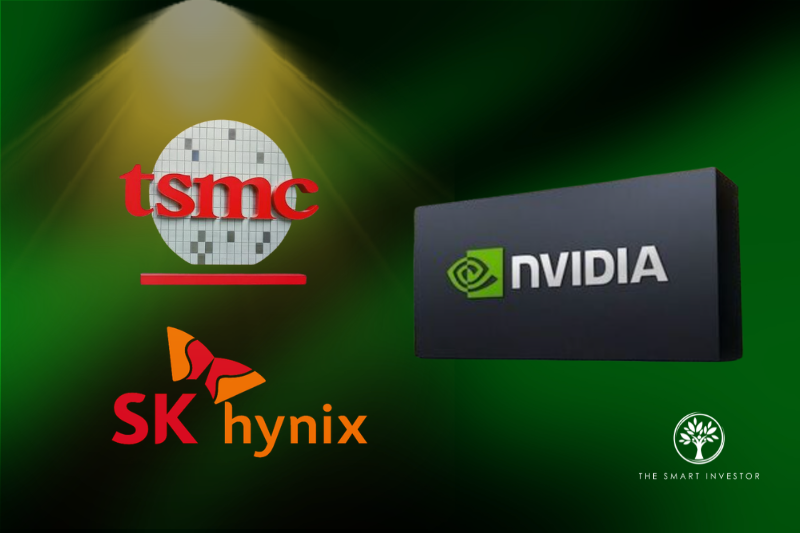
The companies manufacturing NVIDIA’s chips are Taiwan Semiconductor Manufacturing Company (NYSE: TSM), or TSMC, and SK Hynix (KRX: 000660). They are the “Unsung Kings” of AI.
NVIDIA – No Fab? No Problem
Hyperscalers within the Magnificent Seven have recently grappled with investors’ concerns about their rising AI-related capital expenditure (capex).
In contrast, NVIDIA’s fabless model avoids the multi-billion-dollar cost of maintaining production facilities and allows the company to enjoy an asset-light balance sheet and margin-heavy bottom line.
In the first quarter of its fiscal year ending January 2027 (1QFY2027), NVIDIA’s revenue jumped 85% year-on-year (YoY) to US$81.6 billion, driven by a 92% surge in revenue from its Data Center segment to US$75.2 billion.
With NVIDIA’s free cash flow climbing 85.8% YoY to US$48.6 billion, investors are looking at a cash-generating machine.
NVIDIA couldn’t have achieved its impressive numbers without its manufacturing partners that turn its chip designs into reality.
TSMC – Complex GPU Designs? No Problem
As NVIDIA’s GPU systems grow more complex, they require the finest manufacturing expertise in the world to materialise.
And that’s TSMC, the semiconductor foundry that is fabricating NVIDIA’s latest Blackwell-generation chips at enormous scale.
Industry sources place TSMC’s share of manufacturing leading-edge logic chips at an impressive 90%, meaning there is very little effective competition.
In the second quarter of 2026 (2Q2026), TSMC’s revenue rose 36% to US$40.2 billion, while net income surged 77.8% to US$22.37 billion, supported by its leading-edge process technologies.
Part of the process of manufacturing leading-edge logic chips involves advanced chip-on-wafer-on-substrate (CoWoS) packaging.
As AI compute increasingly outpaces memory bandwidth, creating a “memory wall”, TSMC’s stranglehold over its tightly integrated fabrication-and-packaging workflow offers the best chance for NVIDIA to maximise chip yields as production ramps up.
SK Hynix – Breaking the “Memory Wall”
The “memory wall” bottleneck is real.
After all, what’s the point of having the fastest AI chip, only to have its output capped by an inferior memory architecture?
Aside from TSMC’s advanced packaging expertise, optimising memory performance through the high-bandwidth memory (HBM) architecture matters just as much – a strength SK Hynix brings to the table.
Standard memory chips arrange dies in a planar format, but SK Hynix’s HBM stacks them vertically to create a massive data highway, leapfrogging the bandwidth limits of conventional memory.
To stabilise HBM’s complex three-dimensional architecture, which is prone to warping under heat, SK Hynix employs its proprietary MR-MUF manufacturing process to enhance heat dissipation and strengthen the package’s structural integrity.
SK Hynix’s revenue skyrocketed 257% YoY to KRW79.32 trillion in 2Q2026, driven by an overall surge in memory prices, including HBM.
Crucially, despite running a traditional capital-intensive business, SK Hynix enjoyed a high, designer-like gross margin of 83% in 2Q2026, even better than NVIDIA’s 74.9%.
Risks and Opportunities: Expect Potential Growth but Don’t Forget the Downsides
The potential upsides of AI investments are compelling, but the risks are just as significant.
NVIDIA, SK Hynix, and TSMC are key beneficiaries of the enormous global capital poured into building AI infrastructure.
This means they are likely to define the hardware foundations of the nascent global AI stack.
However, as with the railroad boom, one should ask whether their AI offerings, no matter how crucial now amid the global supply crunch, will remain valuable after the global AI stack matures.
Moreover, TSMC’s concentrated operations in Taiwan present geopolitical risks, while SK Hynix, despite its commanding lead in HBM, is not immune to competition from rivals such as Samsung Electronics (KRX: 005930) from Korea and Micron (NASDAQ: MU) from the US.
Get Smart: Winning the Team Sport of AI Supremacy
Argentina, despite having star player Lionel Messi, lost the World Cup 2026 final to Spain, which had the better team.
The lesson? For a team sport, the best team wins, not the best player.
NVIDIA is arguably the best player in the global race for AI supremacy.
However, without crucial support from partners such as SK Hynix and TSMC, it cannot win alone.
Smart investors know better – the victory belongs not just to the best player in the spotlight, but also to the unsung kings behind the scenes.
Not all AI “winners” will survive this cycle.
But a few companies already have the scale, cash flow, and edge to pull ahead. We highlight what to look for in our FREE volatile market report. Download it here.
Follow us on Facebook, Instagram and Telegram for the latest investing news and analyses!
Disclaimer: Larry L owns shares of NVIDIA.