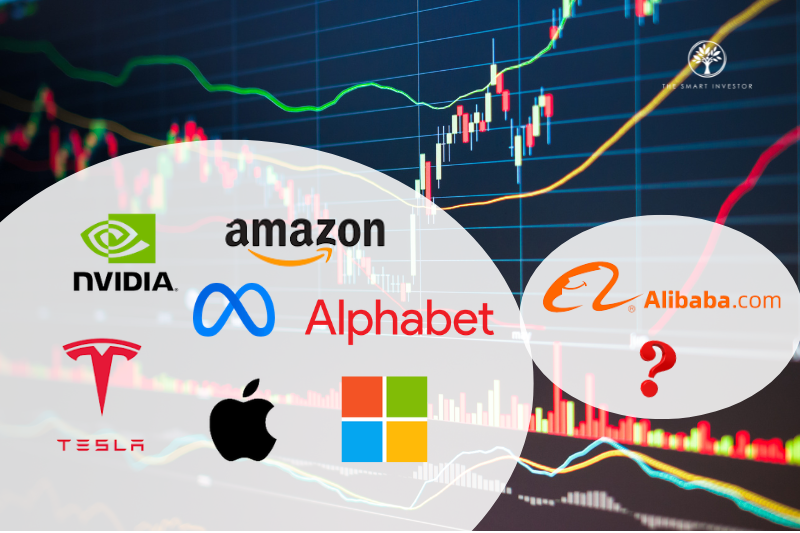
A handful of US tech giants have dominated markets in recent years, and have come to be known as the “Magnificent 7” (Mag 7).
In May, these seven companies made up 35% of the S&P 500’s market capitalisation, according to The Motley Fool.
As such, even investors who don’t own these individual stocks may have significant exposure to them if they own an index fund that tracks the S&P 500.
This presents both opportunities and risks.
The Mag 7 are huge companies.
As of 22 May, AI chipmaker NVIDIA (NASDAQ: NVDA) had the largest market capitalisation of US$5.2 trillion, while Tesla (NASDAQ: TSLA) was the smallest at US$1.3 trillion.
Google-owner Alphabet (NASDAQ: GOOG) (US$4.6 trillion), Apple (NASDAQ: AAPL) (US$4.5 trillion), Microsoft (NASDAQ: MSFT) (US$3.1 trillion), Amazon (NASDAQ: AMZN) (US$2.9 trillion), and Meta Platforms (NASDAQ: META) (US$1.6 trillion) round out the list.
What makes these companies so attractive?
Owning an ecosystem or platform
Mag 7 companies have strong competitive advantages.
For example, Apple provides its users a self-reinforcing ecosystem via the iPhone, which runs on Apple’s proprietary iOS software, allowing for integration over multiple devices.
These devices also offer access to Apple’s services, from Apple Music to Apple Pay, which generate additional revenue streams for the company.
This ecosystem of over 1.5 billion active iPhone users worldwide creates considerable economic value for Apple beyond just the hardware.
Meanwhile, Meta owns the dominant social platforms of our era, from the original Facebook to Instagram and WhatsApp.
Over 3.5 billion users across Meta’s Family of Apps use its platforms to watch videos, read the news, and engage other users.
This huge audience – and the data they generate – is a gold mine for Meta, which uses this information to sell targeted ads.
Exceptional cash flow generation
Members of the Mag 7 generate plenty of cash.
One of the chief beneficiaries of the AI boom is NVIDIA.
In its fourth quarter of the fiscal year ending 31 January 2026 (4QFY2026), the company generated nearly US$35 billion in free cash flow (FCF) – the amount of money a company has after spending on operating expenses and CAPEX.
This was more than double the amount in the same year-ago period.
Analysts expect the company to generate FCF of over US$600 billion over the next few years, raising the question of what the company would do with so much cash.
Apart from share buybacks, the company has embarked on a spate of dealmaking, investing in companies such as Nokia (HEL: NOKIA), Intel (NASDAQ: INTC), and Anthropic.
However, large investments in AI have meant that some of the Mag 7 suffered significant declines in their FCF recently.
For example, Amazon’s 1Q2026 FCF plunged by 95% year on year (YoY).
Structural growth drivers
By investing in the Mag 7, investors gain exposure to structural growth drivers, including AI, cloud computing, robotics, and digital advertising.
According to Microsoft CEO Satya Nadella, its AI business had an annual revenue run rate of US$37 billion in its most recent quarter, representing YoY growth of 123%.
Tesla is at the cutting edge of tech, and is moving away from its roots as a maker of electric vehicles to manufacturing robots, launching robotaxis, and even semiconductor fabrication.
Its California factory that previously produced Model S and X cars has been converted into an Optimus factory able to produce 1 million robots a year.
A second line in Texas is being designed for long-term production capacity of 10 million robots annually.
More prosaic, but equally important, is the contribution of advertising to these businesses.
While Alphabet and Meta have long monetised their assets via advertising, Amazon is seeing significant growth in this space.
Over the last 12 months, Amazon generated nearly US$72 billion in revenue from its advertising services business, up 22% YoY.
Why Concentration Has Increased
While the Mag 7 are excellent businesses, their dominance of the US markets is for reasons that go beyond this.
The rise of passive index investing means that more capital is allocated to the largest companies, further increasing their size.
Their strong performance has also attracted additional flows from active investors, afraid to miss out on these returns.
Add the AI craze of the past few years, which has further widened the gap between the Mag 7 and the broader market, since AI requires a level of investment only the largest companies can make.
This concentration means that investors have to be aware of several risks, including valuation, correlation, and regulatory.
As of 22 May 2026, the Mag 7’s median price to earnings ratio (on a trailing 12 months basis) is 31.6x, higher than the S&P 500’s 27x.
High expectations mean that stellar results are often required just to stay in the same place.
As many of the Mag 7 are now in overlapping businesses (e.g. Microsoft, Amazon, and Google all offer AI and cloud services), changes to the outlook for these sectors will affect all their share prices, increasing correlation risks.
Since the Mag 7 make up 35% of the S&P 500, investors who own these companies individually, as well as index funds tracking the S&P, are likely to see higher correlation in their portfolios.
Finally, the sheer size of these companies, and operations in critical industries such as AI, means increasing scrutiny from governments and regulators.
For example, both Meta and Google are facing pressure from Australia and Indonesia over their compliance with laws that seek to ban children under 16 from accessing social media.
Get Smart: Relook your portfolio
Given above-average valuations and concentration risks, investors might consider re-evaluating each Mag 7 company they own, within the context of their overall portfolio.
An alternative to the Mag 7 might be similar tech stocks from emerging markets such as China, which are generally trading at lower valuations.
For example, Alibaba (NYSE: BABA) is trading at a P/E ratio of 20x, compared to Amazon’s 32x.
Smart investing is not just about owning great stocks – it is about managing risks, diversification, and having long-term discipline.
Many investors think DeepSeek lowering AI costs means less revenue for tech companies. But that’s not the full story, and believing it could cost you. In our latest free report, we unpack a surprising insight from a top tech CEO who explains why lower AI costs may actually drive more tech spending, not less — and he’s got the numbers to prove it. If you’ve misunderstood this trend, you could miss out on some of the biggest investment opportunities. Click here now to access “How GenAI is Reshaping the Stock Market” today to get the full breakdown.
Follow us on Facebook, Instagram and Telegram for the latest investing news and analyses!
Disclosure: Silas owns shares in Alibaba.