Telco shares are not meant to be exciting.
You can even call it boring.
People pay their phone bills every month, the telco earns a profit, and the dividends should arrive like clockwork.
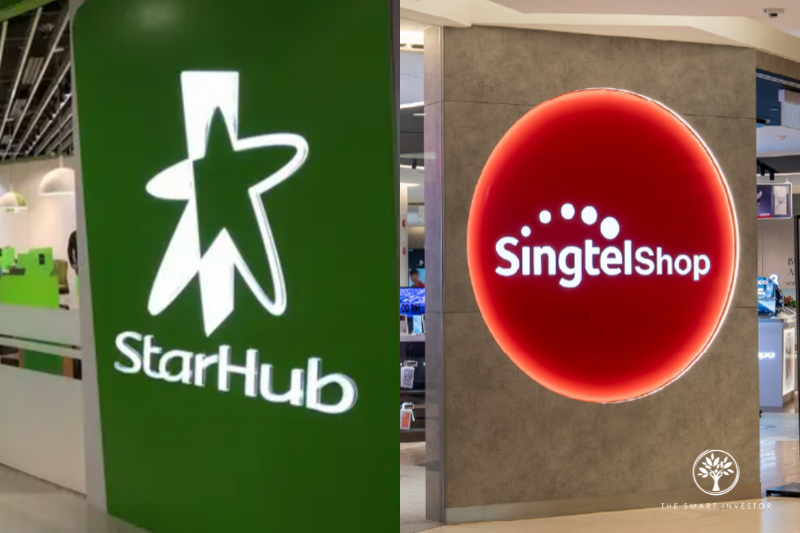
But is that true for both StarHub Ltd (SGX: CC3) and Singapore Telecommunications Limited (SGX: Z74), or Singtel?
The duo offer mobile services to Singapore investors.
Both face price wars, rising costs, and heavy network spending.
If that’s the case: which one makes the better dividend stock?
For that, we have to dive into the latest financials to see which company has better dividend sustainability and potential long-term capital returns.
StarHub vs Singtel: Two Different Business Models
StarHub primarily serves the Singapore market.
It sells mobile, broadband and pay-TV plans, and also offers companies services like managed IT and cybersecurity.
Consumer plans, which mostly run on monthly bills, brought in about 61% of its service revenue in the six months to 30 June 2026 (1H2026), excluding Ensign.
But average revenue per user is falling, with mobile service revenue down 10.5% year on year and broadband down 8.7% over the same period.
StarHub is targeting S$70 million in yearly cost savings by 2028, with about 10% completed thus far.
Enterprise, the other 39%, is the growth plan.
StarHub’s orderbook is up about 52% year on year (YoY), yet regional enterprise revenue slipped 1.8% to S$290.8 million.
Cybersecurity is a priority, though StarHub — to our knowledge — hasn’t provided any breakdown of its contribution.
Staying Singapore-only is a double-edged sword.
On the upside, it enables StarHub to establish a strong position in a compact market with no currency risk.
But there is nowhere to hide when there is a consumer price war.
In contrast, Singtel is a diversified business.
Singtel owns Singtel Singapore and Optus in Australia, plus stakes in associate telcos such as Bharti Airtel in India, AIS in Thailand, and Globe in the Philippines.
Those associates earned S$543 million in the first quarter ending 30 June 2026 (1QFY2027).
The telco’s growth engines these days are data centres alongside enterprise services under Digital InfraCo and NCS, respectively.
When Singapore weakens, Optus and the regional associates can help soften the blow.
Which Telco Has the Stronger Financial Performance?
At first glance, StarHub’s 1H2026 profit of S$258.1 million looks great.
It isn’t.
Most of it is a one-off gain from ending an arrangement with Ensign, which is now an associate.
Without the gain, profit was S$12.4 million.
StarHub expects 2026 EBITDA of just 75% to 80% of last year’s S$403.6 million.
Singtel’s profit is cleaner.
In 1QFY2027, Singtel’s underlying profit rose 21% to S$831 million.
Without a one-off gain, underlying profit still grew 15%.
EBITDA climbed 9% to S$1.08 billion.
Singtel reports cash flow and debt only twice a year, so the latest figures available are for the fiscal year ended 31 March 2026 (FY2026).
It generated S$2.44 billion of free cash flow (FCF) in FY2026.
StarHub’s 2025 FCF was negative S$24 million.
Excluding a S$188 million spectrum payment made during that year, FCF would have been S$163.3 million.
In 1H2026, FCF came in at S$40.6 million.
On debt, Singtel’s net debt at the end of FY2026 came in at S$8.7 billion with an interest cover of 19 times.
StarHub’s debt as of 30 June 2026 was S$847.4 million with a net debt to EBITDA of 2.39 times.
Which Company Offers the Better Dividend?
| Past 12 Months data | StarHub | Singtel |
|---|---|---|
| Dividends (S$ per share) | 0.060 | 0.185 |
| Core dividends (S$ per share) | 0.060 | 0.134 |
| Trailing dividend yield | 5.6% | 4.5% |
| Trailing dividend yield (Core) | 5.6% | 3.2% |
| Last-12-months (LTM) earnings payout ratio (Core) | 36.2% | 60.9% |
| FCF payout ratio (Core) | 59% | 125% |
StarHub’s policy is to pay at least 80% of adjusted profit, but for 2026 it promised at least S$0.06 a share.
That is about S$110 million a year.
Singtel pays two dividends.
The core dividend is 60.9% of LTM underlying profit but 125% of FCF.
The other is the value realisation dividend (VRD), expected to be between S$0.03 and S$0.06 per share per year, paid from asset sales.
FY2026 had S$0.051.
Together they cost S$3.0 billion in cash, against FCF of S$2.44 billion.
Asset sales filled the gap.
Singtel has recycled about S$6.8 billion since April 2024, roughly 75% of its S$9 billion target, and expects S$0.7 billion in special dividends from AIS and Gulf in FY2027.
In this case, the higher yield is more sustainable: StarHub’s 5.6% is well covered by cash and earnings.
What Could Drive Future Growth?
StarHub needs cost cuts and enterprise orders to lift margins, then turn them into cash.
Capital expenditure (Capex) of 13% to 15% of revenue will absorb some of it.
Singtel’s growth is more varied.
It expects operating profit to rise in the low-to-mid single digits in FY2027, and Digital InfraCo revenue grew 19% in 1QFY2027.
Elsewhere, Singel bought data centre operator STT GDC and plans a GPU cluster costing up to S$600 million.
A buyback of roughly S$1+ billion outstanding adds to returns.
StarHub vs Singtel: Which Stock Offers Better Value?
| Relevant Data | StarHub | Singtel |
|---|---|---|
| Share Price (S$) | 1.07 | 4.14 |
| Market Capitalisation (S$ billion) | 1.85 | 67.4 |
| Price-to-earnings (P/E) trailing-12-month (TTM) | 6.5x | 20.7x |
| FCF yield | 10.1% (LTM) | 3% (ending 31 March 2026) |
StarHub looks cheaper on earnings and FCF yield.
On the other hand, Singtel’s 20.7x is richer, though profit is growing and you also get broader geographical exposure.
The market is pricing in stronger growth for Singtel, while StarHub is priced cheaper for operational recovery.
What Are the Biggest Risks for Dividend Investors?
Price competition comes first, as cheaper plans shrink what each customer pays.
Networks also never stop costing money, and higher borrowing costs would eat into dividends.
Then comes the company risks.
StarHub depends on Singapore alone and must deliver its transformation.
Singtel faces overseas operating risks, currency swings and reliance on associates.
Get Smart: Which Telco Would I Buy for Dividends?
Overall, StarHub seems the better dividend buy.
StarHub has the higher yield at 5.6%, which is covered by earnings and cash flows.
Singtel’s 4.5% is lower, yet its core dividend (3.2%) is covered by earnings, cash generation and asset recycling.
It also has the stronger balance sheet and a growing payout, up 9% YoY to S$0.185.
The extra dividend leans on asset sales, so it could shrink.
StarHub could win this call if EBITDA stabilises and the group returns to growth.
Many Singapore stocks fall behind inflation, which means your money quietly loses strength over time. Dividend stocks have a very different track record. Some continued delivering 6% to 13% every year across the toughest market conditions.
In this FREE report, discover 5 crisis-tested dividend stocks that kept rewarding investors while the market struggled. Download your dividend investing guide now.
Follow us on Facebook, Instagram, Telegram and YouTube for the latest investing news and analyses!
Disclosure: Wilson.H does not own shares in any of the companies mentioned.