Income-focused investors are always on the hunt for high, attractive yields.
Genting Singapore Limited (SGX: G13), with its trailing dividend yield approaching 7% (currently 6.5%), is certainly a name that’s likely to catch investors’ attention.
However, is this dividend payout sustainable, or is the company another yield trap?
In this article, we delve deeper into Genting Singapore and see if it can sustain its payout and explore certain key factors investors should be mindful of.
Why Genting Singapore’s Dividend Yield Looks So Attractive
First, let’s see how a dividend yield gets higher.
Yields rise for a variety of reasons; a company could increase its dividends, or its share price could decline.
Sometimes, both factors could happen simultaneously, which makes the yield even more attractive.
Since peaking at around S$0.80 in mid-February 2026, Genting Singapore’s share price has retreated to around S$0.60.
Understanding Genting Singapore’s Business Model
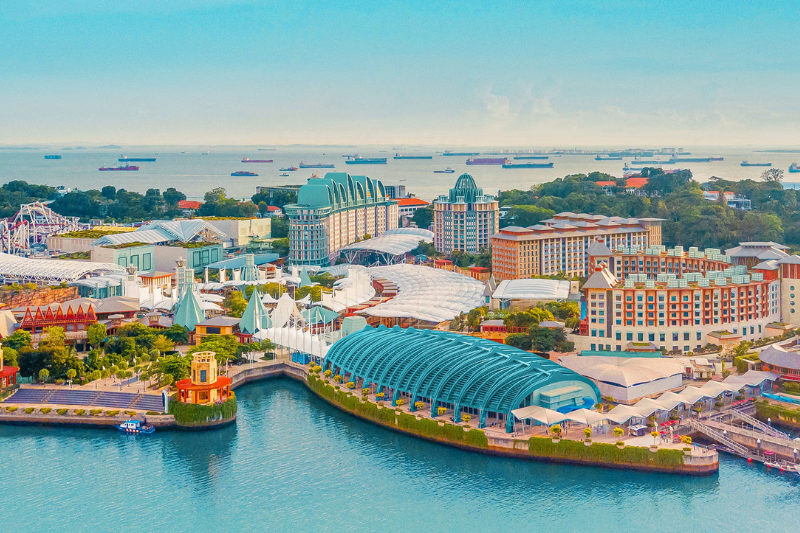
Resorts World Sentosa (RWS) is at the heart of Genting Singapore’s business. Other than RWS’s casino operations, the Singapore tourism landmark also offers hotels, attractions (such as the Oceanarium and Universal Studios Singapore), and retail outlets.
Growth in visitor arrivals and spending in RWS would move the needle for Genting Singapore.
For context, the Singapore Tourism Board is forecasting record-breaking tourist spending in 2026.
The Case for Dividend Sustainability
The bull case supporting Genting Singapore’s dividend payout is the company’s ability to generate consistent positive operating cash flow.
Over the past decade, its operating cash flow has been positive every year – even during the COVID-19 pandemic – and ranged from S$246.5 million to S$1.26 billion.
Crucially, the integrated resort owner has been able to generate higher cash flow than operating earnings.
Next, Genting Singapore’s robust cash position of S$3.2 billion, with zero debt, offers further support to its dividend.
Thirdly, Genting Singapore enjoys a formidable competitive moat, being one of only two integrated resorts in Singapore (Marina Bay Sands being the other), underpinned by strict regulatory requirements.
This favourable position allows Genting Singapore to capture a substantial portion of the economic benefits related to Singapore’s long-term plan of boosting its tourism industry (Tourism 2040).
Finally, Genting Singapore has new initiatives and attractions that were recently launched, including Minion Land at Universal Studios, new restaurants, and malls.
This further strengthens the company’s earnings profile.
Key Financial Metrics Investors Should Examine
Having established the qualitative fundamentals, we now share some key financial metrics worth monitoring for investors.
First, the dividend payout ratio: Is Genting Singapore paying out too much of its earnings and cash flow as a dividend?
Measuring by operating cash flow, the current payout ratio seems decent at 61.1%.
The picture looks less favourable from a free cash flow (FCF) perspective.
Genting Singapore has paid out more in dividends than it generated in FCF, with its payout ratio reaching 228.7%.
In 2025, the company’s revenue slipped 3% to S$2.5 billion while net profit fell to S$450.5 million.
Despite the softer earnings, the company ended 2025 debt-free and with a sizeable cash balance, as mentioned earlier.
What Could Threaten the Dividend?
An economic slowdown that reduces the number of tourists to Singapore and, correspondingly, their spending, could hamper Genting Singapore’s dividend.
Particularly, a sharp gyration in big players’ spending at the casino could hurt the company’s earnings.
As the integrated resort operator expands its offerings, the increase in capital expenditure could also result in significant cash outlay.
Genting Singapore is currently in the midst of its S$6.8 billion RWS 2.0 initiative, which was first announced in April 2019; RWS 2.0 will see the integrated resort’s gross floor area increase by 50% by 2030.
Finally, should the Singapore government decide to crack down on gambling, the company’s revenue from its casino operations could be severely curtailed.
How Genting Compares with Other Income Stocks
Let’s now do a simple comparison against other income stocks, including local real estate investment trusts (REITs) and banks.
Compared with REITs, Genting Singapore is more exposed to the economic cycle, especially relative to defensive names such as the healthcare-focused Parkway Life REIT (SGX: C2PU) and retail-focused Frasers Centrepoint Trust (SGX: J69U).
The trade-off here is that during economic expansions, Genting Singapore could offer higher upside.
Against banks such as DBS (SGX: D05) and OCBC (SGX: O39), Genting Singapore faces similar cyclical exposures.
However, DBS and OCBC both have other operating segments, such as wealth management, that could help cushion against economic downturns.
Overall, Genting Singapore’s near-7% yield is more attractive compared to the average yield offered by the aforementioned REITs and banks, which come at the range of 3%-5%.
What Type of Investor Might Like Genting Singapore?
Income-focused investors could be drawn to Genting Singapore’s attractive yield potential.
The company’s dividend growth since 2022 has been decent too (from S$0.02 per share to S$0.04 per share), which could continue given the solid cash position and the increasing monetisation of its new attractions.
Those looking for exposure to Singapore’s tourism and consumer discretionary spending could also find Genting Singapore attractive.
What Investors Should Watch in Upcoming Results
Do focus on visitor arrivals, gaming revenue trends, and cash flow generation to gauge if Genting Singapore’s operating momentum remains intact.
Management’s commentary on capital allocation and any dividend announcements will also provide important signals regarding the sustainability of its current dividend yield.
Get Smart: Is the Yield Too Good to Ignore?
In summary, while a nearly 7% dividend yield is attractive, you should always look deeper at the business to see if it’s sustainable.
For Genting Singapore, continued cash flow generation, increasing tourist arrivals, and disciplined capital allocation would ultimately determine its dividend sustainability.
One Singapore bank has quietly become one of the strongest income engines in the market. Its dividends have grown at 16.6% a year while others were pulling back. That level of consistency can change a retirement plan entirely. Our FREE 2026 Dividend Game Plan explains why this bank keeps lifting payouts and why many long-term investors rely on it for stable income. Download your free copy today.
Follow us on Facebook, Instagram and Telegram for the latest investing news and analyses!
Disclosure: Wilson H. does not own shares of any companies mentioned.