Singapore’s stock market has had a year worth watching.
The SPDR STI ETF (SGX: ES3), which tracks the Straits Times Index (SGX: ^STI), returned 16.3% year to date.
Most investors would take that gladly.
But eight blue chips did better.
Their total returns ran from the low-40s down to the low-20s, each ahead of the benchmark.
But they did not all get there the same way.
For three of them, the businesses did the pulling.
For the rest, the market appears to have priced something the reported quarter did not obviously show.
Which names ran furthest ahead?
Singapore Exchange (SGX: S68) led with a total return of 43.3%.
OCBC (SGX: O39) returned 36.2%, and Singapore Technologies Engineering (SGX: S63) came in at 33.7%.
Then a second cluster followed: Wilmar International (SGX: F34) at 26.2%, DBS Group (SGX: D05) at 25.2%, Singapore Airlines (SGX: C6L) at 21.2%, United Overseas Bank (SGX: U11) at 20.6%, and SATS (SGX: S58) at 20.3%.
A rising index lifts everything a little.
It does not explain a 43.3% return, and it does not explain how a company whose profit fell still beat the market.
Those answers sit with the individual businesses.
Where did earnings clearly do the work?
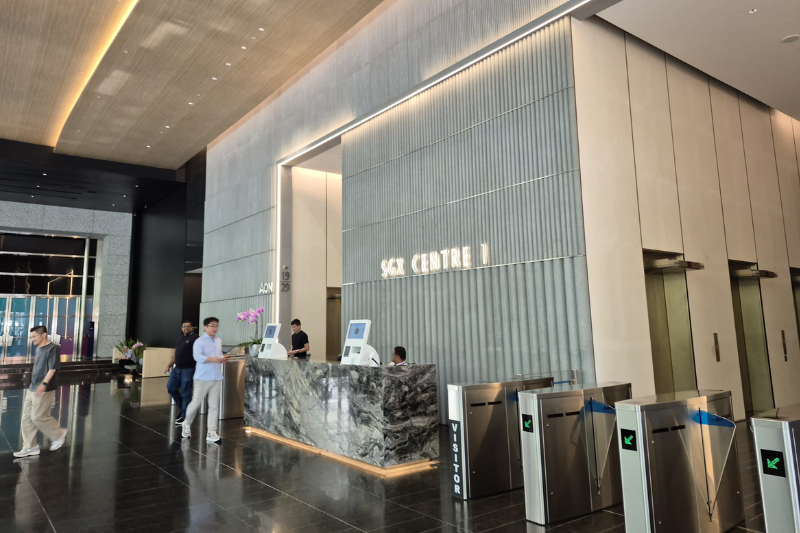
SGX runs Singapore’s only stock market, so when trading activity picks up, the toll-taker collects.
For the first half of its fiscal year to 30 June 2026, net revenue rose 7.6% year on year (YoY) to S$695.4 million.
Reported net profit was almost flat at S$342.7 million, held back by a S$15.0 million goodwill impairment and lower non-operating gains.
Strip those out and adjusted net profit rose 11.6% to S$357.1 million.
Management has committed to lifting the quarterly dividend by 0.25 cents each year to FY2028.
A revenue tailwind paired with a rising, committed payout is the kind of pairing the market tends to reward.
OCBC posted record income while the rate backdrop turned against it.
Total income reached S$3.8 billion in the first quarter of 2026, up 5% YoY, even as net interest income (NII) fell 5% and net interest margin (NIM) compressed 28 basis points to 1.76%.
The bank leaned on the other side of its book.
Non-interest income surged 23% to S$1.6 billion, net fee income rose 24%, and insurance income leapt 34%.
Net profit rose 5% to S$2.0 billion.
The market appears to have concluded that OCBC can grow as rates fall by pivoting towards fees, wealth and insurance.
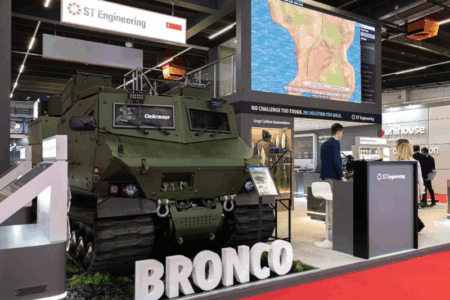
ST Engineering sells into defence, aerospace and urban systems across more than 100 countries, and two of those markets are running hot.
Group revenue climbed 11% YoY to S$3.3 billion in the first quarter of 2026, with all three segments contributing.
The order book is what may have caught the market’s eye: new contract wins of S$4.8 billion lifted the closing order book to S$34.5 billion, of which S$8.0 billion is due for delivery across the rest of the year.
A note of caution belongs here.
First-quarter updates are business snapshots, and the group does not disclose profit or cash flow at this stage.
Management said net profit growth outpaced rebased revenue growth, but the figures behind that claim arrive only with the half-year results.
What about the ones whose profits did not rise?
SATS offers the cleanest case in this second group.
For its fiscal year to 31 March 2026, revenue rose 9.0% YoY to a record S$6.3 billion and net profit climbed 17.0% to S$285.2 million.
Gateway Services led, with revenue up 10.8% and cargo volumes outpacing IATA benchmarks for 10 straight quarters.
The total dividend rose 40% to S$0.07 per share.
Here the earnings and the share price point the same way.
DBS is more nuanced.
Total income edged up 1% to a record S$5.95 billion in the first quarter of 2026, and net profit rose 1% to S$2.93 billion, with return on equity at 17.0%.
NII eased 5% as margins narrowed, but non-interest income rose 10% on record wealth management fees.
The board declared a first-quarter payout of S$0.81 per share, comprising an ordinary dividend of S$0.66 and a Capital Return dividend of S$0.15, up 8% on a year earlier.
The market appears to have rewarded resilience rather than growth.
UOB shows the tension more plainly.
Total income fell 6% YoY to S$3.4 billion and net profit eased 4% to S$1.4 billion.
The bank did not declare a first-quarter dividend, consistent with its semi-annual schedule, so readers should not misread the absence as a cut.
What the market had to weigh instead was reaffirmed full-year guidance and asset quality that held firm, with the non-performing loan ratio improving to 1.5%.
Singapore Airlines reported a 57.4% plunge in net profit to S$1.2 billion for its fiscal year to 31 March 2026.
The headline masks the underlying picture.
Revenue hit a record S$20.5 billion, operating profit surged 39.0% to S$2.4 billion, and free cash flow came in at S$2.5 billion.
Almost the entire profit fall reflected the absence of a S$1.1 billion one-off Vistara gain booked a year earlier, compounded by share of losses from Air India.
The dividend fell to S$0.37 per share from S$0.40.
Investors appear to have separated a one-off-distorted headline from the operating momentum beneath it, though jet fuel costs remain a live headwind into FY2026/2027.
Wilmar closes the run as the most nuanced case.
Revenue rose 21.9% YoY to US$19.8 billion in the first quarter of 2026 on higher volumes and the AWL consolidation, yet net profit fell 22.8% to US$265.6 million.
The decline came mainly from unrealised mark-to-market hedging losses that management expects to reverse in coming quarters.
Net debt fell to US$18.6 billion and net gearing improved to 0.84x.
The market may have read the profit drop as temporary and largely non-cash.
Get Smart: One index, two ways to beat it
There are two roads past the benchmark this year.
Earn visibly more – as SGX, OCBC and ST Engineering did, or convince the market that tomorrow looks better than the last quarter suggested, which is closer to the story at SIA, Wilmar and the banks.
An index hands you both roads at once, the leaders and the laggards averaged together.
Picking the engines is harder, and it carries more risk when a single thesis stumbles: a hedging loss that does not reverse, an order book that thins, a fuel bill that keeps climbing.
The reward this year went to investors who could tell a distorted headline from a weakening business.
Retirement doesn’t happen overnight. It’s built one decision at a time.
We found 6 SGX companies that have paid dividends every year for more than 20 years, through the Global Financial Crisis, COVID-19, and rising interest rates.
If you’re building long-term income for retirement, this free report is a great place to start. Download your copy today.
Follow us on Facebook, Instagram and Telegram for the latest investing news and analyses!
Disclosure: The Smart Investor owns shares of SGX, DBS and OCBC.