The SPDR STI ETF (SGX: ES3), an exchange traded fund that mimics Singapore’s Straits Times Index (SGX: ^STI), returned 13.1% in the first half of 2026.
A respectable showing.
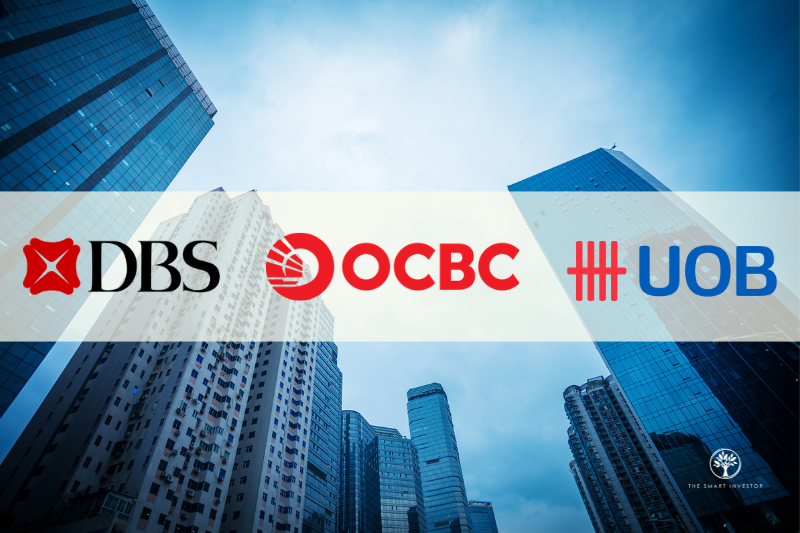
Yet all three of Singapore’s biggest banks left it behind.
Oversea-Chinese Banking Corporation (SGX: O39), or OCBC, led with a total return of 28.2%.
Over the same period, DBS Group (SGX: D05) returned 19.3% while United Overseas Bank (SGX: U13), or UOB, offered a 15% return.
The trio make up the largest components of the 30 index constituents, and all three came out ahead of the benchmark.
Here’s the twist: net interest margins (NIM) are falling during the period.
In other words, margins are being compressed at every bank.
If so, why did these three come out on top?
What powered OCBC to the front?
OCBC delivered a record total income of S$3.8 billion for 2026’s first quarter (1Q2026), up 5% year on year (YoY).
Yet, over the same period, net interest income fell 5% to S$2.2 billion as its net interest margin narrowed 0.28 percentage points to 1.76%.
How? Well, the gains came from everywhere else.
For starters, loans grew 9% YoY on a constant currency basis, cushioning the margin squeeze.
Elsewhere, non-interest income surged 23% to S$1.6 billion, making up more than 40% of total income.
In particular, net fee income rose 24%, led by a 34% jump in wealth management fees.
Not to be outdone, insurance income leapt 34% to S$409 million.
The final conclusion is straightforward.
OCBC proved it could grow income even with a lower NIM.
Investors appear to have paid up for that.
How did DBS hold its ground?
Like OCBC, DBS posted a record total income of S$5.95 billion, up 1% YoY.
The bank’s NIM narrowed 0.23 percentage points to 1.89%, leading to net interest income falling by 5% to S$3.49 billion.
Non-interest income rose 10% to S$2.45 billion on record wealth management fees of S$907 million.
Net profit edged up 1% to S$2.93 billion.
Asset quality improved, with the non-performing loan ratio down to 1%.
DBS was also the only one of the three to raise its dividend this quarter.
The board declared S$0.81 per share, comprising an ordinary dividend of S$0.66 and a Capital Return dividend of S$0.15.
That is 8% higher than the S$0.75 paid for 1Q2025.
For a market rewarding income, a rising payout is a signal dividend investors will not miss.
Why did UOB lag but still beat the index?
UOB is the more nuanced case.
Total income eased 6% YoY to S$3.4 billion.
Net interest income fell 4% to S$2.3 billion as its margin compressed 0.18 percentage points to 1.82%.
The difference from its peers was in non-interest income, which fell 12% to S$1.1 billion.
Net fee income eased 8% as investment banking and loan-related activity moderated.
Net profit declined 4% to S$1.4 billion.
So why a 15% return?
The likely draw was forward-looking rather than backward.
UOB completed its Citi consumer banking integration across Indonesia, Malaysia, Thailand and Vietnam, and now serves more than 8.5 million retail customers across ASEAN.
Management reaffirmed full-year guidance for low single-digit loan growth and high single-digit fee growth.
Investors may have looked past a soft quarter to the enlarged franchise.
A note on the dividends.
Neither OCBC nor UOB declared a payout at 1Q2026.
Both run semi-annual schedules so interim dividends typically land with first-half results.
Get Smart: Did the positives outweigh the negatives?
A single thread runs through all three Singapore banks.
Falling rates squeezed margins everywhere, so the market rewarded the banks that could replace that income from elsewhere.
OCBC did it most convincingly and returned the most.
DBS backed record fee income with a higher dividend.
UOB leaned on an enlarged franchise to carry a softer quarter.
The market may have recognised that fee-driven income tends to be steadier than rate-driven income.
If you hold these banks for the long term, watch whether the non-interest engines keep running as rates settle.
That is where the next leg of returns will be decided.
2008. 2020. 2022. Three of the toughest stretches for Singapore markets in a generation. We found 6 SGX companies that paid a dividend every single year through all three. Our free report reveals the six companies and what allowed them to keep paying when others couldn’t. Click here to download now.
Follow us on Facebook, Instagram and Telegram for the latest investing news and analyses!
Disclosure: Chin Hui Leong owns all the stocks mentioned.