Singapore-listed companies were busy shopping for their own shares in the first quarter of 2026 (1Q2026).
Buybacks hit close to S$560 million, a massive jump from the S$330 million in 1Q2025 and S$232 million in 1Q2024.
Unsurprisingly, the heavy lifting was done by the “Big Three” — Singtel (SGX: Z74), OCBC (SGX: O39), and Keppel (SGX: BN4) — who accounted for nearly four-fifths of the total.
But if you look past these fortress-like blue chips, a few quieter names were also putting their money where their mouth is.
For dividend seekers, share buybacks are like a management “thumbs up” – they signal confidence that the share price is undervalued.
The real question, however, is whether these companies can sustain their payouts.
Let’s look at three non-STI stocks that saw insider buying in 1Q2026 and see if their dividend engines have enough fuel for the long haul.
Credit Bureau Asia (SGX: TCU): The Debt-Free Cash Machine
Credit Bureau Asia isn’t exactly a household name, but it’s a vital “toll booth” operator for our financial system, providing credit data to banks across the region.
For FY2025, the numbers were a bit of a mixed bag.
Revenue grew slightly by 0.7% year on year (YoY) to S$60.1 million, but net profit slipped 4.4% due to lower interest income and higher employee costs.
Where Credit Bureau Asia stands out is its balance sheet.
The group is entirely debt-free.
As at 31 December 2025, it held S$46.5 million in cash plus S$24.7 million in short-term financial assets — a total war chest of S$71.2 million.
Even better, its free cash flow of S$27.2 million was more than enough to cover its dividend.
Management even bumped up the total FY2025 payout to S$0.042.
At a share price of S$1.25, you’re looking at a respectable 3.4% yield.
The company repurchased 89,700 of its own shares in 1Q2026 at an average price of S$1.26.
It’s a modest buyback, but it shows management is comfortable with its cash position.
Just keep an eye on its data segment; if credit activity slows down, growth might stay stuck in low gear.
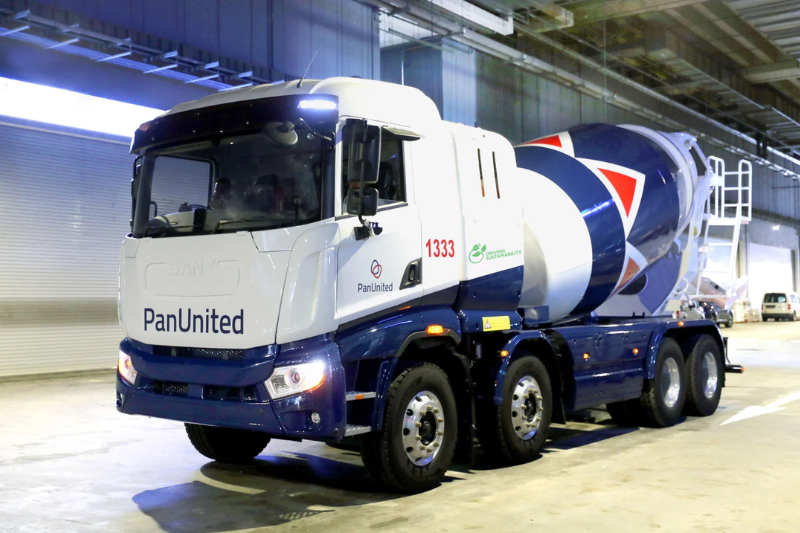
Pan-United Corporation (SGX: P52): Building on Solid Ground?
Pan-United is the big brother of Singapore’s concrete industry.
Business has been brisk thanks to healthy construction activity, with 1H2025 net profit jumping 11% to S$20.6 million.
Management was feeling generous, hiking the interim dividend by 43% to S$0.010.
On the surface, that’s an “umbrella” worth holding onto during a rainy day.
But here’s the caveat: free cash flow actually fell sharply to just S$1.0 million because the company spent heavily on capital projects.
Essentially, the dividend hike was funded by the cash already sitting in the bank rather than the cash generated this past year.
That’s okay for now – Pan-United has a massive S$430 million contract for Changi Airport T5 to keep it busy, but we’ll want to see that free cash flow bounce back in the second half of the year.
The company was quite active in the market, buying back 330,000 shares in 1Q2026 at an average price of S$1.37.
Kimly (SGX: 1D0): More Than Just Your Local Kopi
Kimly is a familiar face, operating 86 food outlets across the island.
While its FY2025 revenue and profit growth were fairly flat, its cash-generating ability remains as steady as your morning kopi order.
Operating cash flow was a robust S$85.3 million.
Although free cash flow dipped to S$55.3 million (it bought two coffee shop properties), the company is in great financial shape.
It has cleared almost all its bank loans and maintained a dividend of S$0.020.
At S$0.39 per share, that’s a tasty 5.1% yield.
In 1Q2026, Kimly repurchased 1.37 million shares.
It’s a clear sign management thinks the business is worth more than the market suggests.
The main hurdle lies with the F&B sector still grappling with a tight labour market and rising costs.
For Kimly to grow, it’ll likely need to keep hunting for new acquisitions rather than just relying on more people buying an extra slice of toast.
Get Smart: Cash is the Ultimate Cushion
Buybacks and dividends both come from the same wallet.
When a company does both, you need to make sure that wallet isn’t running thin.
The good news is that all three of these companies boast net-cash positions and very little debt.
That provides a nice buffer when cash flow gets lumpy.
However, remember that a strong balance sheet is a safety net, not the performance itself.
The best dividend stocks are the ones where the business consistently generates more cash than it knows what to do with.
S$5 billion in government backing. S$1.1 billion already deployed. Singapore’s small-cap market is about to explode, and most people are completely clueless. Our FREE report gives you the inside track on 5 companies positioned to benefit. Download now before the crowd catches on.
Follow us on Facebook, Instagram and Telegram for the latest investing news and analyses!
Disclosure: Calvina L. does not own any of the stocks mentioned. Chin Hui Leong contributed to the article and owns shares of OCBC and Credit Bureau Asia.