Singapore’s blue chips had a rough October.
The SPDR STI ETF (SGX: ES3), which mirrors the Straits Times Index (SGX: ^STI), delivered a total return of negative 5.5% for the month.
When the broader market pulls back like this, it is easy to assume everything on the exchange is sliding down the same slope.
Yet not every stock followed the benchmark lower.
Old Chang Kee (SGX: 5ML), or OCK, delivered a total return of 1.7%.
Civmec (SGX: P9D) returned 1.4%, while Tai Sin Electric (SGX: 500) returned 1.0%.
These are total returns, so they capture dividends as well as share price moves.
Granted, gains of one or two percent might look modest on paper.
But standing in stark contrast to a sea of red across the STI, they naturally catch an investor’s eye.
So what did these three small caps have going for them?
One month proves little on its own.
Look a little closer, however, and each company offers investors something concrete to hold on to when the broader market turns chilly.
What can a curry puff maker offer in a falling market?
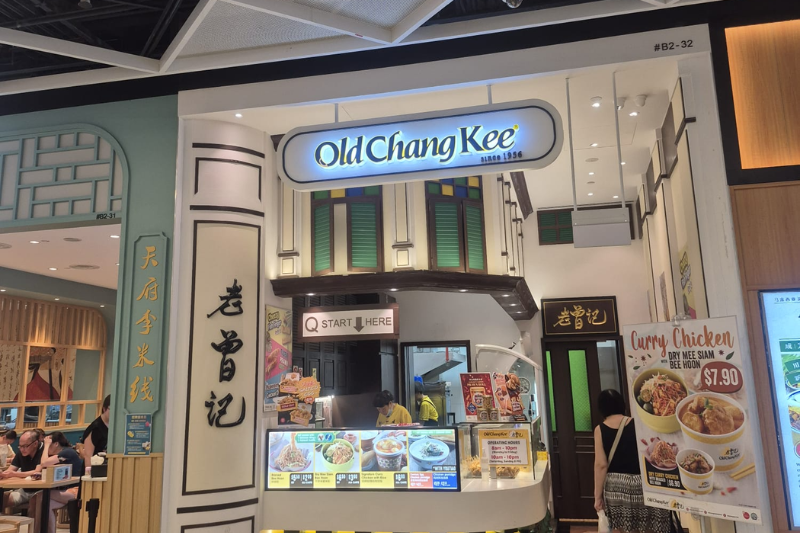
OCK is practically a household name across Singapore, best known for its signature deep-fried curry puffs.
Beyond its familiar retail snack kiosks at high-traffic MRT stations and shopping malls, the group also generates revenue through food delivery, catering services and business-to-business supply channels.
For its fiscal year ended 31 March 2026 (FY2026), OCK grew revenue by 1.5% year on year (YoY) to S$103.5 million.
Profit went the other way.
Net profit attributable to shareholders fell 15.8% YoY to S$9.6 million as wage adjustments, higher depreciation and lower interest income took their toll.
So where’s the comfort for investors?
It’s the cash.
As at 31 March 2026, OCK held S$61.6 million in cash and deposits against just S$1.4 million of debt.
In other words, it had net cash of around S$60 million.
The group also generated S$21.0 million of free cash flow in FY2026, down from S$23.2 million a year earlier.
OCK declared an interim dividend of S$0.01 and proposed a final dividend of S$0.01.
On top of these ordinary dividends, the board proposed a special dividend of S$0.01.
Looking ahead, management expects inflationary pressure and local manpower shortages to remain persistent headwinds.
OCK plans to counter these operational hurdles by tightening cost controls and expanding its non-retail sales channels.
Can Civmec’s order book carry the momentum?
Civmec, headquartered in Henderson, Western Australia, provides engineering, construction and naval shipbuilding services to the energy, resources, infrastructure, and marine and defence sectors.
For the first quarter of its fiscal year ending 30 June 2027 (1QFY2027), Civmec grew revenue by 70.2% YoY to a record A$324.0 million, up from A$190.4 million a year earlier.
Net profit after tax surged 75.2% YoY to A$18.4 million.
The group’s construction division spearheaded this rapid expansion as major project work for resource giants like BHP Group Limited and Iluka Resources Limited ramped up significantly.
The order book gives investors a view of the work ahead.
It stood at around A$1.4 billion at the end of the quarter, up from A$1.15 billion a year prior.
Building on that momentum, the group announced on 5 October 2026 that it had secured additional contract awards and extensions worth over A$220 million.
Shareholders also received Civmec’s final dividend of A$0.035 per share for FY2026 on 23 October 2026, bringing total dividends declared for that financial year to A$0.060.
Investors should keep two gaps in view.
The quarterly update didn’t include a cash flow statement or balance sheet, so the quarter’s free cash flow remains unknown.
Management also gave no financial guidance for FY2027.
Why might investors look past Tai Sin’s profit slump?
Tai Sin makes and distributes electrical cables and wires across Southeast Asia.
It also runs electrical-product distribution, testing and inspection and renewable energy businesses.
For its fiscal year ended 30 June 2026 (FY2026), Tai Sin grew revenue by 24.2% YoY to S$597.2 million.
Its renewable energy division, acquired back in November 2025, made an immediate impact by contributing S$59.8 million to that revenue total.
Profitability, however, took a severe hit.
Net profit attributable to equity holders plunged 56.8% YoY to S$11.2 million.
Here’s the thing: most of the damage came from a S$23.1 million provision for onerous contracts.
Tai Sin had signed long-term, fixed-price cable contracts when copper was cheaper.
Copper prices have since risen and those contracts now lose money.
The good news?
The provision is a non-cash charge, so cash flow held up.
Operating cash flow staged a dramatic recovery to S$16.7 million, reversing an outflow of S$5.2 million a year earlier.
Free cash flow similarly swung back into positive territory at S$9.0 million, compared with negative S$9.9 million in FY2025.
That matters, because free cash flow is what ultimately pays for dividends.
Tai Sin kept its final dividend unchanged at S$0.016 per share, leaving its total full-year dividend steady at S$0.0235 per share.
The risks are real, though. Bank borrowings rose to S$106.2 million from S$84.4 million as the group paid for its acquisition and pricier copper.
As at 30 June 2026, Tai Sin had S$44.6 million in cash.
Further increases in copper prices could also trigger more provisions.
Get Smart: Test the anchor, not the month
It feels good to own a stock that made money while the STI ETF lost 5.5%.
But one good month tells you very little about the next.
A better question is how much weight each anchor can bear.
OCK’s cash already sits on its balance sheet, while Civmec still has to deliver on its order book.
Tai Sin’s cash flow improved, but its borrowings and copper exposure grew too.
So before you buy a stock just because it held up in a bad month, ask yourself this: if the STI keeps sliding, which of these anchors would you still trust?
What if you could collect a steady income from Singapore companies for decades to come? We found one in a near-duopoly with 70%+ market share that’s practically printing money. Our FREE small-cap report uncovers this “hidden monopoly” advantage (plus 4 other dividend powerhouses) that will keep paying no matter what the market does. Click here to grab your copy now.
Follow us on Facebook, Instagram, Telegram and YouTube for the latest investing news and analyses!
Disclosure: Calvina L. does not own shares in any stocks mentioned. Chin Hui Leong contributed to this article and does not own shares in any stocks mentioned.