November is dividend month for three SGX small caps.
A dividend cheque tells you what a company paid, but it will not tell you whether the business can do it again next year.
For that, we need to look at cash flow and the balance sheet.
On those metrics, these three businesses could not be more different.
If you are already a shareholder, here is when the cash lands.
| Company | Ticker | Dividend payment date |
|---|---|---|
| Micro-Mechanics (Holdings) Ltd | SGX: 5DD | 17 November 2026 |
| Tiong Woon Corporation Holding Ltd | SGX: BQM | 18 November 2026 |
| Tai Sin Electric Limited | SGX: 500 | 27 November 2026 |
Can Micro-Mechanics fund its growth and its dividend at the same time?
Micro-Mechanics (Holdings) Ltd (SGX: 5DD) makes precision tools and parts used in semiconductor manufacturing.
In the financial year ended 30 June 2026 (FY2026), revenue rose 15.8% year on year (YoY) to S$75.5 million.
Profit grew even faster, as profit attributable to owners climbed 28.3% to S$15.9 million.
Shareholders didn’t get a raise, though.
The board kept the total dividend at S$0.06 per share, unchanged from the prior year.
The November payment forms part of that total, and the payout ratio stands at 52.4%.
Is the dividend covered? Yes.
Free cash flow of S$16.8 million was higher than the year’s profit.
The latest quarter was a record.
In the three months to 30 September 2026 (1QFY2027), revenue rose 45.0% YoY to S$24.2 million, while net profit more than doubled to S$6.4 million.
Cash didn’t keep pace.
Free cash flow fell 10.6% YoY to S$3.7 million as receivables, tax payments and capital expenditure rose.
The company still held S$33.3 million in cash and had no bank borrowings at the end of September.
It will need some of that cash, as it plans to spend S$12.0 million in FY2027 to expand its manufacturing footprint and upgrade its equipment.
The spending supports a five-year goal of at least S$150 million in revenue, roughly double FY2026 levels.
In other words, the flat dividend may be the board’s way of keeping cash in hand for growth.
Can Tiong Woon sustain a 43% dividend increase?
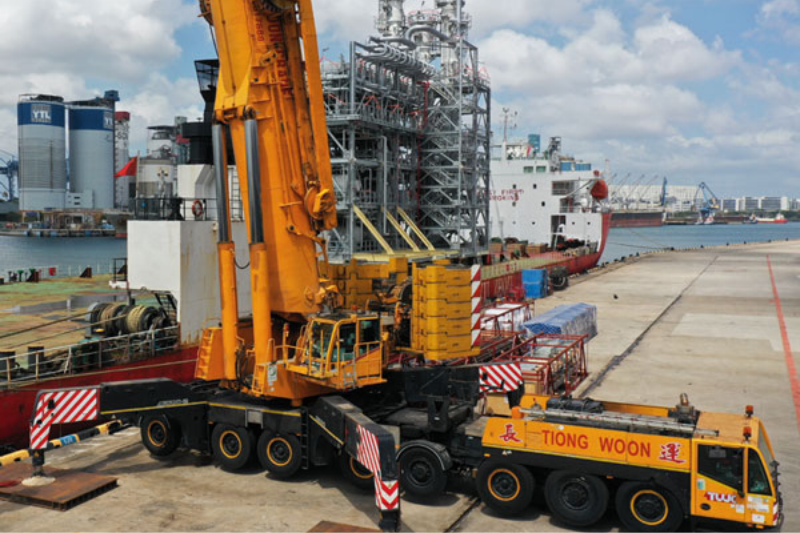
Tiong Woon Corporation Holding Ltd (SGX: BQM) is an integrated heavy-lift specialist, with crane and transport hire making up 96% of its revenue.
In FY2026, revenue rose 15% YoY to S$187.7 million, and profit attributable to shareholders grew 24% YoY to S$23.9 million.
Gross margin widened to 40.7% from 37.6%.
Shareholders got a bigger slice, as the board proposed a final dividend of S$0.025 per share, up 43% from S$0.0175 a year ago.
Put simply, the dividend grew faster than profit.
Where did the money come from?
Free cash flow climbed to S$43.7 million from S$6.3 million a year ago.
Operating cash flow grew 31%, and cash spent on equipment nearly halved.
Here’s the thing: a crane company needs cranes.
Management plans to keep renewing and expanding its fleet.
If spending picks up, free cash flow could fall below this year’s level.
Tiong Woon also carries more debt than cash.
As of 30 June 2026, it held S$86.6 million in cash and bank deposits against S$108.0 million in debt, excluding lease liabilities.
For context, the Building and Construction Authority projects S$47 billion to S$53 billion in construction demand for 2026 and expects S$39 billion to S$46 billion a year from 2027 to 2030.
Management expects demand to hold up, despite intensifying competition and high costs.
Why did Tai Sin hold its dividend when profit more than halved?
Tai Sin Electric Limited (SGX: 500) makes and distributes electrical cables and wires across Southeast Asia.
In November 2025, it bought Integra R.E., a renewable energy equipment distributor.
In FY2026, Tai Sin’s revenue climbed 24.2% YoY to S$597.2 million.
The new renewable energy unit added S$59.8 million over part of the year.
Profit went the other way.
Net profit attributable to shareholders fell 56.8% YoY to S$11.2 million.
Copper explains most of the damage.
Tai Sin booked a S$23.1 million provision for onerous contracts, having signed the long-term, fixed-price cable contracts when copper was cheaper.
Rising copper prices have made them loss-making.
A one-off S$4.0 million bargain purchase gain softened the blow.
The provision is a non-cash charge, so Tai Sin’s cash flow held up.
Operating cash flow swung to an inflow of S$16.7 million from an outflow of S$5.2 million, while free cash flow reached S$9.0 million, reversing the prior year’s negative S$9.9 million.
The board held the line, proposing a final dividend of S$0.016, unchanged from a year ago.
The full-year payout stays at S$0.0235.
On the flip side, borrowings climbed to S$106.2 million from S$84.4 million, against S$44.6 million in cash.
The extra debt funded the acquisition, the new unit’s inventory and pricier copper.
Copper remains the wild card.
Further price moves could trigger more provisions, or reverse the existing one.
Get Smart: Ask where the cash came from
Free cash flow fuels dividends, so don’t just stop at the headline number.
Ask how the company got there.
Tiong Woon’s free cash flow rose partly because it spent less on equipment.
Micro-Mechanics shows the opposite: its free cash flow fell in the latest quarter, even as profit doubled.
So when a company raises or holds its dividend, try a simple test.
Imagine capex back at its usual level.
Would the cash still cover the payout?
If the answer is yes, and the balance sheet can carry a lean year, you’ve found a dividend with staying power.
What if you could collect a steady income from Singapore companies for decades to come? We found one in a near-duopoly with 70%+ market share that’s practically printing money. Our FREE small-cap report uncovers this “hidden monopoly” advantage (plus 4 other dividend powerhouses) that will keep paying no matter what the market does. Click here to grab your copy now.
Follow us on Facebook, Instagram, Telegram and YouTube for the latest investing news and analyses!
Disclosure: Calvina L. does not own any stocks mentioned. Chin Hui Leong contributed to this article and owns shares in Micro-Mechanics.