The best stock for a long-term portfolio isn’t always the one with the best share price run.
So, what should you look for, and could one portfolio hold three very different companies?
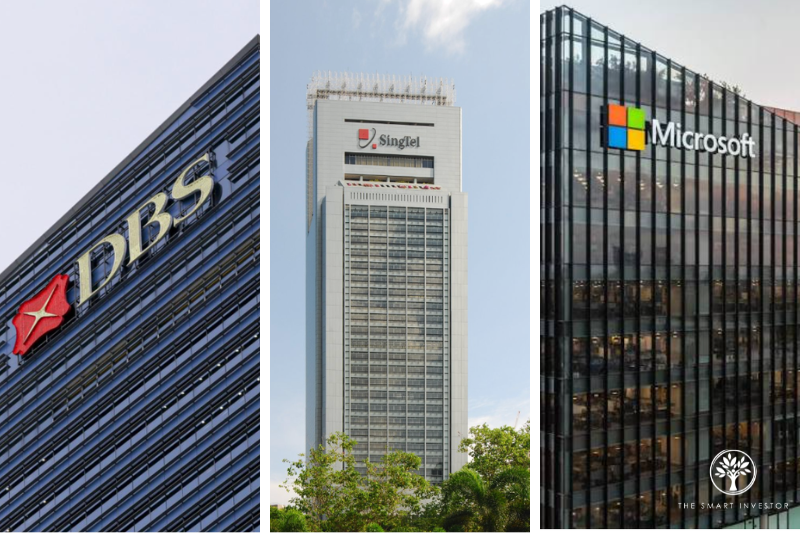
DBS Group Holdings Ltd (SGX: D05) is Singapore’s biggest bank.
Singapore Telecommunications Limited (SGX: Z74), or Singtel, runs telcos here and in Australia, and owns stakes in phone companies around the region.
Microsoft Corporation (NASDAQ: MSFT) is the US software giant behind Windows and the Azure cloud.
They do quite different jobs in a portfolio.
DBS and Singtel are mainly there for the dividends, while you’d own Microsoft for growth.
DBS: A Dividend-Paying Banking Powerhouse
Start with the one that is a favourite among Singapore investors.
DBS has operations spread across Asia, and it is very good at making money.
In its latest results, for the first half of 2026 (1H2026), the bank earned a record net profit of S$6.01 billion.
Crucially, this was achieved with a stunning return on equity (ROE) of 17.9%, which is the best among the three local banks.
DBS’s wealth management business helped, with fees from affluent clients hitting a record S$1.83 billion.
That money flowed back to shareholders.
Over the last twelve months (LTM), DBS returned S$3.18 per share in dividends to shareholders (of which S$0.60 per share was a capital return, with the rest being ordinary dividends).
That works out to a trailing yield of 4.3%.
DBS can afford it.
Its capital cushion, the common equity tier 1 (CET1) ratio, is healthy at 14.6%. and only 1.0% of its loans have gone bad.
Falling interest rates are the main risk for DBS investors.
Banks earn less on the loans they disburse when rates decline.
DBS is not immune to this, although loan growth and fee income from areas such as wealth management can help cushion the impact.
Slower loan growth and rising credit costs could also weigh on the bank’s earnings.
The key takeaway is that DBS is a fine choice if you’re seeking dividends from an established bank, as long as you accept the interest-rate and economic risks that accompany it.
Singtel: A Combination of Dividends and Regional Growth
Singtel is a different animal.
People keep paying phone and internet bills whatever the economy does, and that steady stream is what the company is built on.
It runs telcos in Singapore and Australia (the latter through Optus).
Ownership stakes in telcos across the region, such as Airtel in India and AIS in Thailand, provide further geographical diversification.
For the financial year ended 31 March 2026 (FY2026), Singtel generated S$2.44 billion in free cash flow.
In the three months to 30 June 2026 (1QFY2027), Singtel’s regional stakes earned S$543 million in profit after tax, up 16% year on year (YoY).
Its data centre arm, Digital InfraCo, grew its top line by 19%, and Optus lifted its EBIT (earnings before interest and taxes) by 14%.
Consequently, Singtel’s underlying profit rose 21% from a year ago to S$831 million.
The dividend needs a careful read.
Singtel paid S$0.185 per share for FY2026, but only S$0.134 per share was a regular dividend.
The other S$0.051 came from selling assets, something that can’t go on forever.
Singtel still has about S$2.25 billion in planned asset disposals to complete, after which the additional payout might cease.
At current prices, this translates to a dividend yield of 4.5%.
The risks for the telco giant include intensifying competition for its telco operations and capital expenditure needed to grow its data centre business.
Currency swings are something to pay attention to as well.
On balance, Singtel gives you steady telco cash flow and a slice of the digitalisation and data centre boom.
However, as noted above, its extra dividend payout could be curtailed once its asset disposal programme runs its course.
Microsoft: A Global Technology Growth Engine
Microsoft is the odd one out.
It pays a dividend, but investors buy it for growth.
Much of its revenue recurs.
Businesses pay for Microsoft 365 through subscriptions, while Azure, its cloud platform, bills them for what they actually use.
Microsoft says what sets Azure apart is the hybrid cloud architecture, which lets companies run their own servers alongside it.
Artificial intelligence (AI) has given Azure a real push.
In the first quarter of its FY2027 (1QFY2027), Azure revenue grew 48% YoY, while total revenue rose 19% YoY to US$92.3 billion.
The catch is how much Microsoft is spending to keep up.
It put US$115.9 billion into property and equipment in FY2026, and it hasn’t slowed down since.
Capital spending hit US$46 billion in 1QFY2027, which knocked free cash flow down to US$18.6 billion.
Shareholders weren’t left out, though.
Microsoft still handed back US$10.2 billion through dividends and buybacks in the quarter, and the hope is that all this spending shows up as bigger profits a few years from now.
You do pay for that growth.
Microsoft trades at about 27 times forward earnings.
The dividend was recently raised 8% to US$0.98 a quarter, but that still only works out to a yield of about 0.75%.
This valuation leaves little room for error, given strong competition from rival cloud providers and AI model makers.
Microsoft may appeal to investors prioritising long-term capital appreciation, although its relatively low dividend yield makes it less suitable for those seeking substantial immediate income.
Should You Own All Three in One Portfolio?
You could, and the mix makes sense.
Banks, telcos and tech companies tend to behave differently.
DBS and Singtel provide reliable dividend income (reinvesting payments received can further turbocharge your compounding journey), while Microsoft provides a stronger growth angle for the portfolio.
But three stocks alone aren’t a portfolio.
Both DBS and Singtel depend heavily on the region, so if the region slows down, you’d feel it in both at once.
Microsoft brings a different problem: it earns in US dollars, leaving you exposed to currency swings.
It’s better to see these three as a starting point, not your whole portfolio.
Get Smart: Different Stocks, Different Roles
So which stock should you pick?
That is the wrong question.
Instead, ask what your portfolio is missing.
If you need income, DBS and Singtel do the heavy lifting.
If you want growth, Microsoft is the one.
Each does a different job, and a good portfolio needs more than one of them.
2008. 2020. 2022. Three of the toughest stretches for Singapore markets in a generation. We found 6 SGX companies that paid a dividend every single year through all three. Our free report reveals the six companies and what allowed them to keep paying when others couldn’t. Click here to download now.
Follow us on Facebook, Instagram, Telegram and YouTube for the latest investing news and analyses!
Disclosure: Wilson H. does not own shares in any of the companies mentioned.