Mention that a stock yields 5% and income investors’ ears perk up.
While a 5% yield is nice, smart investors know the critical question to ask is: how did it get there?
Sometimes the payout grew.
Other times, the share price slumped, and a dividend cut may be next.
In this article, we examine five different Singapore names that carry a yield of more than 5% to answer a simple question: is the 5% sustainable?
Latest Dividend / Distribution Per Unit
| Stock / Ticker | Dividend / DPU | Yield |
|---|---|---|
| Venture Corporation Limited (SGX: V03) | S$0.80 (TTM) | 5.3% |
| CapitaLand Integrated Commercial Trust (SGX: C38U) | S$0.1198 (FY2025) | 5.2% |
| ComfortDelGro Corporation Limited (SGX: C52) | S$0.085 (FY2025) | 6.7% |
| United Hampshire US REIT (SGX: ODBU) | US$0.0446 (TTM) | 10.4% |
| Coliwoo Holdings Limited (SGX: W8W) | S$0.03 (TTM) | 8.6% |
Dividend/DPU data are based on trailing 12 months (TTM) as at 30 October 2026, unless otherwise indicated.
Venture Corporation Limited (SGX: V03) – The Blue-Chip Income Play
At around S$15, Venture’s shares are about 20% below its 52-week high of S$18.75 and offer a trailing dividend yield of 5.3%.
The electronics manufacturer has paid an annual dividend since 1992.
Its ordinary dividend has held at S$0.75 since FY2021.
In FY2025, a one-off special dividend of S$0.05 lifted the total to S$0.80.
The FY2025 dividend consumed 101% of the year’s earnings.
Likewise, free cash flow (FCF) of S$226.3 million fell short of the dividend payment of S$230.2 million.
Hence, the small shortfall was covered by Venture’s net cash of S$1.11 billion (as at 30 June 2026).
Looking forward, management highlights strong demand from networking, test equipment and chip equipment customers, which, if sustained, could bring Venture’s payout back within earnings and FCF.
While an earnings decline could further stretch its payout ratio, Venture’s healthy cash level can plug this gap while waiting for a rebound in earnings.
Overall, the payout is stretched, but Venture’s business appears to be resilient given net profit rose 5.6% in 1H2026.
CapitaLand Integrated Commercial Trust (SGX: C38U), or CICT – The Defensive High Yielder
CICT’s units currently trade around S$2.28, which is not far off its yearly high of S$2.31.
Distribution per unit (DPU) growth has supported CICT’s high yield: for the six months ending 30 June 2026 (1H2026), CICT recorded DPU growth of 7.1% to S$0.0602.
This continues the trend of steadily increasing distributions since the recovery from the COVID-19 pandemic.
In the third quarter of 2026 (3Q2026), Singapore’s largest real estate investment trust (REIT) continued to report stable overall portfolio occupancy at 96.1% while enjoying healthy rental reversions for its retail and office assets.
Gearing rose to a manageable 39.7% after the Paragon acquisition, with a healthy weighted average debt maturity of 4.2 years.
Future growth for CICT is likely to come down to new accretive acquisitions and further asset enhancement initiatives.
The main thing to watch for would be a slowdown in the local economy given a significant portion of its portfolio is located in Singapore.
For investors seeking quality income from a defensive stalwart, look no further than CICT.
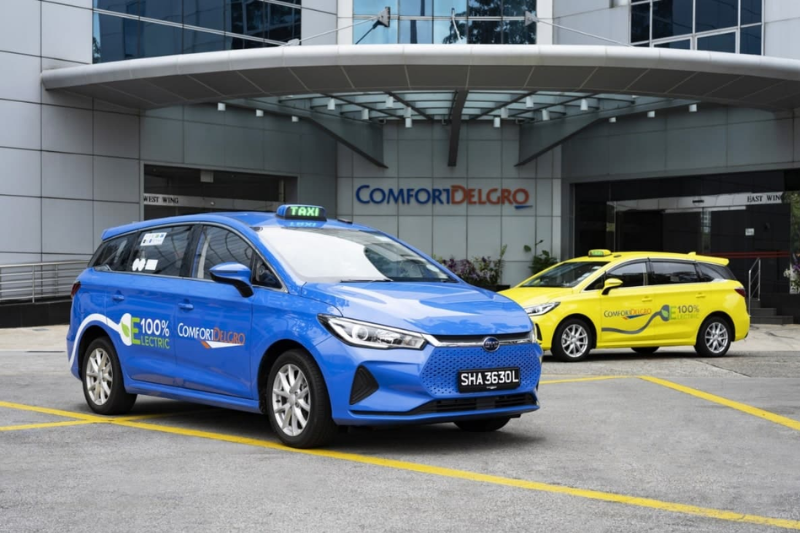
ComfortDelGro Corporation Limited (SGX: C52) – High Yield, But Earnings Are Pressured
At roughly S$1.27, ComfortDelGro’s trailing yield stands at 6.7%, given it paid S$0.085 per share in dividends.
However, its latest 1H2026 results (for the six months ended 30 June 2026) leave much to be desired.
While the top line posted a steady 5.7% increase to S$2.6 billion, operating profit fell 17.3% as its taxi and private-hire business faced stiffer competition, cautious consumer spending and weaker UK corporate demand.
FCF for the half tells a more positive story, swinging from 1H2025’s negative S$229.9 million to a positive S$45.6 million on lower capital expenditure.
At a payout ratio of 99.5%, ComfortDelGro has limited headroom to increase its payout, especially given its net debt position of S$903.6 million.
Looking ahead, the renewal of its London public bus contracts at improved margins, potential wins in the ongoing Liverpool and West Yorkshire bus franchise tenders and local fare adjustments could help support earnings and dividends.
ComfortDelGro trades at a price-to-earnings (P/E) ratio of about 13.9x its trailing earnings, inline with its five-year historical average.
For the dividend to grow again, ComfortDelGro needs to see a turnaround in earnings and continued recovery in FCF.
United Hampshire US REIT (SGX: ODBU), or UHREIT – The High-Yield REIT
At US$0.43, UHREIT yields 10.4% given the US$0.0446 in distributions over the last year.
Part of the elevated yield is due to a sell-off from its 52-week high of US$0.57 on 26 February 2026.
As at 30 June 2026 (1H2026), its US grocery-anchored centres were 97.6% occupied, with a weighted average lease expiry (WALE) of 7.9 years.
Some of its notable tenants include consumer staple names such as BJ’s Wholesale Club (NYSE: BJ) and Koninklijke Ahold Delhaize N.V. (AMS: AD).
Built-in rental escalations have contributed to DPU growth of 3.4% to US$0.0216.
Net leverage seems reasonable at 39.7%, with an interest coverage ratio (ICR) of 2.4x.
Cost of debt stood at 4.89%.
Its weighted average debt maturity is short, at 2.9 years; refinancing at higher interest rates could further pressure its interest coverage, though nothing is due until February 2028.
On balance, the rent is recurring, but thin interest coverage is something to be mindful of.
Coliwoo Holdings Limited (SGX: W8W) – The Contrarian Income Opportunity
Colliwoo’s shares trade at around S$0.35, below its listing price of S$0.60 in November 2025.
At that price, the S$0.03 in dividends paid over the past year translates into an 8.6% yield.
Operationally, the co-living business is faring well.
Revenue and profits have been climbing, while occupancy rates for its rooms have held firm at above 90%.
FCF of S$9.8 million for the half ended 31 March 2026 (1HFY2026) covers the S$9.6 million in dividends paid.
Leverage is the concern.
Gearing is elevated at 57.2% (as at 31 March 2026) as debt rose to S$259.5 million on property purchases.
However, Coliwoo has been divesting assets to address its elevated leverage.
The sell-off seems harsh for a business still chugging along fine, but until it deleverages further, the yield carries risk here, especially given the thin dividend coverage.
Are 5%+ Yields Sustainable?
Warning signs usually appear before a cut.
Watch for dividends that swallow nearly all of a company’s profit or FCF.
Rising debt or a deterioration in occupancy and rental reversions for REITs could foretell a payout cut.
Remember to check a company’s history over several years to better gauge its payout sustainability.
Get Smart: Look Beyond the 5% Yield
All five names pay well, but the risks differ widely.
Venture and CICT are the sturdiest.
ComfortDelGro requires an earnings recovery, while UHREIT and Coliwoo have softer balance sheets.
Before buying, check several years of payouts and the earnings and FCF behind them.
Watch out for debt as well.
A steady 5% from a growing business trumps a 10% yield that gets cut.
Start with a payout a business can comfortably afford.
One Singapore bank has quietly become one of the strongest income engines in the market. Its dividends have grown at 16.6% a year while others were pulling back. That level of consistency can change a retirement plan entirely. Our FREE 2026 Dividend Game Plan explains why this bank keeps lifting payouts and why many long-term investors rely on it for stable income. Download your free copy today.
Follow us on Facebook, Instagram, Telegram and YouTube for the latest investing news and analyses!
Disclosure: Wilson H. does not own shares or units in any of the companies mentioned.