A company can pay out more than it earns for a while, but for how long?
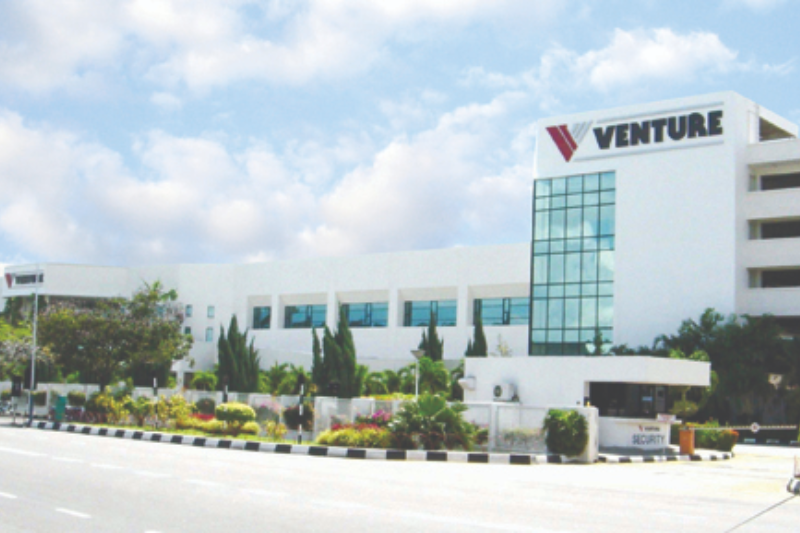
Venture Corporation Limited (SGX: V03) is an established Singapore electronics manufacturer.
The company has paid a dividend every year since its listing in 1992.
Now, where is the dividend coming from: the earnings or its balance-sheet cash?
Let’s find out.
Venture Corporation Dividend History
| Financial year (ending 31 December) | Earnings per share (S$) | Dividend per share (S$) | Payout ratio |
|---|---|---|---|
| FY2021 | 1.07 | 0.75 | 70% |
| FY2022 | 1.27 | 0.75 | 59% |
| FY2023 | 0.93 | 0.75 | 81% |
| FY2024 | 0.85 | 0.75 | 88% |
| FY2025 | 0.79 | 0.80 | 101% |
Venture has paid at least S$0.75 per share every year since FY2020.
That includes FY2023, when net profit fell about 27% year on year (YoY).
In FY2025, the dividend went up to S$0.80 thanks to a one-off special dividend of S$0.05 paid alongside the interim dividend.
At current prices, Venture offers a trailing annualised yield of about 5.3%.
The company’s latest interim dividend stood at S$0.30 per share, unchanged from FY2025.
Now, there is no fixed dividend payout policy; instead, management says it is committed to enhancing shareholder returns.
How Strong Is Venture’s Cash Position?
As at 30 June 2026 (1H2026), Venture had net cash of S$1.11 billion (zero debt), making up roughly 25% of its market capitalisation.
Cash grew from S$807.9 million at end-FY2021 to S$1.28 billion at end-FY2025.
At a dividend per share of S$0.80, it costs Venture roughly S$230 million a year to keep its stable payout.
That works out to roughly 4.8 years of payments given its current net cash position.
But cash on the balance sheet is flexibility, not a promise.
A manufacturer requires cash to fund its working capital and to also support growth investments.
Can Venture’s Earnings Support Its Dividends?
Earnings are recovering slowly; revenue rose 7.4% YoY to S$1.35 billion, and net profit increased 5.6% to S$119.3 million.
Consequently, earnings per share (EPS) came in at S$0.414, up from S$0.392.
The mix matters: in 2Q2026, networking, test and measurement, and chip equipment customers lifted revenue by 25.7%, offsetting an 8.5% decline in life science, MedTech and consumer products.
Crucially, net margin eased to 8.8% (1H2025: 9.0%).
As seen in the table, Venture’s payout ratio was 101% in FY2025, meaning it paid out slightly more than it earned.
Worryingly, this also continues the trend over the last few years of increasing payout ratios.
That is fine for a year or so, but not indefinitely.
What happens if the company maintains its payout but earnings decline?
A 10% decline in EPS would push the payout ratio to 113% and leave a S$26 million yearly gap between earnings and dividends.
A 20% decline would push the payout ratio to 127% and leave an annual shortfall of S$49 million.
A short dip is easy to survive.
A long slump is different.
The cash would last, but it would shrink each year, and the board would face a choice between a cut and a smaller safety net.
Free Cash Flow: The Real Test of Dividend Sustainability
| S$ million | Operating Cash Flow (OCF) | Capital Expenditure (Capex) | Free Cash Flow (FCF) | Dividends paid | FCF coverage of dividends |
|---|---|---|---|---|---|
| FY2021 | 101.8 | (10.8) | 91.0 | 217.8 | 0.4x |
| FY2022 | 269.1 | (32.7) | 236.4 | 218.1 | 1.1x |
| FY2023 | 521.4 | (47.5) | 473.9 | 218.2 | 2.2x |
| FY2024 | 482.5 | (16.6) | 466.0 | 217.5 | 2.1x |
| FY2025 | 251.5 | (25.2) | 226.3 | 230.2 | 1.0x |
| Last-twelve-months (LTM) | 114.7 | (26.7) | 88.0 | 230.1 | 0.4x |
Over five years, free cash flow of S$1.49 billion covered S$1.10 billion of dividends.
But two bumper years did the heavy lifting.
FY2025 fell just short, and the past 12 months fell well short.
In 1H2026, operating cash flow was just S$12.9 million, because Venture built up inventories to support growth.
Cash fell S$175 million in six months.
Paying out more than the business generates can’t go on forever.
At the current shortfall of about S$142 million a year, the pile would last about eight years.
Not a crisis, but no free lunch either.
What Could Support Venture’s Future Dividend Growth?
Demand looks better.
Management says customers’ feedback shows demand continuing to strengthen in networking and communications, test and measurement, and chip equipment.
Earlier this year, it linked that demand to strong growth in hyperscale data centres.
Revenue for 2Q2026 rose 12.5% YoY.
Venture is also pushing into higher-value work such as life science.
Its engineering skills and customer ties help, but margins haven’t improved yet.
Spending plans look light; inventory is a bigger call on cash than any potential acquisitions for now.
Is Venture Still an Attractive Dividend Stock at Today’s Price?
| Valuation Metric | Venture | DBS Group Holdings Ltd (SGX: D05) | Singapore Telecommunications Limited (SGX: Z74), or Singtel |
|---|---|---|---|
| Trailing dividend yield | 5.3% (5.0% on ordinary dividends) | 3.6% | 3.3% |
| LTM Price-to-earnings (P/E) | 18.6x | 16.7x | 20.7x |
| Price-to-Book (P/B) | 1.6x | 3.0x | 2.6x |
As at 27 October 2026. (Source: Fiscal.ai)
At S$15.03, Venture yields 5.3% (including the special dividends).
That beats Singtel’s 3.3% and DBS’s 3.6% on ordinary dividends.
A high yield can mean investors expect a cut, and a 99% payout of the past 12 months’ earnings gives them a reason to.
The valuation doesn’t show that fear.
Venture trades at 18.6x its earnings over the past 12 months.
That sits between DBS’s 16.7x and Singtel’s 20.7x.
Its P/B ratio is 1.6x, against 3.0x for DBS and 2.6x for Singtel, though a bank and a telco hold very different assets.
Strip out the S$3.86 a share of net cash and the business trades at about 14 times earnings.
On FY2022’s peak earnings of S$1.27 a share, today’s price would be just 12x.
So the price already factors in the cash and some recovery.
It isn’t a bargain.
The dividend case strengthens if earnings per share climb back near S$1.00, which would bring the payout to about 80%.
FCF also needs to stay above the S$230 million dividend bill for a full year.
The warning signs are a payout above 100% for a second year, net cash under S$1 billion and another year of weak cash flow.
Get Smart: Cash Reserves Buy Time, but Earnings Sustain Dividends
The dividend is sustainable for the next few years, but only because of the cash.
Net cash covers about five years of payments, and even a 20% drop in earnings would leave a manageable gap.
It is not yet self-funded.
The payout ratio was 101% in FY2025 and about 99% over the past 12 months, and FCF covered just 0.4 times the past year’s dividends.
A recovery in customer orders could change that, and 1H2026 growth is a good start.
If it stalls, the cash pile is the only thing holding the S$0.80 up.
Watch FCF in the next results before leaning on the yield.
Retirement doesn’t happen overnight. It’s built one decision at a time.
We found 6 SGX companies that have paid dividends every year for more than 20 years, through the Global Financial Crisis, COVID-19, and rising interest rates.
If you’re building long-term income for retirement, this free report is a great place to start. Download your copy today.
Follow us on Facebook, Instagram, Telegram and YouTube for the latest investing news and analyses!
Disclosure: Wilson H. does not own shares in any of the companies mentioned.