Dividend / Distribution Yield
| Company Name | Stock Ticker | Latest Dividend / Distribution | Dividend / Distribution Yield |
|---|---|---|---|
| Mapletree Logistics Trust | SGX: M44U | S$0.01816 (2QFY2027 DPU) | 6.8% |
| Genting Singapore Limited | SGX: G13 | S$0.02 (1H2026 Interim) | 6.7% |
| Frasers Logistics & Commercial Trust | SGX: BUOU | S$0.0295 (1HFY2026 DPU) | 6.6% |
Yields are based on closing prices on 29 October 2026 and distributions or dividends declared over the past 12 months.
A high dividend yield is easy to spot.
Working out what pays for it takes more work.
Mapletree Logistics Trust (SGX: M44U), or MLT, Genting Singapore (SGX: G13) and Frasers Logistics & Commercial Trust (SGX: BUOU), or FLCT, all offer high yields at today’s prices.
Each one pays for its dividend in a different way, and that tells you more than the headline number.
Can MLT hold its DPU while it sells assets?
MLT owns 172 logistics properties across nine Asia-Pacific markets, with assets under management of S$13.1 billion as at 30 September 2026.
In the second quarter of its fiscal year ending 31 March 2027 (2QFY2027), MLT grew gross revenue 1.4% year on year (YoY) to S$180.0 million.
Net property income (NPI) edged up 1.0% to S$154.8 million.
Distribution per unit (DPU) was S$0.01816, up 0.1% YoY.
Several factors drove revenue higher: contributions from Mapletree Joo Koon Logistics Hub and an Indian acquisition, organic growth in Singapore, and a stronger renminbi and Australian dollar.
A weaker yen and lost income from divested properties partly offset these gains.
Higher property taxes pushed property expenses up 4.4% YoY.
Distributions to perpetual securities holders spiked 33.6% after MLT issued S$400 million of new perpetual securities ahead of redeeming an existing issue in November 2026.
Rental reversion improved to 2.1% from 0.9% in 1QFY2027, and was 4.2% excluding China.
China is the weak spot.
Portfolio occupancy was unchanged from the previous quarter at 96.4%.
MLT has divested about S$243 million of assets so far in FY2027 at an average 3.1% premium to valuation, including two Wuxi logistics parks sold to a sponsor-led fund.
Additionally, the real estate investment trust (REIT) announced a S$141 million Changi South redevelopment to convert two older assets into a five-storey ramp-up facility, expanding gross floor area by 34% with completion targeted for the second quarter of 2029.
Aggregate leverage dipped to 37.5% from 40.5% because perpetual securities proceeds were temporarily used to repay debt; pro forma gearing would be 40.4%.
Management flags higher-for-longer interest rates and currency volatility as ongoing headwinds.
Can Genting’s cash reserve carry the dividend?
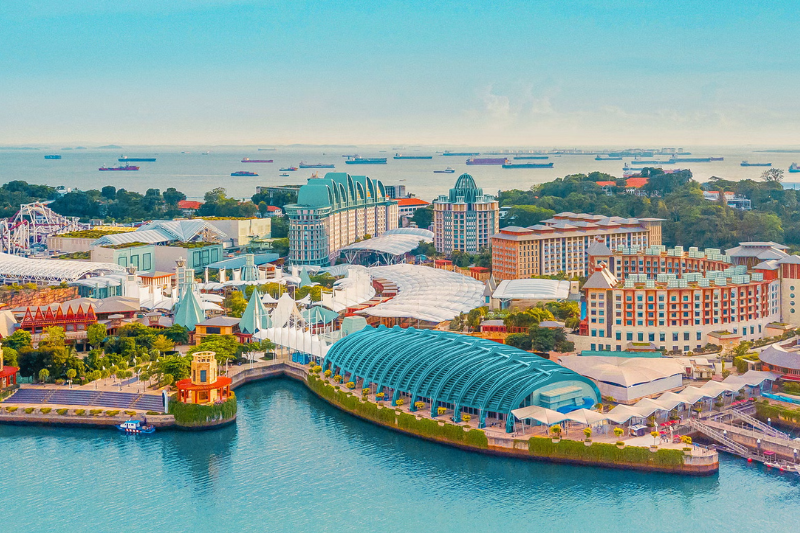
Genting Singapore owns and operates Resorts World Sentosa (RWS), one of Singapore’s two integrated resorts.
For the first half of 2026 (1H2026), gaming revenue slipped 0.9% YoY to S$804.4 million.
Non-gaming revenue partly offset this, growing 6.4% to S$398.8 million on the back of a 9% rise in hotel room revenue.
Net profit fell 33.5% to S$156.1 million.
Depreciation and amortisation rose 25% as Genting upgraded its assets, and interest income fell 55% as market rates came down.
Here’s the thing: depreciation doesn’t cost cash.
Operating cash flow gives a clearer picture.
Genting generated S$331.4 million in cash flow from operations during the period.
Capital expenditure, mostly for the multi-year RWS 2.0 expansion, swallowed S$322.5 million, leaving free cash flow at S$8.9 million – an improvement from negative S$5.8 million a year earlier.
The dividend held all the same.
The board declared an interim tax-exempt dividend of S$0.02 per share, unchanged YoY.
Genting’s balance sheet makes that possible.
As at 30 June 2026, the group held S$2.9 billion in cash and had no borrowings, excluding lease liabilities.
Free cash flow is the lifeblood of dividends, and Genting’s is running thin.
RWS 2.0 won’t be finished until 2030.
Until then, the cash reserve carries much of the load.
Management has also flagged geopolitical uncertainty, higher travel costs and softer tourism demand.
Will FLCT’s new warehouses pay for the debt behind them?
FLCT owns 114 logistics, industrial and commercial properties across Australia, Germany, the Netherlands, the UK and Singapore, with assets under management of S$7.1 billion.
For context, FLCT reports financials only half-yearly.
Its update for the third quarter of the fiscal year ending 30 September 2026 included no revenue, NPI or DPU figures.
The full-year numbers arrive in November.
The operating numbers have improved.
Portfolio occupancy recovered to 96.1%, up from 92.5% a year ago.
Logistics and industrial (L&I) assets are effectively full at 99.7%, and L&I rental reversion came in at 11.9%.
The commercial side is weaker, with rental reversion at -0.3%.
At Alexandra Technopark, FLCT renewed nine leases at 3.6% below expiring rents, and occupancy dipped to 85.3%.
FLCT is also buying growth.
It acquired interests in four freehold German and Dutch logistics properties for about S$441.5 million.
Management expects the deal to lift DPU by 1.7%.
The catch? FLCT paid for it entirely with debt.
Aggregate leverage rose 1.7 percentage points to 35.4%.
Once the deal settles, aggregate leverage will reach around 38.7% on a pro forma basis, leaving less room below 40%, the level FLCT measures its debt headroom against.
If FLCT issues new units for its next deal, they could eat into that 1.7% gain.
Get Smart: Trace the cash before you trust the yield
A yield tells you what a company has paid.
It doesn’t tell you what will pay for the next dividend.
Before you buy, check whether this year’s operating cash covers the payout.
If it doesn’t, find out what fills the gap and how long that can last.
FLCT’s full-year results in November are a good place to start.
Imagine receiving steady rent increases for more than two decades. It sounds unusual, but one healthcare REIT already has rental escalations locked in until around 2042. Income visibility like this is hard to find today. We break down how this REIT built such dependable cash flow in our FREE dividend report and how it could strengthen a retirement portfolio. Get the free report here.
Follow us on Facebook, Instagram, Telegram and YouTube for the latest investing news and analyses!
Disclosure: The Smart Investor owns units in MLT.