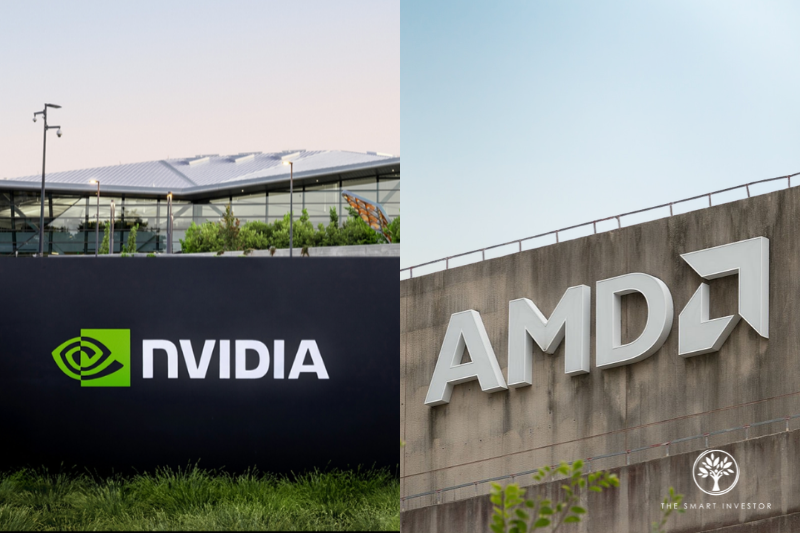
Nvidia (NASDAQ: NVDA) and AMD (NASDAQ: AMD) are two of the leading players in the market for advanced AI chips.
Yet, their business models, profitability and valuations differ.
Nvidia is the more established – and far larger – company.
As of 16 October 2026, it had a market capitalisation of US$5.2 trillion, compared to AMD’s US$863 billion.
But there are benefits to being a challenger, and both companies have been swept up in the enthusiasm for all things AI.
Nvidia: The Dominant Player
Nvidia is the undisputed market leader in graphics processing units (GPUs), each of which can have many cores that allow for processing of complex operations simultaneously, making them suitable for training the large language models (LLMs) that are the foundation of generative AI.
Notably, Nvidia also owns the CUDA computing platform, which allows developers to use GPUs for general-purpose processing, and not just the graphics rendering they were traditionally designed for.
Many developers in AI have been trained to use CUDA, which only works with Nvidia chips, creating a barrier to entry for other chip companies.
Nvidia is the biggest beneficiary of the AI boom – its revenue rose by 3.5x to US$216 billion in its financial year ending January 2026 (FY2026), compared to FY2024.
Its margins are equally impressive, with a gross margin of 71% in FY2026. The company also generated nearly US$103 billion in cash from operating activities in the same year.
Part of this windfall has gone into investments and partnerships with key players in the AI ecosystem, from frontier labs OpenAI and Anthropic, to AI data centre operators such as CoreWeave (NASDAQ: CRWV).
Some market participants have likened these arrangements to circular financing, since all are important Nvidia customers.
AMD: The Upstart
AMD’s traditional strength was in making central processing unit (CPU) chips, which were initially overlooked when the AI boom first started.
However, the increasing focus on inference and AI agents means that demand for CPUs is expected to increase by 10x from 2025 to 2030.
Indeed, Muse. from Meta Platforms’ (NASDAQ: META), and OpenAI’s Dots, the two companies’ respective AI agents, both run on AMD’s EPYC-branded CPUs.
AMD is also challenging Nvidia in the GPU space with its Instinct product, which it is combining with its CPUs, networking, and ROCm software stack to create Helios, its fully integrated AI infrastructure offering.
Unlike CUDA, AMD’s ROCm is open-source and can run on GPUs from other manufacturers, even Nvidia’s.
If ROCm is able to attract more developers and users, it may even be able to breach the CUDA moat.
Hyperscalers from Meta to Microsoft (NASDAQ: MSFT) are spending huge sums of money on AI chips and looking for alternatives to Nvidia so it doesn’t exercise excessive market power.
This presents AMD with an opportunity to take market share from the leader.
Which Chipmaker Has the Stronger Business?
For now, Nvidia is still far ahead of AMD, which had US$35 billion in revenue for its financial year ending December 2025 (FY2025), 1.5x its FY2023 revenue.
But this was still just 16% of Nvidia’s top line for the comparable period.
Both have data centre businesses that are growing strongly.
In Nvidia’s most recent quarter, 2QFY2027, its data centre revenue grew by 2.2x to US$89 billion on strong demand for its cutting-edge Blackwell chips.
AMD’s data centre business experienced similar levels of year-on-year growth, with the segment’s revenue of US$6.7 billion being 2.1x the year-ago figure.
Yet, Nvidia’s business is far more profitable, a reflection of its market leadership.
For example, its 1HFY2027 net income margin was 66%, compared with AMD’s 17% for 1HFY2026.
Despite its market leadership, Nvidia isn’t resting on its laurels.
Earlier this year, it announced the Vera CPU, purpose-built for agentic AI, which it claims is twice as efficient as, and 50% faster than traditional CPUs.
Still, the desire from hyperscalers to see a viable alternative supplier to Nvidia should ensure that AMD gets its share of AI-driven demand.
AMD also stands to benefit from operating leverage, as fixed costs are spread across a larger business.
Its gross profit margin rose from 40% in 2QFY2025 to 54% in 2QFY2026, and is expected to reach 56% in 3QFY2026.
Looking ahead, both businesses must continue to innovate to stay ahead of the competition.
Size also gives Nvidia the advantage here.
In 1HFY2027, it spent US$13.4 billion on R&D, nearly 3x the US$4.9 billion AMD spent in its equivalent period.
It’s also worth noting that Nvidia’s R&D expenditure was just 7.5% of revenue over that period, compared to 22.6% for AMD.
Valuation and Risk
Given Nvidia’s superior economics, one might expect it to attract a premium valuation to AMD.
However, this is not the case.
Nvidia’s forward price-to-earnings ( P/E) ratio is 24.9x, while its PEG ratio (which accounts for expected earnings growth) is 0.5x.
The equivalent figures for AMD are 39.5x and 0.6x respectively.
Part of the explanation for this paradox is that AMD has already seen a significant run-up in its share price – it is 137% higher in the year to 16 October 2026.
Nvidia’s share price, in contrast, rose by just 13% over the same period.
Although both companies face similar risks, including the bursting of the AI bubble and the cyclicality of the semiconductor industry reasserting itself, AMD’s higher valuation also means that it is more susceptible to changes in investor sentiment.
Nvidia, meanwhile, might be doubly exposed to the underperformance of the companies in the AI ecosystem it has invested in.
In the past week, for example, CoreWeave’s share price has fallen by 24% as investors fret over its debt levels and ability to scale its business.
Get Smart: Which AI Chip Stock Would I Buy?
Nvidia and AMD offer two distinct ways to invest in the growth of AI computing.
Nvidia benefits from its established leadership, strong software ecosystem and proven profitability.
AMD offers the potential for significant growth and operating leverage if it successfully expands its market share.
However, given its superior economics and lower valuation, Nvidia might be the pick between the two, despite understandable scepticism about how much more a US$5.2 trillion company can grow.
Big Tech is spending hundreds of billions on AI, and the ripple effects are just beginning. Our new investor guide shows how AI is changing the way companies generate revenue, structure their business models, and gain an edge. Even if you already know the major players, this report reveals something far MORE important: The why and how behind their moves, and what it means for your portfolio. Download your free report now.
Follow us on Facebook, Instagram, Telegram and YouTube for the latest investing news and analyses!
Disclosure: Silas does not own any of the stocks mentioned.