Today, you will need far less money to buy into some of Singapore’s blue chips.
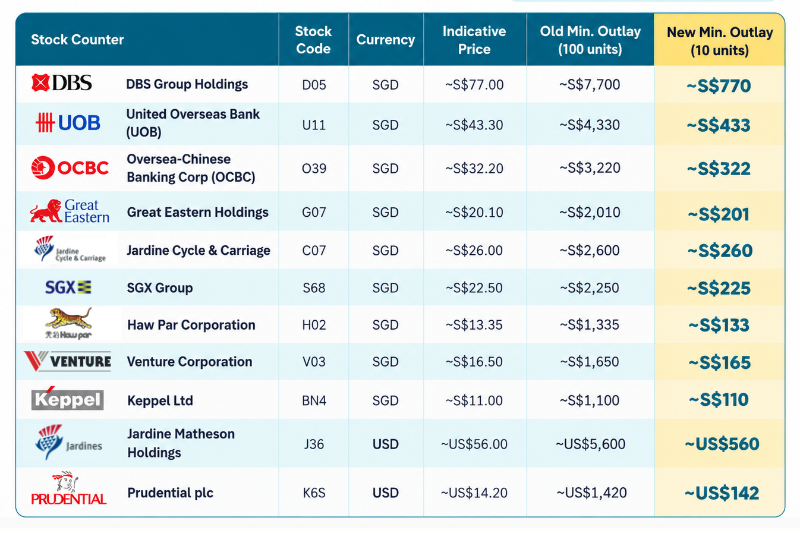
As of 5 October 2026, the Singapore Exchange (SGX) has cut the standard board lot size for 11 securities from 100 shares down to 10.
A S$32 stock that used to require S$3,200 per lot will now require just S$320 to get started.
The change covers securities that trade above S$10 or US$10 for US dollar counters.
The shares you already own stay as they are, and SGX will review eligible stocks every quarter.
Once a lot shrinks, it stays small.
Do note that SGX cleared all resting orders for these counters at the close of trading on Friday, 2 October.
You will need to re-enter any unfilled orders today.
A cheaper ticket makes these companies easier to own, but it does nothing to alter the fundamental quality of the underlying businesses.
Following our earlier look at four featured stocks from the first batch, this second instalment examines another four counters set to benefit from the lower trading threshold.
How did OCBC grow profit while its margin shrank?
Oversea-Chinese Banking Corporation Limited (SGX: O39), or OCBC, Singapore’s longest-established bank, earned less on each dollar it lent in 1H2026.
Its net interest margin (NIM) narrowed by 0.25 percentage points to 1.73%.
The bank partly offset the margin compression by expanding its loan book.
Customer loans grew 12% year on year (YoY) to S$364.5 billion, which limited the drop in net interest income (NII) to just 3%, bringing it to S$4.5 billion.
Non-interest income filled the gap and then some, climbing 36% to S$3.5 billion as trading income rose 46% and insurance income surged 49%.
Consequently, total income rose 11% to S$8.0 billion, while the non-performing loan (NPL) ratio remained stable at 0.9%.
Net profit rose 13% to a record S$4.2 billion, prompting the board to lift the interim dividend by 15% to S$0.47 per share.
Management upgraded its FY2026 guidance on 7 August and now expects only a slight dip in full-year net interest income.
What drove UOB’s profit growth?
United Overseas Bank Limited (SGX: U11), or UOB, which serves more than 8 million retail customers across ASEAN, felt a similar squeeze.
As benchmark rates fell, its NIM narrowed from 1.96% to 1.78%, while NII eased 3% YoY to S$4.6 billion.
Wealth management fees rose 15%, though loan-related fees fell 19%.
Total income slipped 1% to S$7.0 billion and operating profit before allowances declined 4% to S$3.9 billion.
Despite these headwinds, net profit still rose 3% to S$2.9 billion.
UOB achieved this by setting aside less money for bad loans, as total allowances fell 27% to S$414 million.
One-off asset sale gains also boosted other income, while the non-performing loan ratio held steady at 1.6%.
UOB paid an interim dividend of S$0.88 per share on 28 August, up from S$0.85 per share a year ago.
Does cash flow back Jardine Matheson’s higher dividend?
Jardine Matheson Holdings Limited (SGX: J36) is a diversified, Asia-focused investment company with key operations including Astra, Hongkong Land (SGX: H78) and DFI Retail (SGX: D01).
Revenue fell 7% YoY to US$15.9 billion in 1H2026, yet underlying profit rose 9% to US$735 million.
Hongkong Land, DFI Retail and lower financing costs drove the gains.
Jardine Pacific’s contribution rose by US$35 million, though US$24 million of that total stemmed from one-off lease gains.
Meanwhile, Astra’s contribution fell 8%.
Jardine generated less cash during the period, with free cash flow declining 23% to US$1.5 billion.
The group held US$7.5 billion in cash against US$14.8 billion in borrowings, putting net debt at roughly US$7.4 billion.
The board still raised the interim dividend by 8% to US$0.65 per share.
Management expects a full-year dividend of at least US$2.47 per share and has launched a US$500 million share buyback programme.
Why did Venture’s free cash flow turn negative?
Venture Corporation Limited (SGX: V03) provides technology solutions and products to the global electronics industry, serving sectors ranging from medical devices to semiconductor equipment.
Revenue rose 7.4% YoY to S$1.35 billion in 1H2026.
Customers in test and measurement, networking and semiconductors drove this growth, including those supporting AI-related infrastructure.
Net profit increased 5.6% to S$119.3 million.
However, free cash flow swung to negative S$0.9 million, down from S$137.7 million a year ago.
While operating profit before working capital changes actually improved, Venture put S$194 million into inventories to support growth.
The group ended June with a robust S$1.11 billion in cash and zero borrowings.
Venture raised its ordinary interim dividend by 20% to S$0.30 per share.
Because last year’s payout included a S$0.05 special dividend alongside a S$0.25 ordinary dividend, the total interim payout remained unchanged at S$0.30 per share.
Get Smart: Use the smaller lot to buy in stages
A 10-share lot size allows you to build positions in much smaller, more deliberate steps.
Let each earnings release guide your next move.
Check whether free cash flow still covers the dividend.
Set one-off gains aside before you judge how fast profit is growing.
If the numbers hold up, add a little more.
If they don’t, you will have risked far less than a full 100-share lot.
We found 6 SGX companies that have paid dividends every year for more than 20 years, through the Global Financial Crisis, COVID-19, and rising interest rates.
If you’re building long-term income for retirement, this free report is a great place to start. Download your copy today.
Disclosure: Joanna Sng owns shares of OCBC, UOB, Hongkong Land, DFI and Venture.