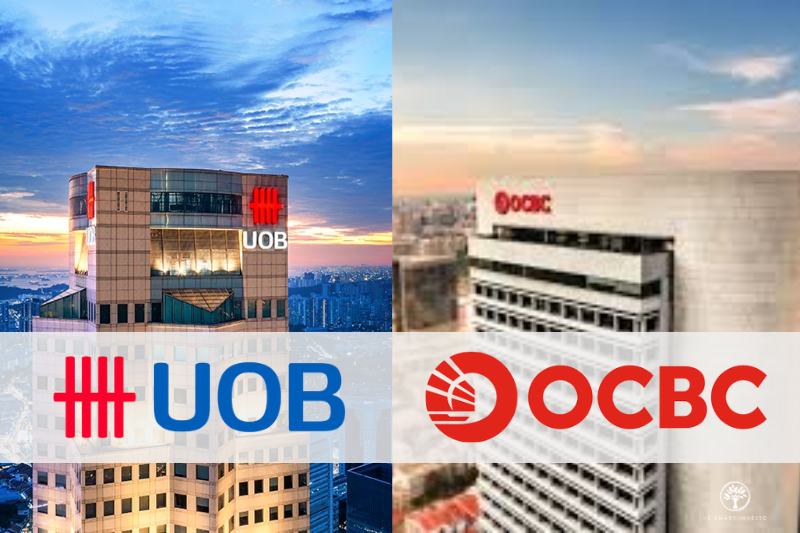
Singapore’s banking giants have released their first-quarter scorecards for 2026.
As benchmark interest rates begin their inevitable descent, the divergence between one bank’s ASEAN integration and another’s wealth management engine has never been more apparent for income-seeking investors.
The first quarter of 2026 (1Q2026) marked a significant turning point for Singapore’s banking sector.
After years of reaping the benefits of “higher-for-longer” interest rates, the local lenders are now navigating a landscape defined by compressing margins.
However, as the latest results from United Overseas Bank Limited (SGX: U11) and Oversea-Chinese Banking Corporation Limited (SGX: O39) show, the impact of these macro headwinds depends largely on where a bank places its bets.
The Margin Squeeze: A Shared Challenge
Both banks felt the chill of lower benchmark rates.
UOB saw its Net Interest Margin (NIM) compress by 18 basis points year on year (YoY) to 1.82%, resulting in a 4% decline in net interest income (NII) to S$2.3 billion.
OCBC faced a steeper margin contraction of 28 basis points, with NIM falling to 1.76%. NII slipped 5% to S$2.2 billion, although asset growth and lower deposit costs partly cushioned the decline.
To combat this, both institutions turned to loan volume.
UOB grew its gross customer loans by 4% to S$353.8 billion, while OCBC was even more aggressive, posting 9% loan growth on a constant currency basis to reach S$347 billion.
This expansion in lending acted as a vital cushion, preventing a more severe erosion of the banks’ primary income streams.
OCBC’s Wealth Management Triumph
The standout story of the quarter belongs to OCBC.
Despite the margin pressure, the group delivered a record total income of S$3.8 billion, up 5% YoY.
The secret sauce was a massive 23% surge in non-interest income, which now accounts for over 40% of the group’s total earnings.
OCBC’s diversified model – spanning banking, wealth management, and insurance – fired on all cylinders.
Wealth management fees jumped 34% YoY to S$412 million, helping drive total net fees and commissions up 24% to S$675 million.
Meanwhile, insurance income through Great Eastern Holdings (SGX: G07) leapt 34% to S$409 million on a 31% rise in new business embedded value.
This performance propelled OCBC’s net profit to S$2.0 billion, a 5% YoY increase, proving that its “wealth boom” is more than enough to offset the interest rate cycle.
UOB: Integration and Resilience
In contrast, UOB’s 1Q2026 was a period of consolidation.
Having completed its massive integration of Citi’s consumer banking business across four key ASEAN markets, UOB now serves a massive 8.5 million retail customers.
However, the current quarter was characterised by “risk-off” market sentiment, which weighed on fee income.
Total income for UOB eased 6% to S$3.4 billion, with net profit attributable to shareholders down 4% to S$1.4 billion.
While fee income from investment banking and loan-related activities moderated, UOB’s asset quality remained a bright spot.
Its non-performing loan (NPL) ratio improved to 1.5%, demonstrating the underlying strength of its loan book despite the softer top-line figures.
Operational Efficiency and Dividends
On the efficiency front, OCBC continues to show remarkable consistency, maintaining an NPL ratio of 0.9% for the eighth consecutive quarter.
UOB’s operating profit before allowances fell 9%, while OCBC saw a 4% rise.
Investors looking for immediate payouts will have to wait.
Neither bank declared a dividend this quarter, as both stick to their semi-annual schedules.
UOB’s CEO Wee Ee Cheong reaffirmed full-year guidance, including a NIM of 1.75% to 1.80%, while OCBC management maintained its FY2026 guidance of 50% ordinary dividend payout and an ongoing S$2.5 billion capital return plan.
Get Smart: Diversification is King
The lesson for 2026 is clear: when interest rates fall, diversification saves the day.
OCBC’s record performance proves that its wealth and insurance engines are powerful hedges against a cooling credit market.
While UOB is currently digesting its Citi acquisition and facing temporary fee headwinds, its expanded ASEAN footprint offers significant long-term scale.
For now, OCBC holds the momentum, but both banks remain pillars of stability with healthy asset quality and clear capital return paths.
Many Singapore stocks fall behind inflation, which means your money quietly loses strength over time. Dividend stocks have a very different track record. Some continued delivering 6% to 13% every year across the toughest market conditions.
In this FREE report, discover 5 crisis-tested dividend stocks that kept rewarding investors while the market struggled. Download your dividend investing guide now.
Follow us on Facebook, Instagram and Telegram for the latest investing news and analyses!
Disclosure: The Smart Investor owns shares of OCBC.