Retail investors poured more than S$300 million into S-REITs in March alone, even as the sector slumped 6.9% for the month.
The iEdge S-REIT Index posted negative total returns of 6.4% for the first quarter of 2026 (1Q2026), weighed down by geopolitical tensions and expectations that US interest rates may stay higher for longer.
Yet the buying tells a different story.
Across the top five S-REITs by retail inflows – CapitaLand Ascendas REIT (SGX: A17U), Frasers Centrepoint Trust (SGX: J69U), Mapletree Industrial Trust (SGX: ME8U), Keppel REIT (SGX: K71U), and Lendlease Global Commercial REIT (SGX: JYEU) – every single one recorded negative total returns in 1Q2026.
And four of the five saw distribution per unit (DPU) decline year on year (YoY) in their latest results.
So are retail investors buying genuine bargains – or chasing yields that may not last?
The answer lies beneath the headlines.
The Headlines Don’t Tell the Full Story
Take CapitaLand Ascendas REIT (CLAS), which attracted the largest retail inflows at S$197.7 million.
Its DPU slipped 1.3% YoY to S$0.15005 for FY2025, but distributable income actually grew 1.4% to S$678.3 million.
The per-unit decline was entirely due to an enlarged unit base following a S$500 million equity fundraising.
Beneath the surface, rental reversions came in at a healthy +12% for the full year, with the fourth quarter hitting +19.6%.
Aggregate leverage stands at 39%, with cost of debt improving to 3.5%.
Keppel REIT tells a similar story.
DPU fell 6.6% to S$0.0523 for FY2025, but distributable income from operations would have risen 6.3% YoY had management fees been paid entirely in units.
The decline, once again, was driven by dilution from a private placement and preferential offering to fund the acquisition of a 75% stake in Top Ryde City Shopping Centre and an increased stake in Marina Bay Financial Centre Tower 3.
Portfolio occupancy improved to 96.7%, with rental reversions at +11.5%.
In both cases, operational income grew while per-unit distributions shrank – a distinction that matters enormously for dividend sustainability.
Where the Dividend Case Is Strongest
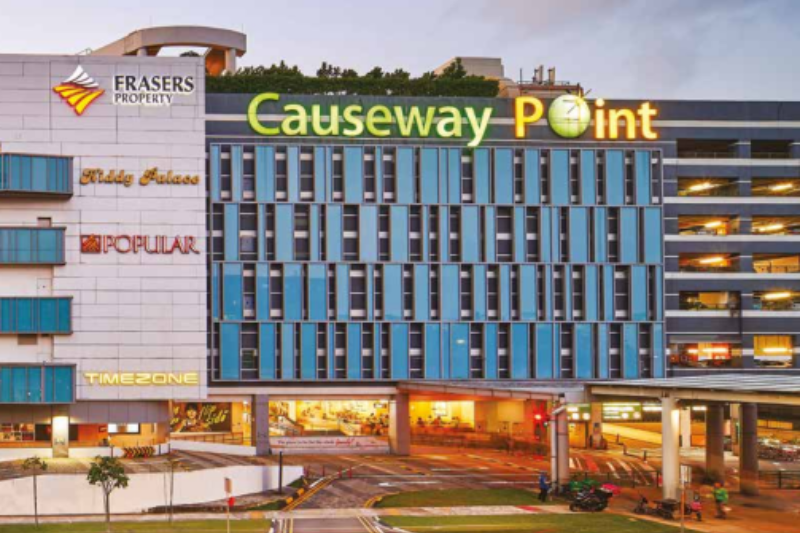
Frasers Centrepoint Trust (FCT) stands out as the most straightforward dividend story among the five.
Full-year DPU edged up 0.6% to S$0.12113 for FY2025, supported by gross revenue growth of 10.8% YoY.
Committed occupancy for the latest quarter reached 98.1%, rising to 99.9% after backfilling cinema spaces vacated by Cathay Cineplexes.
What makes FCT’s case compelling is the structural tailwind ahead.
The Johor Bahru-Singapore Rapid Transit System, expected to commence by end-2026, is projected to drive a 25% to 27% uplift in residential population across Singapore’s northern region over the next 10 to 15 years – precisely where several of FCT’s malls are located.
Where Caution Is Warranted
The picture is more nuanced for Mapletree Industrial Trust (MIT) and Lendlease Global Commercial REIT (LREIT).
MIT’s DPU declined 7% YoY in 3QFY2026, or 3.9% excluding a one-off divestment gain distributed in the prior year.
Revenue fell 8%, dragged down by the absence of income from three Singapore properties divested in August 2025, lease non-renewals in North America, and a weaker US dollar.
The REIT is in transition, targeting S$500 million to S$600 million of further divestments in North America while pivoting towards data centre markets across Asia Pacific and Europe.
Whether dividends stabilise depends on the pace and quality of redeployment.
LREIT recorded the weakest total return of the five at -12.7% for 1Q2026.
Its DPU fell 6.9% to S$0.036 for FY2025.
However, the revenue decline was largely attributed to the prior year’s upfront recognition of supplementary rent from Sky Complex.
On an adjusted basis, revenue would have risen 1.1%.
More significantly, the divestment of Jem’s office component for S$462 million is set to slash gearing from 42.6% to approximately 35%, while the cost of debt has improved to 3.09% per annum (as at 30 September 2025).
This is a balance sheet repair story – the question is whether deleveraging can translate to stabilised DPU going forward.
Get Smart: Look Beyond the Yield
Retail investors buying the dip need to distinguish between headline DPU declines and underlying operational health.
In three of the five S-REITs examined, DPU fell not because the business weakened but because equity dilution from fundraising exercises reduced the per-unit share of a growing income pie.
Free cash flow, occupancy trends, and rental reversions tell the real sustainability story.
The yield on your screen today is backward-looking — the dividend’s durability depends on what lies ahead.
Imagine receiving steady rent increases for more than two decades. It sounds unusual, but one healthcare REIT already has rental escalations locked in until around 2042. Income visibility like this is hard to find today. We break down how this REIT built such dependable cash flow in our FREE dividend report and how it could strengthen a retirement portfolio. Get the free report here.Follow us on Facebook, Instagram and Telegram for the latest investing news and analyses!
Disclosure: The Smart Investor owns units of CLAR, FCT and MIT.