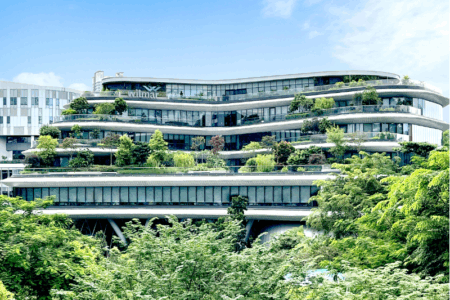
Temasek Holdings recently announced a bold and massive bet on the future, to the tune of more than doubling its artificial intelligence (AI) exposure from 6% to as much as 15% by 31 March 2031.
Temasek’s CEO Dilhan Pillay explained that Temasek’s investments reflect the company’s view of AI as a structural, long-term driver of value creation.
To capture this AI-led tailwind, Temasek is deploying capital across five areas of the AI value chain: energy and data centres, semiconductors, cloud services providers, foundation models, and AI applications and software infrastructure.
It also singles out vertically integrated mega-caps — large companies with expertise spanning more than one of those areas.
Of course, no one should blindly follow others’ investment decisions.
Even a global investment company like Temasek has its fair share of investment blunders.
Still, it helps to reference the areas Temasek is investing in, and to ask whether companies in those areas make sense for your own investing objectives.
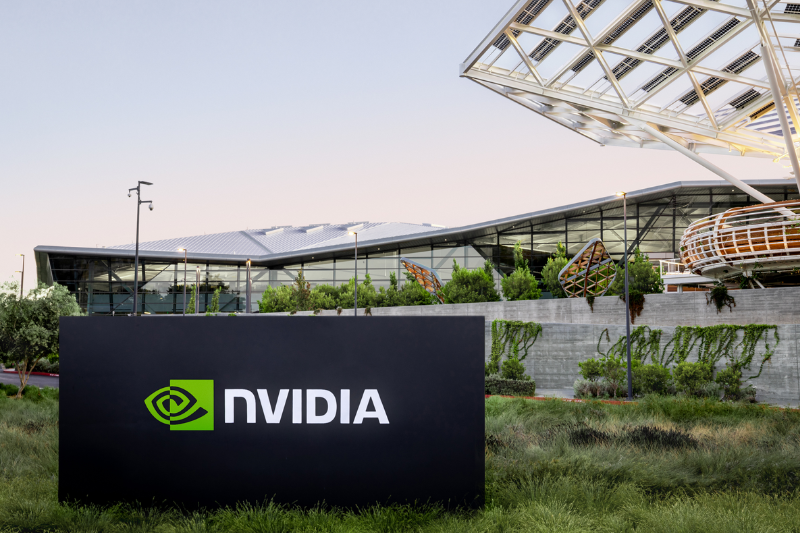
NVIDIA (NASDAQ: NVDA) — The “Picks and Shovels” of AI
NVIDIA is the world leader in graphics processing units (GPUs), providing the accelerated computing required to train and deploy massive AI models.
It doesn’t just sell GPUs; it offers an entire ecosystem that powers every major cloud and edge device through its proprietary CUDA software platform, making the switching cost extremely high for other tech giants or start-ups.
In the first quarter ended 26 April 2026 (1QFY2027), its revenue surged 85% year on year (YoY) to a record US$81.6 billion, thanks to what CEO Jensen Huang described as the “extraordinary speed” of the buildout of AI factories.
Specifically, its Data Centre segment was doing most of the heavy lifting, growing at 92% to a record US$75.2 billion in 1QFY2027 as the new Blackwell architecture was massively ramped up.
It doesn’t matter whether OpenAI, Alphabet (NASDAQ: GOOGL) or other frontier labs win the frontier model race.
As the “picks and shovels” provider to the entire AI gold rush, NVIDIA is already benefiting from the competition.
Taiwan Semiconductor Manufacturing Company (NYSE: TSM), or TSMC — A Monopoly in Advanced Silicon
If the Strait of Hormuz is a chokepoint for the global supply trade, Taiwan is a chokepoint for advanced semiconductors.
Crucially, this chokepoint is anchored by TSMC, which controls more than 90% of global most advanced chip manufacturing.
In the second quarter of 2026 (2Q2026), its revenue increased 33.7% YoY to US$40.2 billion.
Net profit climbed 77.4% YoY to NT$706.56 billion, helped by wider margins as well as higher sales.
Here’s the thing about this silicon powerhouse: after spending decades mastering the complexities of running advanced fabrication plants, it is currently the only foundry mass-producing the leading-edge AI chips designed by NVIDIA and other mega-cap tech titans.
That barrier to entry remains formidable.
Like NVIDIA, which serves as a vital partner to virtually every mega-cap tech company, TSMC’s business is expected to stay resilient regardless of who dominates the AI application landscape.
Microsoft (NASDAQ: MSFT) — The Hyperscale Ecosystem Platform
If you only know Microsoft as your Word, Excel, and Teams office software suite provider, you are missing out on what truly matters for this hyperscale powerhouse en route to building the ultimate AI ecosystem.
Having already established itself as a leading cloud computing giant through Azure, it also secured a multi-billion-dollar stake in OpenAI and embedded Copilot AI into its ubiquitous commercial software suite.
For the fourth quarter of the fiscal year ended 30 June 2026 (4QFY2026), Microsoft’s revenue increased 18% YoY to US$90 billion, while diluted earnings per share (EPS) rose 32% to US$4.81.
Excluding the impact of its OpenAI investment, EPS rose 23% to US$4.74.
Azure and other cloud services revenue grew 43%, while paid Microsoft 365 Copilot seats passed 30 million, with net seat additions more than doubling quarter on quarter.
Once Copilot is wired into enterprise users’ daily workflows, the cost of switching to another provider is extremely high, creating an “enterprise stickiness” that’s almost impossible to break.
Microsoft is funnelling its operating cash flow into infrastructure, with capital expenditure expected to reach roughly US$175 billion in the calendar year of 2026 – a figure revised down from about US$190 billion because of an accounting change, not because the company is spending less.
Get Smart: Follow the AI Enablers and Proven Adopters
AI-enabling tech titans are clear beneficiaries in the age of AI with a long growth runway that should outlast any single economic cycle.
However, Temasek isn’t just looking at AI-enablers.
It is also working with its existing portfolio companies to accelerate their own AI adoption.
Smart investors know better than to speculate on the ultimate winner of the AI race.
The good news is we don’t have to.
While enablers and adopters are expected to be key beneficiaries of AI, it’s crucial to lean towards those that are supported by real-world productivity gains.
Not all AI “winners” will survive this cycle.
But a few companies already have the scale, cash flow, and edge to pull ahead. We highlight what to look for in our FREE volatile market report. Download it here.
Follow us on Facebook, Instagram and Telegram for the latest investing news and analyses!
Disclaimer: Larry L. owns shares of NVIDIA, Alphabet and Microsoft.