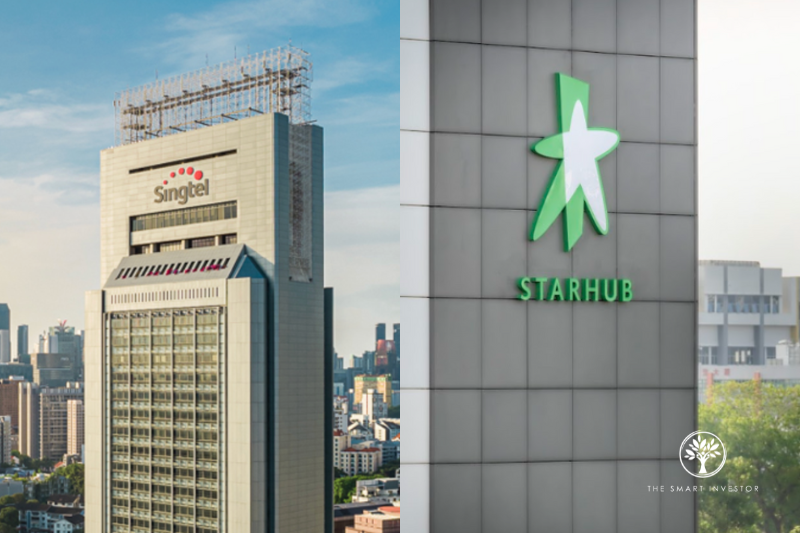
Singapore’s telcos are fighting hard for your mobile plan.
That fight is showing up in their profits, but not in the same way.
If you’re choosing between the two for income today, the dividend from Singapore Telecommunications Ltd (SGX: Z74), or Singtel, looks safer.
Its core payout moves with profit, and profit is growing.
For StarHub Ltd (SGX: CC3), its dividend rests on a promised minimum while its profit and cash flow shrink.
Singtel reports by half-year and StarHub by quarter, so watch the labels – only StarHub’s free cash flow is covered here.
| Company | Period | Dividend | Change |
|---|---|---|---|
| Singtel (interim total) | 1H FY2027 (half year to 30 September 2026) |
S$0.09 | +9.8% year on year |
| Singtel (core) | 1HFY2027 | S$0.071 | +10.9% (our calculation) |
| Singtel (value realisation) | 1HFY2027 | S$0.019 | vs S$0.018 a year ago |
| StarHub | FY2026 (guidance) | Higher of S$0.06 or at least 80% of adjusted net profit | Not comparable |
What pays for Singtel’s dividend?
Singtel runs four business units: Optus in Australia, Singtel Singapore, NCS and Digital InfraCo.
For the first half of its financial year ending 31 March 2027 (1HFY2027), Singtel’s directors approved an interim dividend of S$0.09 per share, up 9.8% from S$0.082 a year ago.
That payout has two parts, and they are worth keeping apart.
The core dividend of S$0.071 (S$0.064 a year ago) equals 78% of underlying net profit, the same share as a year ago.
Underlying net profit rose 10.4% year on year (YoY) to S$1.49 billion, though at constant exchange rates, it would have grown 15.9%.
NCS and Digital InfraCo grew revenue by 10% and 22% respectively.
In other words, the core dividend grew 10.9% because profit grew.
That kind of increase can repeat.
Buybacks help on a per-share basis too.
Singtel has bought back 216 million shares for S$974 million so far under its S$2 billion programme.
The remaining S$0.019 (S$0.018 a year ago) is a value realisation dividend, which sits outside that 78% core payout.
Count it, but don’t build your budget around it.
Where could Singtel’s dividend come under pressure?
Singtel is not immune to the price war.
In Singapore, mobile service revenue fell 1.6% amid intense price competition.
Singtel Singapore’s EBIT fell 4.5%.
A one-off item also lifted its profit this half.
A first-time S$153 million dividend from Gulf helped cut net finance expenses by 55%.
There is no guarantee that boost returns.
Spending is rising too.
Singtel plans an additional S$1.2 billion of capital expenditure this financial year, mainly for data centres and AI, with S$0.7 billion of it to be funded by external partners and customer advances.
On the flip side, management raised its full-year operating profit growth guidance to between mid and high single digits.
Can StarHub’s 6-cent dividend floor hold?
StarHub holds the second-largest mobile market share and the largest broadband share in Singapore.
For FY2026, StarHub has reiterated a full-year dividend of the higher of S$0.06 or at least 80% of net profit adjusted for one-off items, paid twice a year.
Here’s the thing: a floor is a promise, not a profit.
For the third quarter of 2026 (3Q2026), service revenue rose 2.9% YoY to S$396.1 million.
Profit went the other way.
Net profit attributable to shareholders fell to S$3.9 million from S$22.1 million, a drop of 82%.
EBITDA fell 26.3% to S$72.1 million on lower gross profit, higher operating expenses and lower other income.
Operating expenses rose 11.0%, mainly on higher staff costs.
These figures exclude Ensign.
Free cash flow is the lifeblood of dividends, and StarHub’s fell 79% YoY to S$26.0 million.
Net debt to trailing 12-month EBITDA rose to 2.76 times from 2.00 times at the end of 2025.
Interest cover dropped to 7.1 times from 9.4 times.
Management expects FY2026 EBITDA to come in at 75% to 80% of FY2025’s level.
With a smaller earnings base, the S$0.06 floor leans more on the promise than on profit.
What could turn StarHub around?
The price war shows in its consumer numbers.
Mobile revenue fell 6.0% YoY to S$121.2 million, as average revenue per user slipped to S$19.20 from S$21.70.
Enterprise is the bright spot.
Enterprise revenue rose 18.4% YoY to S$172.5 million, with managed services up 27.7%.
StarHub is also on track for S$70 million of savings by 2028, though only about 15% has been achieved so far.
On 24 November 2026, StarHub and Keppel Ltd (SGX: BN4) announced definitive agreements for an all-share merger combining StarHub and M1 (expected to complete by 1H2027, subject to regulatory and shareholder approvals).
This move would reduce Singapore’s mobile network operators from four to three and could ease competitive pressure over time.
Get Smart: Sort a dividend by what pays for it
A dividend paid from growing profit can keep growing.
A dividend held up by a floor needs the business to recover before it can rise again.
So when a company’s profit falls, ask which part of the payout it still promises you, and what it will use to pay.
If the business has to recover first, the dividend is promising more than the business is delivering.
How do rich Singaporeans invest when volatility hits?
They turn to companies with cash, history, and discipline. This free report highlights 5 blue chips that deserve your attention. Get your copy here and see who made the list.
Follow us on Facebook, Instagram, Telegram and YouTube for the latest investing news and analyses!
Disclosure: Calvina L. does not own shares in any company mentioned.