For the past few years, the Magnificent Seven were the “in thing” – the stocks everyone wanted to own.
Nvidia (NASDAQ: NVDA), Microsoft (NASDAQ: MSFT), Amazon (NASDAQ: AMZN), Alphabet (NASDAQ: GOOGL), Meta (NASDAQ: META), Apple (NASDAQ: AAPL), and Tesla (NASDAQ: TSLA) became shorthand for America’s technology and artificial intelligence (AI) boom.
But markets are constantly changing.
Recently, a new label is doing the rounds: MANGOS.
The question now is whether MANGOS are the next generation of market leaders, or simply another catchy Wall Street nickname.
What Are the MANGOS Stocks?
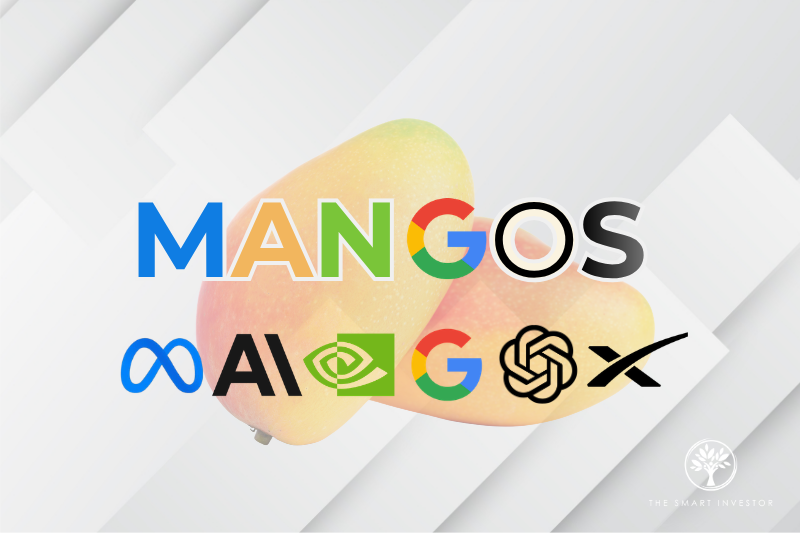
MANGOS stands for Meta, Anthropic, Nvidia, Google, OpenAI and SpaceX (NASDAQ: SPCX).
Meta runs Facebook, Instagram and WhatsApp, funded by advertising that AI now targets more accurately.
While revenue rose 28.0% year on year (YoY) to US$60.8 billion in 2Q2026, profit fell to US$15.8 billion from US$18.3 billion as costs jumped 55.2%.
Anthropic sells Claude, an AI assistant bought mainly by businesses.
Quarterly revenue passed US$11.5 billion against US$787 million a year earlier, and its annualised revenue pace hit US$65 billion by end-July.
Nvidia designs the chips that train and run AI.
The company recorded revenue of US$96.2 billion in 2Q2027, more than double a year earlier, with data centre sales at US$89 billion.
Google (Alphabet) owns Search, YouTube, Android, Google Cloud and Gemini.
Revenue grew 24.2% YoY to US$119.8 billion in 2Q2026, with cloud jumping 81.8% YoY to US$24.8 billion.
OpenAI sells ChatGPT subscriptions and developer tools.
While still a private company, its annualised revenue is near US$40 billion.
SpaceX launches rockets, sells Starlink internet and owns the AI firm xAI.
Its first results as a listed company beat forecasts, with 2Q2026 revenue jumping 91.9% YoY to US$7.81 billion, though it still made a net loss of US$541 million.
MANGOS is a shorthand for a group of companies benefiting from powerful technology and structural growth trends, rather than a formal index or investment product.
Each builds part of the AI engine: the chips, the models or the computing power behind them.
While the Magnificent Seven bet on the consumer internet, MANGOS bets on AI.
Why Wall Street Is Looking Beyond the Magnificent Seven
There are two main reasons.
First, the Magnificent Seven have grown so large that achieving the same rate of growth gets harder every year.
Second, that story has moved on.
Investors are now looking a layer deeper, at the companies supplying the AI itself, and at the cloud computing, digitalisation and rising technology spending flowing to them.
MANGOS tells that story cleanly.
MANGOS vs. Magnificent Seven
| Factor | Magnificent Seven | MANGOS |
| Company size | All mega-cap, all listed | Three mega-caps, one newly listed, two still private |
| Growth potential | High, but from a very big base | Faster at the three AI-native names |
| AI exposure | Some benefit only indirectly | Almost entirely AI and advanced computing |
| Valuation | Expensive against their own history | Harder to judge – two have no share price |
| Profitability | All profitable, with huge cash flows | Meta, Nvidia and Alphabet very profitable; the newer three barely or not yet |
| Risk | Concentration and regulation | The same, plus listing timing, thin trading and unproven profits |
While the Magnificent Seven are all listed mega-caps and profitable with huge cash flows, MANGOS is a mixed bag: three mega-caps, one listed in June, and two still private.
The newer names definitely grow faster but earn less.
Parts of the Magnificent Seven benefit from AI only indirectly, while almost all of MANGOS is AI and advanced computing.
Valuation is harder to judge, since two members have no share price.
The risks overlap, with concentration and regulation on both sides, plus listing timing and unproven profits on the MANGOS side.
So is MANGOS genuinely different exposure?
Partly – Meta, Nvidia and Alphabet sit in both groups, so owning the Magnificent Seven already gets you half of MANGOS.
What Could Drive MANGOS Higher?
As software and digital infrastructure expand, companies and the public sector will keep spending aggressively on AI.
That cash trickles into everything from data centres and the cloud to automation and ads, positioning every key player somewhere along the money trail.
The Risks of Buying the Next Big Thing
Take SpaceX for example: its shares, priced at about US$135 on 24 August 2026, had closed 19.2% higher on day one of listing (12 June 2026).
The price rose past US$225 within days, then fell below US$105 by early August before recovering to around US$150.
Anyone who bought at the top was down more than half in seven weeks, and the business had barely changed.
That is the risk of buying a story before the market has settled on its price.
Buying into the next big thing usually comes with high expectations, leaving little room for disappointment.
New listings often have few shares trading, so prices swing hard, and early investors can add selling pressure later.
Lastly, AI spending may cool, growth may slow with size, and several of the six compete with each other.
Should Investors Replace the Magnificent Seven With MANGOS?
You do not have to choose.
The established mega-caps offer strong balance sheets and proven profits, while the newer names offer faster growth and more uncertainty.
With two still private companies, a full MANGOS portfolio isn’t available anyway.
If the theme appeals, judge each listed company on its own merits, and keep any new listing small enough that a sharp fall won’t upset your plans.
Get Smart: Acronyms Change, Great Businesses Don’t
FAANG became MAANG, then MAMAA, then the Magnificent Seven, and now MANGOS.
Most of those labels faded; only the good businesses inside them did not.
Treat market acronyms as a research guide, not an automatic buy list.
Examine each business for revenue growth, profitability, and reasonable valuation – with a durable competitive moat as the absolute priority.
Don’t buy MANGOS because the name is catchy.
But buy businesses you believe can be far larger ten years from now.
If the market falls further, will you be ready… or fully invested?
This is where most investors get it wrong. Our FREE report shows how to stay prepared for what comes next. Get it free here.
Follow us on Facebook, Instagram, Telegram and YouTube for the latest investing news and analyses!
Disclosure: Si-Fan T. owns shares of Amazon, Apple, and Nvidia.