If you follow earnings season, you’ll know blue chips tend to hog the spotlight.
This time, some of the biggest profit gains came from much smaller companies.
Three Singapore-listed small caps grew their profits by 24% or more, and one more than doubled its bottom line.
If you invest for dividends, profit growth is a good start.
The cash behind it matters more.
One thing to keep in mind as you read: the three report over different periods, so watch the labels.
Can Tiong Woon keep raising its dividend?
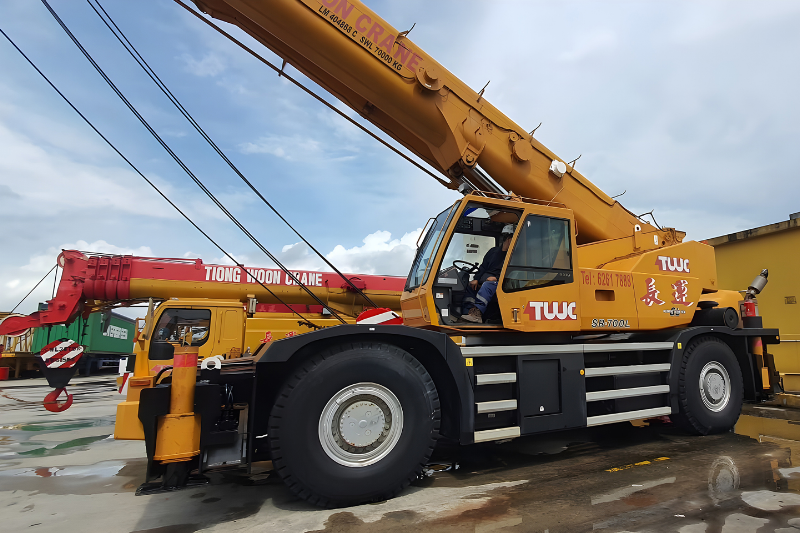
Tiong Woon Corporation Holding Ltd (SGX: BQM) is a one-stop integrated heavy-lift specialist with a presence in 12 countries.
Crane and transport hire makes up 96% of revenue.
For the financial year ended 30 June 2026 (FY2026), revenue rose 15% year on year (YoY) to S$187.7 million.
Profit attributable to shareholders climbed 24% to S$23.9 million.
The crane business drove the gains. Heavy Lift and Haulage external revenue grew 12% YoY, helped by Singapore, India and Brunei.
Gross margin widened to 40.7% from 37.6% on higher margins in that segment.
Turn to the cash flow statement, and you’ll see why Tiong Woon stands out.
Operating cash flow rose 31%, while capital expenditure nearly halved.
Free cash flow rose to S$43.7 million from S$6.3 million a year ago.
The board shared some of that cash.
It proposed a final dividend of S$0.025 per share, up 43% from S$0.0175.
You’ll still want to keep an eye on the balance sheet.
Tiong Woon held S$86.6 million in cash and bank deposits against S$108.0 million in borrowings, excluding lease liabilities.
The low capex bill may not last either. Management plans to keep renewing and expanding its fleet.
Demand looks supportive.
Tiong Woon cites official forecasts of Singapore construction demand of S$47 billion to S$53 billion in 2026, with Changi Airport Terminal 5 among the big projects.
Can Micro-Mechanics turn record profits into bigger dividends?
Micro-Mechanics (Holdings) Ltd (SGX: 5DD) makes precision tools and parts used in semiconductor manufacturing.
For the first quarter of fiscal 2027 (1QFY2027) ended 30 September 2026, revenue rose 45.0% YoY to S$24.2 million, an all-time quarterly high.
Net profit rose 102.8% to S$6.4 million, also a quarterly record.
Wondering why profit grew faster than sales?
Look at the margins.
Gross margin widened to a 20-quarter high of 55.0%, from 51.5% a year ago.
Overheads fell to 20.7% of revenue from 25.1%.
In other words, more of each extra dollar of sales now reaches the bottom line.
Free cash flow moved the other way.
It fell 10.6% YoY to S$3.7 million.
Trade receivables rose in line with higher revenue, and the company paid more tax.
Capital expenditure also rose to S$0.9 million from S$0.3 million.
Should that worry you? Not much.
Micro-Mechanics had S$33.3 million in cash and no bank borrowings as at 30 September 2026.
No dividend was declared for the quarter, and that is normal since the company typically declares dividends in the second and fourth quarters.
Spending is the bigger question.
Micro-Mechanics expects to invest S$12 million in FY2027, including expanding its manufacturing footprint.
Under a five-year strategy, it wants to double revenue to at least S$150 million. That investment will compete with dividends for cash.
What’s missing from Civmec’s record quarter?
Civmec Limited (SGX: P9D) is an integrated construction and engineering services provider to the energy, resources, infrastructure, and marine and defence sectors.
It is headquartered in Henderson, Western Australia and reports in Australian dollars.
For the first quarter of the fiscal year ending 30 June 2027 (1QFY2027), revenue rose 70.2% YoY to a record A$324 million.
Net profit after tax climbed 75.2% to A$18.4 million.
A significant uplift in activity in Civmec’s construction division drove the growth.
Work ramped up on BHP’s Port Debottlenecking Project 2 and Iluka Resources’ Eneabba Rare Earths Refinery.
The order book stood at around A$1.4 billion, up from A$1.15 billion a year ago.
Here’s the thing: the quarterly update did not include a cash flow statement or balance sheet.
You can’t see free cash flow, cash or debt for the quarter.
For a contractor, profit and cash can drift apart as big projects ramp up, so this is a real gap.
You should also note how thin the margins are.
Civmec’s net profit margin was 5.7%, against 5.5% a year ago.
That leaves little room for error on large projects.
No dividend was declared for the quarter.
Civmec paid a final dividend of A$0.035 on 23 October 2026.
Together with the A$0.025 interim, that took FY2026 dividends to A$0.060.
Get Smart: Check whether the cash followed the profit
Free cash flow is the lifeblood of dividends.
So when a company posts a big profit gain, ask one more question: did the cash show up too?
Tiong Woon passes that test.
Profit grew 24%, while free cash flow rose almost sevenfold.
Micro-Mechanics doubled its profit, but free cash flow dipped as it invested more and waited on customer payments.
Civmec hasn’t shown its cash yet.
So the next time a small cap reports a record, open the cash flow statement before you get excited.
Profit that never turns into cash shouldn’t count for much in your dividend plans.
While your friends debate which tech stock to buy next, money is quietly flowing into these 5 Singapore companies you see every day. They are proven to have steady dividends and strong balance sheets. Our FREE report shows you exactly which ones and why they’re safer than flashy darlings everyone’s chasing. Download your free report now.
Follow us on Facebook, Instagram, Telegram and YouTube for the latest investing news and analyses!
Disclosure: Calvina L. does not own any shares in any of the companies mentioned. Chin Hui Leong contributed to the article and owns shares in Micro-Mechanics.