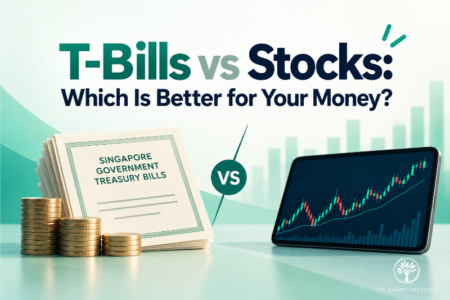
A guaranteed 4% return is a tough benchmark to beat, which is why Singapore’s CPF Special Account (CPF SA) remains a cornerstone of local financial planning.
Still, there are plenty of long-term investors who aim for better returns by investing in solid companies.
So here’s the question: Can S$30,000 in stocks turn into something that consistently tops that 4%?
Why the CPF Special Account Is Such a High Benchmark
The CPF remains Singapore’s financial bedrock, guaranteeing 2.5% on the Ordinary Account and 4% or more on Special, MediSave, and Retirement Accounts.
Your money compounds safely in the background, completely insulated from market turbulence, fees, or active management.
However, clearing that risk-free 4% hurdle in the open market is tricky once trading fees and volatility enter the frame.
The Monetary Authority of Singapore (MAS) expects core inflation to average 1.5% to 2.5% in 2026, which leaves the CPF SA’s 4% delivering a real return of around 1.5% to 2.5%.
That is a respectable floor – but it is a floor, and savers chasing more than inflation-plus-a-bit turn to the CPF Investment Scheme (CPFIS) to give their long-term wealth extra horsepower.
Can Stocks Beat 4% Over the Long Term?
To beat the 4% hurdle, quality stocks rely on three engines: capital growth from rising earnings, steady dividends, and long-term compounding through reinvestment.
Major STI constituent banks like DBS Group (SGX: D05) often yield 4% to 6% in dividends alone.
However, CPF SA provides absolute certainty.
Equities offer higher expected returns, but investors must endure short-term price volatility to capture that equity risk premium over the long run.
What Could S$30,000 Look Like Over Time?
In early years, the gap between a 4% CPF SA rate and a 6% to 8% stock return seems modest.
But give it three decades, and the picture changes completely.
Here is how a single S$30,000 lump sum grows across different return rates:
| Horizon | 4% p.a. (CPF SA Benchmark) | 6% p.a. (Conservative Equities) | 8% p.a. (Growth Equities) |
| 10 Years | S$44,407 | S$53,725 | S$64,768 |
| 20 Years | S$65,734 | S$96,214 | S$139,829 |
| 30 Years | S$97,302 | S$172,305 | S$301,879 |
After 30 years, an 8% return takes you past S$300,000, which is over three times what you’d get sticking with 4%.
That divide is the real reason people with patience ride out the ups and downs in the market.
What Kind of Investments Could Potentially Beat 4%?
Blue-Chip Stocks
These are established, market-leading companies that offer long-term capital stability alongside resilient cash dividends that frequently exceed 4%.
DBS posted a 1Q2026 net profit of S$2.93 billion and declared a quarterly dividend of S$0.81 per share.
At a share price of S$74.02 as of 31 July 2026, that works out to an annualised yield of around 4.4% (inclusive of capital returns), topping the 4% CPF SA hurdle on payout yield alone.
Similarly, Singapore Telecommunications Limited (SGX: Z74) delivered an FY2026 underlying net profit of S$2.77 billion and reported a total annual dividend of S$0.185 per share.
At a share price of S$4.38, this works out to a yield of roughly 4.2%, clearing the Special Account’s 4% bar.
Singapore Real Estate Investment Trusts (S-REITs)
REITs like CapitaLand Integrated Commercial Trust (SGX: C38U), or CICT, pool income-generating properties to distribute regular rental payouts, making them ideal for income investors.
CICT reported a 1Q2026 net property income of S$314.4 million, up 7.9% YoY.
At a unit price of S$2.44, its distribution yield of around 4.4% outpaces the CPF SA through resilient commercial real estate cash flows.
Another popular S-REIT amongst local investors is Mapletree Logistics Trust (SGX: M44U), which generated an FY2025/2026 distribution per unit (DPU) of S$0.07262.
At S$1.22 per unit, the distribution yield works out to roughly 6%.
Broad Market & REIT ETFs
Funds like the SPDR Straits Times Index ETF (SGX: ES3) or the Lion-Phillip S-REIT ETF (SGX: CLR) offer instant diversification across top blue chips or property trusts, capturing steady market growth and income payouts well above 4% while mitigating individual stock risk.
The SPDR STI ETF, for example, offers a trailing yield of 3.1% with long-term capital appreciation.
The Risks of Chasing Higher Returns
Outperforming CPF requires accepting market volatility, since capital values fluctuate and dividends are never guaranteed.
Beyond market swings, the biggest threats are panic-selling during downturns and trying to time the market.
Achieving higher long-term returns demands accepting greater uncertainty and having the discipline to ride out temporary losses.
A Smarter Way to Think About CPF and Investing
It isn’t an either-or decision.
The smartest strategy leverages both systems for their distinct strengths.
Use the CPF SA as a rock-solid foundation for guaranteed capital preservation while relying on equities as a long-term engine to beat inflation and build passive income.
Pairing CPF’s risk-free floor with market upside secures your retirement baseline while giving your wealth genuine room to grow.
Who Should Consider Investing Instead of Keeping Everything in CPF?
If you already have a strong emergency fund and can handle the market’s ups and downs without losing sleep, then equity investing makes sense for you.
Don’t get caught up comparing CPF’s steady, guaranteed rates with overly hopeful stock market returns, and avoid jumping at eye-catching dividend yields.
A high payout means nothing if your investment loses value or the dividends dry up.
Instead, focus on total returns and make sure you’re investing in solid businesses.
Get Smart: Aim to Beat CPF Only If You Understand the Price
That 4% guaranteed interest rate from your CPF Special Account is solid.
Yes, good stocks, REITs, or ETFs may offer better yields, but you have to be prepared to stomach market volatility.
Use your CPF as a safety net and let your investments handle the heavy lifting for long-term growth.
That way, you get stability and a shot at building real long-term wealth.
2008. 2020. 2022. Three of the toughest stretches for Singapore markets in a generation. We found 6 SGX companies that paid a dividend every single year through all three. Our free report reveals the six companies and what allowed them to keep paying when others couldn’t. Click here to download now.
Follow us on Facebook, Instagram and Telegram for the latest investing news and analyses!
Disclosure: Joseph G. does not own shares of any stocks mentioned.