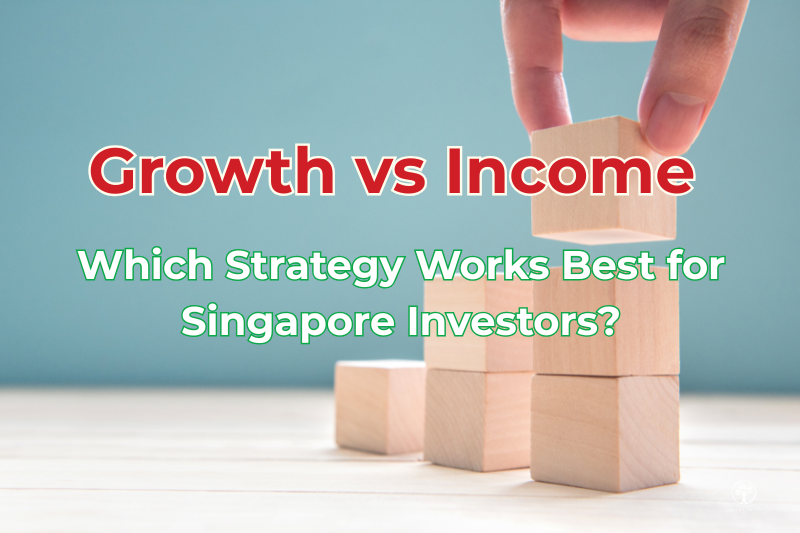
Today, investors have access to a wider range of opportunities than ever before.
Yet, one question persists: is it better to prioritise income or growth?
While income and growth often feel like opposing strategies, they are not mutually exclusive – each offers distinct advantages.
Let us break down how these strategies work and how they can build you a resilient, future-ready portfolio.
What the Two Strategies Mean
Singapore’s markets offer a vast selection of dividend stocks and REITs, which naturally draws many investors toward income-generating investments.
Income investing focuses on stocks that generate cash flows through dividends and distributions.
The objective is to achieve predictable income with lower volatility.
Income stocks are typically represented by quality companies such as DBS Group Holdings (SGX: D05), Singapore Exchange (SGX, SGX: S68), and Parkway Life REIT (SGX: C2PU).
These companies are supported by strong balance sheets and robust cash flows, with DBS and Parkway Life REIT offering higher yields suited for income seekers, while SGX provides a more modest but consistent payout.
Growth investing, however, involves identifying companies with the potential to increase earnings, driving capital appreciation over time.
As these companies typically reinvest profits into expansion, they may pay little or no dividends.
Growth stocks typically command higher price-to-earnings (P/E) ratios, reflecting investor expectations of robust future earnings growth.
Examples include iFAST Corporation Ltd (SGX: AIY), Singapore Technologies Engineering Ltd (SGX: S63), and NVIDIA Corporation (Nasdaq: NVDA) – all trading at premium valuations that signal confidence in their long-term growth trajectories.
Both income and growth investing offer unique advantages, from dependable dividends to explosive potential of global and local growth leaders.
Prioritising income or growth ultimately depends on the investor’s goals and time horizon.
The Case for Income Investing
Singapore’s market structure favours dividend investors, with strong banks, reliable REITs, and solid blue-chip companies.
Income investing is highly appealing due to its reliability and consistency, which provides stability during market volatility.
Singapore’s blue-chip companies generally reward their shareholders with steady dividends, as evident when comparing the dividend yield of an ETF tracking the STI to that of its global peers.
The SPDR Straits Times Index ETF (SGX: ES3) offers a dividend yield of approximately 4.0%, compared to about 0.85% from Invesco S&P 500 Index Y (Nasdaq: SPIDX) or around 3.16% from HSBC FTSE 100 ETF (LSE: HUKX).
Another major advantage of income investing is the compounding effect of reinvested dividends over time.
Consider an investor with S$50,000 invested in CapitaLand Integrated Commercial Trust (CICT) (SGX: C38U) for 10 years.
Assuming CICT’s current trailing dividend yield of 4.7% remains constant over the period, with full dividend reinvestment, the investor would have approximately S$79,200 at the end of 10 years – a total gain of S$29,200 driven entirely by dividend reinvestment, not accounting for any share price appreciation or volatility.
Income investing offers predictability, supported by strong balance sheets and robust cash flows, but with limited capital growth in a slower market.
The Case for Growth Investing
Growth investing is about capturing the upside of companies that are scaling rapidly or undergoing significant business transformation.
These companies thrive in lower-rate environments, which allows them to benefit from cheaper capital to support quick expansion.
A notable example of a Singapore growth stock is iFAST Corporation, which saw its net profit grow by 55.5% year-over-year (YoY) to S$26 million in the company’s latest 3Q2025 results.
iFAST has demonstrated strong earnings growth over recent years, with its diluted EPS growing at a significantly faster pace than traditional income stocks like SGX and DBS.
Now, how would returns compare between growth and income portfolios over 5 years?
Assume an investor put S$50,000 each into SGX, trading at S$9.32 per share, and iFAST, at S$3.06 per share, on 4 January 2021.
Nearly five years later, SGX trades at S$16.86 per share and iFAST at S$9.12 (as at 18 November 2025).
The S$50,000 investment in SGX is now worth approximately S$90,500, while the iFAST investment is worth approximately S$149,000 – before factoring in any dividends or distributions.
Growth investing has the potential to deliver superior long-term compounding, but comes with higher volatility and timing risk.
How Singapore Investors Can Combine Both
The best portfolios strike a balance between growth and income, aligned with investment goals and horizons.
Consider a mix of 60% dividend-oriented stocks for income and 40% growth stocks for capital appreciation.
Over time, this hybrid strategy can reduce volatility, provide a recurring income stream, and still capture the benefits of transformational growth.
As market cycles shift, you may need to rebalance your portfolio accordingly.
Dividend stocks tend to outperform during defensive periods, while growth stocks shine in bull markets.
Life changes may also warrant a portfolio adjustment.
Greater financial responsibilities, for instance, may call for a more income-heavy allocation, such as 80% dividends and 20% growth.
By combining both strategies thoughtfully, investors can reduce risk and capture multiple return drivers.
What This Means for Investors
Singapore’s stock market provides a strong foundation for income investing, but investors should not ignore the importance of growth investing.
Neither strategy is inherently better – what matters is whether the strategy aligns with your goals.
If you prioritise steady cash flow, income investing with local stalwarts like DBS, CICT, and SGX is compelling.
If your focus is on long-term capital appreciation, growth names like iFAST and global tech giants like Nvidia may make more sense.
Most investors will benefit from a hybrid approach, tailoring the split between income and growth based on risk tolerance, time horizon, investment goals, and income needs.
Get Smart: Growth and Income Complement Each Other
Choosing between growth and income investing is not an either-or decision.
Instead of thinking of them as opposing strategies, recognise that a hybrid approach often delivers the best of both worlds: the reassurance of stable dividends and the potential for capital appreciation through high-growth companies.
The smartest investors strike the right balance and build portfolios that earn cash flow today while compounding wealth for tomorrow.
Some companies cut dividends in a downturn. These 5 didn’t.
Find out which Singapore blue chips have weathered past chaos…and why they could be your portfolio’s anchors in the next wave of downturn. Download the report free.
Follow us on Facebook, Instagram and Telegram for the latest investing news and analyses!
Disclosure: Wenting does not own any of the above-mentioned stocks.