It’s easy for investors to overlook the supermarket aisle in favor of high-growth tech stocks, but boring businesses often harbour the most dependable compounding power.
Still, necessity alone doesn’t protect a grocery chain from brutal price wars.
Supermarkets build true durability only by translating frequent shopping trips into customer lock-in and entrenched cost advantages.
Costco Wholesale Corporation (NASDAQ: COST) in the US and Sheng Siong Group Ltd (SGX: OV8) in Singapore offer a masterclass in how to build an unshakeable retail moat.
What Makes a Consumer Staples Business a “Moat”?
For grocers, the moat usually stems from convenient locations, purchasing scale, and distribution operations.
Pleasant shopping experiences certainly drive foot traffic, but with non-existent switching costs, grocery retail is a game of razor-thin margins.
Walking the fine line between competitive shelf prices and healthy profitability is retail’s classic dilemma.
Industry giants often lean on bulk procurement power and fixed-cost leverage to stay ahead.
Costco: The Membership Model as a Competitive Advantage
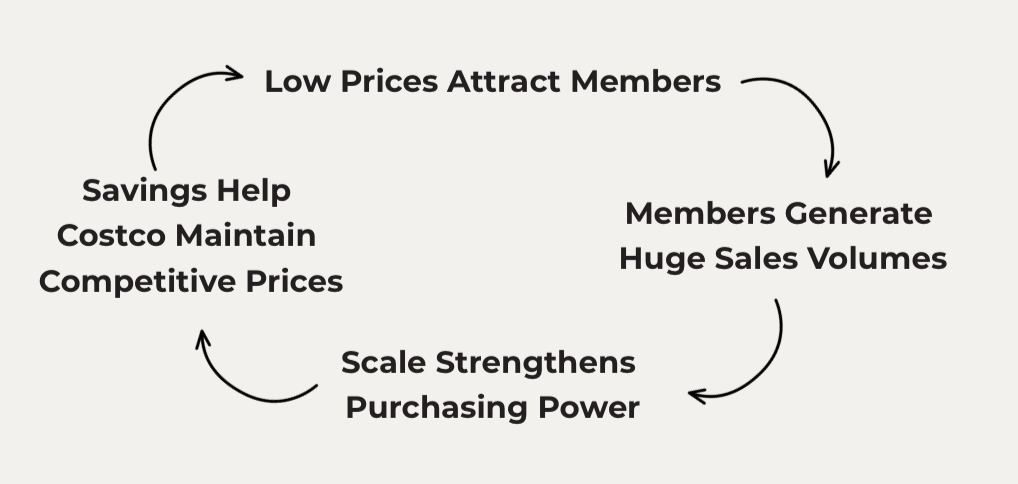
Costco differs from a traditional supermarket because customers pay before they shop.
Membership fees provide recurring revenue while giving customers another reason to keep returning.
At the end of the third quarter of its fiscal year 2026 (FY2026), Costco had 82.9 million paid members, up 4.1% year on year (YoY).
Renewal rates for the membership remained high at 92.2% in the US and Canada, and 89.7% worldwide, while membership fee revenue rose 10.7% YoY to US$1.37 billion.
Net sales increased 11.6% YoY to US$69.2 billion, bringing total revenue to US$70.5 billion, also up 11.6% from US$63.2 billion a year earlier.
Net income climbed 15.2% to US$2.19 billion.
This creates a powerful flywheel:
Executive members, who account for 41.2 million of the total member count of 82.9 million, are especially valuable, accounting for around 75% of Costco’s sales in 3QFY2026.
Costco also remains highly efficient despite deliberately operating on thin merchandise margins, with an inventory turnover ratio of 13.5.
Additionally, the company generated US$8.8 billion in free cash flow in the last 12 months.
Costco’s growth runway remains substantial.
The company opened four warehouses in 3QFY2026 and expects another 12 to be completed for the rest of FY2026. Management has a target to open 30-plus net new warehouses per year in the coming years.
Costco has also been improving its digital operations by scaling push notifications in its app to streamline warehouse efficiency and expanding pre-scans across international stores.
These enhancements boosted digitally enabled comparable sales by 21.5% and traffic to its e-commerce site and app by 37.0% in 3QFY2026.
New warehouses, international expansions, e-commerce, and continued membership growth give Costco several avenues for further compounding.
Sheng Siong: Building a Local Grocery Moat
Sheng Siong’s moat is built around convenience, pricing, and local consumer knowledge.
Prime heartland locations and tailored local merchandising keep driving repeat visits.
In the first half of 2026 (1H2026), revenue and net profit both jumped 11.9% YoY to S$855.4 million and S$81.0 million respectively.
Sheng Siong also generated S$183.4 million in free cash flow in the last 12 months, helped by an inventory turnover ratio of 12.4, and this cash generation raised the company’s cash holdings to S$402.3 million.
Network expansion remains the core growth engine for Sheng Siong.
In 1H2026, the company added three net-new Singapore stores to bring the total to 91.
Sheng Siong also has six outlets in Kunming, China.
The new Sungei Kadut distribution centre is designed to support more than 120 stores, providing capacity for continued domestic expansion.
China offers an additional growth option, although it remains a relatively small part of the business.
However, Sheng Siong has weaker customer lock-in than Costco.
Customers pay nothing to switch to another supermarket, meaning the company must continually earn loyalty through convenient locations, attractive prices, and consistent execution.
What Happens During a Recession?
Groceries are usually the last thing people cut from their monthly budget.
While travel and fancy dinners get chopped first, everyday food runs stay steady, often driving budget-conscious shoppers straight to value grocers like Costco and Sheng Siong.
However, being defensive does not mean risk-free.
Wage, rental, and supplier inflation can pressure margins, while fierce competition limits how much either company can pass higher costs on to consumers.
Dividend and Shareholder Returns
Costco raised its quarterly dividend to US$1.47 per share in 3QFY2026, up from US$1.30 per share a year ago, and has historically returned surplus cash through occasional special dividends.
However, its forward dividend yield is only 0.65%.
Sheng Siong offers a stronger income proposition.
Its 1H2026 interim dividend rose from S$0.032 per share a year ago to S$0.0375, while its dividend yield is around 2.32%.
Valuation is where things become more interesting.
As of 15 September 2026, Costco traded at US$901.35 per share, which equates to a price-to-earnings (P/E) ratio of 45.3.
Although expensive in absolute terms, Costco’s P/E ratio remains broadly in line with the elevated level seen over the past five years.
Sheng Siong traded at S$3.22 per share, with a P/E ratio of 30.8, significantly above its historical average of roughly 19.5.
Its share price has rerated sharply as investors increasingly prize its defensive earnings and growth prospects.
In other words, neither business looks obviously cheap.
Which Consumer Staples Stock Would I Prefer?
For global growth, Costco has the stronger proposition.
Costco’s combination of global scale, paid-membership lock-in, and international growth gives it an almost unassailable moat.
In contrast, Sheng Siong appeals directly to income investors seeking higher yield, zero debt, and dependable heartland spending.
Ultimately, for long-term compounders, Costco holds the structural edge thanks to stronger returns on capital and a far longer runway to redeploy cash.
But valuation matters.
A great company bought at too high a price can still deliver disappointing returns, while Sheng Siong’s elevated valuation similarly leaves less room for execution mistakes.
Get Smart: Boring Businesses Can Build Powerful Moats
Costco and Sheng Siong show that powerful retail moats can emerge through very different models: one through membership and global scale, the other through local convenience and execution.
For investors, the best business is not automatically the best investment – the return ultimately depends on how much you pay for that moat.
We’ve found 5 SGX-listed dividend stocks with strong track records in turbulent markets. If you want consistency in an uncertain world, start here.
Follow us on Facebook, Instagram, Telegram and YouTube for the latest investing news and analyses!
Disclosure: Si-Fan T. does not own shares of any companies mentioned.