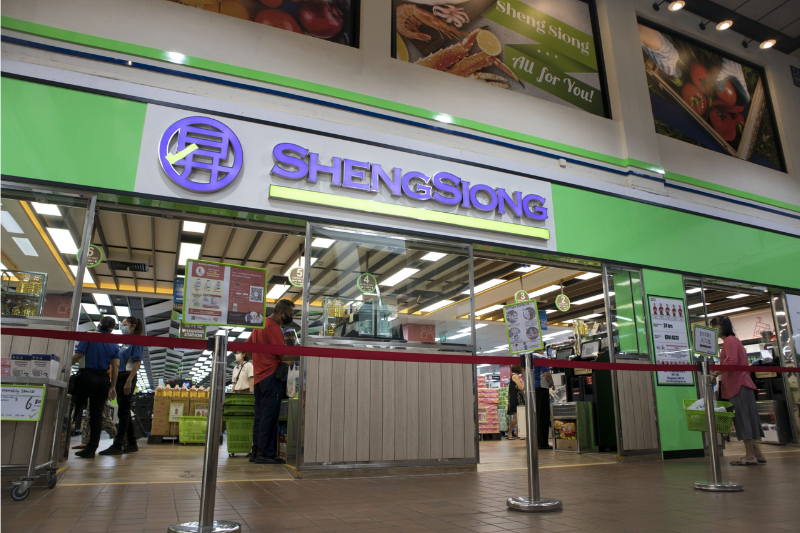
Sheng Siong (SGX: OV8) has long been a local favourite.
Its resilient earnings and defensive business model have helped it outperform across multiple market cycles.
That success comes at a price.
As of market close on 24 July, shares traded at S$3.26 per share, near the top of its 52-week range (S$2.02 to S$3.40).
Inevitably, many investors are asking: is Sheng Siong still worth buying?
Why Sheng Siong Has Earned Its Premium Valuation
People buy essential goods regardless of economic conditions, making earnings for supermarkets like Sheng Siong more predictable than those of most retail formats.
For FY2025 (ended 31 December 2025), revenue grew 9.9% year on year (YoY), from S$1.4 billion to S$1.6 billion, while net profit rose 8.7% YoY to S$149.2 million.
Momentum continued into 1Q2026 – revenue jumped 12.4% YoY from S$403.0 million to S$452.8 million, while net profit increased 12.6% YoY to S$43.4 million.
Gross profit margin widened to 31.0%, helped by a better sales mix even as operating costs increased.
Cash and cash equivalents rose to S$461.1 million at end-FY2025 (up S$25.6 million in just one quarter), leaving the group well capitalised to self-fund new stores without taking on debt.
What Has Driven the Share Price Higher?
When markets get uncertain, investors shift towards businesses whose earnings don’t swing wildly with the economy, and Sheng Siong fits that bill.
Its dividend history helps too.
The final dividend was S$0.038 per share, up 18.8% from S$0.032 per share a year earlier.
This brings FY2025’s total dividend to S$0.07 per share, and a trailing twelve months (TTM) dividend yield to 2.15%.
That’s a payout ratio of 70.4% – meaning the company paid out approximately 70% of its profit as dividends, with the rest reinvested.
With ample cash and zero debt, management can keep opening stores and paying dividends without external funding.
The Bull Case: Why Sheng Siong Could Still Be Worth Buying
Two new outlets at Smith Street and Canberra Crescent are set to open in 2Q2026, with another at Rivervale Crescent in 3Q2026.
Five HDB tenders are still pending, with two more expected within six to 12 months.
Each new store adds directly to revenue.
Additionally, the group is investing S$520 million in a new integrated headquarters and distribution centre in Sungei Kadut.
The seven-storey building is expected to be completed in 2029, supporting a network of more than 120 stores, giving Sheng Siong significant headroom to keep expanding well beyond current levels without being constrained by logistics capacity.
This expansion sits against a favourable backdrop – as Singapore’s population grows, long-term grocery demand should grow with it.
Government support measures, like CDC vouchers, also help ease cost pressures and underpin consumer spending.
If management keeps executing with discipline, revenue and profit growth should flow through to distributions.
The Bear Case: Is the Market Paying Too Much?
A forward P/E ratio of 31.8x is a meaningful step up from where Sheng Siong has historically traded.
Its closest peer, DFI Retail Group (SGX: D01), trades at a lower forward P/E of around 19.8x and offers a yield of 4.1%.
DFI sold its Cold Storage, CS Fresh and Giant stores to Macrovalue in December 2025 and now runs Guardian and 7-Eleven here, alongside food, convenience and home furnishings businesses across Asia.
Over the past three years, Sheng Siong’s earnings per share (EPS) has grown only around 4% a year, while the share price has climbed about 34.4% a year over the same period.
This means the stock has become a lot more expensive relative to its actual profit growth, raising the bar for future execution.
Should Long-Term Investors Worry About Valuation?
Quality businesses rarely look cheap, and Sheng Siong’s premium reflects a decade of consistent execution.
Paying a fair price for a quality business has historically tended to outperform buying a lower-quality business just because it looks cheap on paper.
The more useful question isn’t whether the stock looks expensive today, but whether its store pipeline, cash pile, and pricing power can keep translating into earnings and dividend growth.
One way to reduce the risk of overpaying at a peak is dollar-cost averaging – buying at regular intervals rather than trying to time a “perfect” entry price.
How Sheng Siong Compares With Other Defensive Singapore Stocks
Beyond DFI, two other Singapore blue-chip defensives offer useful benchmarks.
DBS Group (SGX: D05) trades at a lower P/E of 19.3x and pays a higher dividend yield of 4.2%, though its earnings are more rate-sensitive than Sheng Siong’s grocery sales.
ST Engineering (SGX: S63) trades even richer (roughly 72.1x) but yields less, at just 1.7%.
Sheng Siong’s growth drivers are comparatively narrow — opening more stores and growing same-store sales.
So its case rests almost entirely on execution and earnings predictability, not on being the cheapest or highest-yielding option on the exchange.
What Investors Should Watch Going Forward
Investors should keep an eye on new store openings and tender wins, particularly the five pending HDB tenders.
Same-store sales growth also matters because it needs to stay positive to justify the current valuation.
That said, don’t shun a quality business just because it’s near its all-time high.
But also don’t buy a stock simply because it looks “cheap” on one metric.
It’s important to understand the business quality and cash generation instead.
Management’s execution on its broader strategy is one thing to watch here – its push into quick commerce and ongoing store optimisation in China could weigh on earnings if it doesn’t pay off as planned.
With inflation and rising staff costs also in the picture, gross margin and consumer spending trends are worth watching.
Most importantly, monitor dividend growth and whether the payout ratio can hold even as earnings growth slows.
Companies with strong multi-year trends in earnings and dividends are usually better long-term picks than those driven by short-term price swings.
Get Smart: A Great Business Isn’t Always a Cheap Business
Because Sheng Siong’s resilience, strong balance sheet, and store expansion are already priced in, it’s no longer a bargain.
The real question isn’t whether the stock is expensive, but whether its competitive advantage is strong enough to drive the future earnings growth needed to justify this higher price tag.
One of these six companies is the only one legally allowed to operate in Singapore. It has increased its dividend for 16 consecutive years. Discover which one it is in our free report here.
Follow us on Facebook, Instagram and Telegram for the latest investing news and analyses!
Disclosure: Si-fan T. owns shares of DBS.