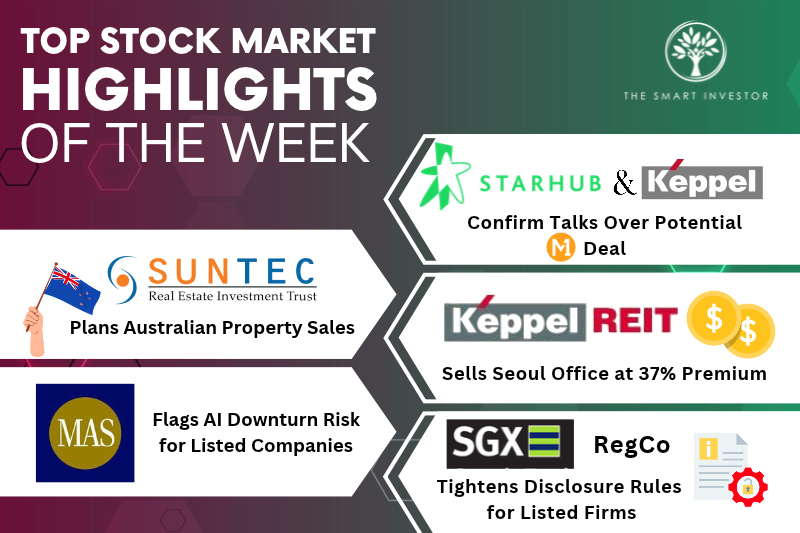
Talk of consolidation returned to Singapore’s telco sector this week as StarHub (SGX: CC3) and Keppel Ltd (SGX: BN4) confirmed discussions over M1.
Two S-REITs also moved to sharpen their focus on Singapore by selling overseas properties.
Elsewhere, the Monetary Authority of Singapore (MAS) stress-tested listed companies against a severe artificial intelligence (AI) downturn, while Singapore Exchange Regulation (SGX RegCo) unveiled new disclosure rules aimed at building a value creation culture among issuers.
StarHub and Keppel confirm talks over a potential M1 deal
StarHub and Keppel confirmed on 23 September 2026 that they are in talks over a potential transaction involving M1.
Both cautioned that there is no certainty a deal will materialise.
Keppel, which controls M1, repeated its view that Singapore’s telco sector needs consolidation.
The talks follow the collapse in May of Simba’s proposed S$1.4 billion acquisition of M1’s telco business.
A StarHub-M1 combination would cut the number of mobile network operators in Singapore from four to three, subject to regulatory approval.
StarHub’s results show why consolidation is on the table.
For the first half of 2026 (1H2026), mobile service revenue fell 10.5% year on year (YoY) to S$245.3 million amid intense price competition.
StarHub and M1 have each targeted around S$70 million in cost savings in preparation for a possible tie-up.
Temasek is the controlling shareholder of both StarHub and Keppel.
On the day of the announcement, StarHub’s shares closed flat at S$1.11, while Keppel’s rose 1% to S$11.21.
Suntec REIT pivots towards Singapore with Australian sales
Suntec REIT (SGX: T82U) announced on 21 September 2026 that it will grow its Singapore assets and reduce its overseas exposure.
The decision follows a strategic review of the portfolio that new sponsor Tang Organization launched in March.
As a first step, the manager plans to sell three Australian properties: 177 Pacific Highway, 21 Harris Street and 477 Collins Street.
Chong Kee Hiong, CEO of the REIT manager, said the sales should bring aggregate leverage below 40%.
That would create room for acquisitions, unit buybacks or capital distributions.
The divestments should also remove an earnings drag from Australia’s high-interest-rate environment.
Singapore already contributes about 74% of Suntec REIT’s income, with Australia at 15% and the UK at 11%.
The REIT is coming off a strong 1H2026, with distribution per unit (DPU) rising 24.8% YoY to S$0.03936.
Not everyone is convinced yet.
Jefferies kept its “hold” call and S$1.38 target price.
It said the announcement lacked detail on DPU-accretive capital recycling opportunities in Singapore.
Keppel REIT sells Seoul office at a healthy premium
Keppel REIT (SGX: K71U) announced on 23 September 2026 that it will divest its 99.38% stake in T Tower, a freehold Grade A office building in Seoul, to a South Korea-based real estate fund.
The agreed property value of KRW 348.8 billion is a 37.2% premium to T Tower’s purchase price in May 2019.
It is also a 7.4% premium to the property’s valuation as at 31 August 2026.
The sale reflects an exit net property income yield of 3.9%, and completion is expected in the fourth quarter of 2026 (4Q2026).
Keppel REIT also recently sold KR Ginza II in Tokyo.
On a pro forma basis, the two sales together should lower aggregate leverage from 40.0% to 38.0%.
The manager also intends to use up to S$25 million of the proceeds for unit buybacks.
CEO Chua Hsien Yang said the sale demonstrates Keppel REIT’s ability to crystallise value.
After both divestments, Singapore will make up 81.1% of the S$11.5 billion portfolio, and Australia will account for the rest.
MAS flags AI downturn risk for one-third of listed firms
MAS released its annual Financial Stability Review on 22 September 2026.
It found that around 32% of Singapore-listed companies would be at risk under a severe downturn in AI-related investment.
The stress test applied revenue shocks of up to 30% and interest rate shocks of up to 400 basis points, calibrated to each firm’s exposure to the AI supply chain.
A company counted as at risk if its interest coverage ratio fell below one.
It also counted as at risk if it had negative cash flow and its cash buffers covered less than six months of the shortfall.
At-risk firms would account for about 16% of overall corporate debt.
Highly leveraged, capital-intensive and smaller companies were over-represented.
That said, MAS noted that most firms could weather the shock and that corporate balance sheets were generally sound.
The banking system’s corporate non-performing loan ratio also fell to an 18-year low of 1.2% in 2Q2026.
The central bank named a possible reassessment of AI-related valuations as a key risk.
It urged firms and households to keep adequate liquidity buffers.
SGX RegCo tightens disclosure rules for listed companies
SGX RegCo announced on 23 September 2026 that listed companies will face stricter disclosure requirements from 1 January 2027.
The rules cover executive pay, dividends and investor engagement.
Issuers will need to disclose the key performance indicators used to set executive remuneration and explain how these align with long-term value creation.
Annual reports must also include a dividend policy, an investor relations policy and a description of key shareholder engagement activities.
Companies must also maintain a dedicated investor engagement website or webpage.
Issuers do not have to commit to a dividend payout, and those retaining capital for growth can simply say so.
SGX RegCo CEO Tan Boon Gin said the changes “strengthen disclosure standards while preserving flexibility for issuers”.
Many firms are already partway there.
More than 90% of issuers tie remuneration to financial indicators, but only 47% disclose which ones they use.
The first annual reports under the new rules will be issued in 2028.
It almost feels like the government is paying companies to make you wealthier. Singapore’s new S$5 billion market boost could send fresh money into local stocks. We identified 5 companies positioned to benefit, including familiar names with surprising wealth potential. Our free report reveals these hidden opportunities before the money flows in. Download it now before it’s too late.
Follow us on Facebook, Instagram, Telegram and YouTube for the latest investing news and analyses!