The dream of living off dividend income is alluring.
Who wouldn’t want to stack up quality shares after years of working hard, then let dividends cover living costs for the rest of their lives?
But, is it really possible to retire on dividends alone in Singapore?
It would rely on several factors, including portfolio size, yield sustainability, and personal financial needs.
Today, we will take a deep dive into these three stocks – Parkway Life REIT (SGX: C2PU), Singapore Exchange (SGX: S68), and DBS Group Holdings (SGX: D05) – and examine if dividend income can indeed support financial independence.
Parkway Life REIT (SGX: C2PU)
One of Asia’s largest healthcare REITs, Parkway Life REIT (PLife) invests in healthcare-related assets and is one of Singapore’s most reliable dividend payers.
Compared to cyclical retail or hospitality REITs, healthcare real estate tends to have longer leases and resilient tenant cash flows.
This makes PLife’s distribution more stable and relatively predictable.
Since its IPO, the REIT’s distribution per unit (DPU) has been growing steadily, from its initial S$0.0632 per unit in 2007 to S$0.1492, more than double in 2024.
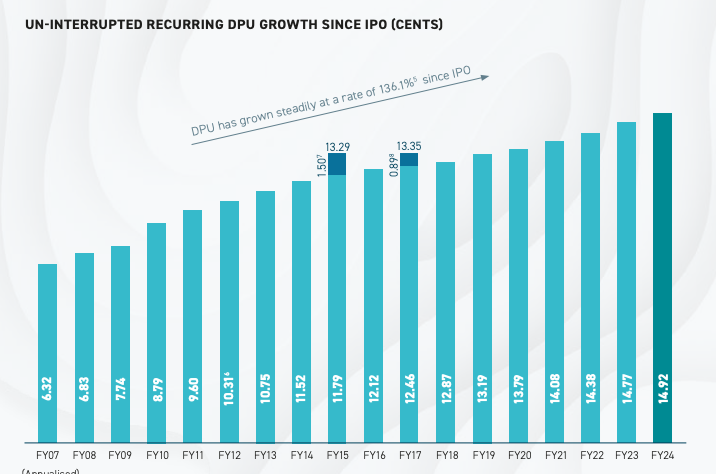
As of mid-2025, the REIT’s trailing 12-month DPU stands at S$0.1503, translating to a dividend yield of around 3.7% based on a unit price of S$4.05.
PLIfe maintained a near-100% committed occupancy across its properties in Singapore, Japan and France as of 30 June 2025.
With a long Weighted Average Lease to Expiry (WALE) of 14.68 years, the REIT enjoys steady locked-in rental income.
However, investors should note that it relies on a small number of key tenants for a substantial portion of its income.
Losing one or more of these key tenants could have a significant impact on performance.
With a healthy gearing ratio of 35.8%, PLife has approximately 86% of its interest rate exposure hedged, and its effective all-in cost of debt is 1.57%.
This long WALE and healthcare tenant base mean the REIT’s DPU is less exposed to economic cycles and more likely to be sustained.
PLife’s combination of stability and growth makes it well-suited for retirees seeking reliable dividend income in their golden years.
Singapore Exchange (SGX: S68)
The Singapore Exchange (SGX) is a market infrastructure business that provides listing, trading, clearing, settlement, depository, data, and index services.
Generating recurring fee income, SGX’s businesses maintain consistent profitability through market cycles.
As they are less volatile than those of cyclical industrial companies, SGX is a dependable dividend payer.
SGX has maintained relatively stable dividends, paying out S$0.375 per share for FY2025.
Previous five years’ annual dividend pay out started from S$0.305 in FY2020, rising to S$0.35.
The payout ratio for FY2025 is 61.9%, up 0.2 percentage points from FY2024.
SGX’s trailing annual dividend yield is 2.2%, while its five-year average dividend yield is 3.2%.
In its FY2025 annual report, the bourse operator shared that a steady dividend increase by S$0.0025 every quarter from FY2026 to FY2028 is expected, subject to board approval.
SGX is Singapore’s sole stock market operator but it also has multiple revenue streams.
In fiscal year 2025, SGX’s equities-cash segment’s net revenue increased 18,7% YoY to S$392.7 million, representing 30.3% of total net revenue.
Meanwhile, its derivatives segment’s net revenue increased 13.8% YoY to S$345.9 million, representing 26.6% of total net revenue.
This diversified revenue mix results in strong operating margins (57.2% for FY2025), helping to support dividends through cycles.
This stability makes SGX a cornerstone income stock for long-term investors, and particularly retirees who prefer lower volatility in payouts.
DBS Group Holdings (SGX: D05)
DBS Group is the largest bank in Singapore and operates in Hong Kong, Greater China, Southeast Asia, and India.
The group achieved a net profit of S$2.9 billion for its third quarter of 2025 (3Q2025), 2% lower than a year ago.
The stable profit came despite heightened macroeconomic uncertainty, sharp declines in Singapore Overnight Rate Average (SORA) and Hong Kong Interbank Offered Rate (HIBOR), significant currency fluctuations, and the implementation of the 15% global minimum tax.
Commercial book net interest income (NII) rose by 3% quarter on quarter.
For the first nine months of 2025, DBS kept its commercial book NII decline to around 3% year on year, reflecting the bank’s strong ability to manage interest rate headwinds through tactical hedging and balance sheet growth.
Over the last 12 months, the bank had paid S$2.85 per share in dividends, and its trailing annual dividend yield is at 5.2% based on recent trading data..
In addition to ordinary dividends, the blue-chip stalwart also pays capital return dividends and special dividends, although these are not frequent.
With businesses in various services such as personal banking, investment banking, loans, and wealth management, DBS’s mix of strong dividend payouts and resilient earnings provides both income and peace of mind for retirees.
How Can Dividends Fund Retirement?
When you have substantial investments in quality companies, your portfolio can provide a sustainable income stream for your retirement years.
By reinvesting dividends during accumulation years, you can compound returns and receive steady payouts in your golden years.
Suppose you have S$600,000 in investments in the above three stocks, splitting them into S$200,000 each.
Using their recent trailing annual dividend yield, and assuming the yields remain constant
- Parkway Life REIT: 3.7% = S$7,400 in annual dividends
- Singapore Exchange: 2.2% = S$4,400 in annual dividends
- DBS Bank: 4.9% = S$10,400 in annual dividends
The total annual dividend income is S$22,200, which gives approximately a 3.7% yield on S$600,000 capital.
Alternatively, you could shift to higher-yielding and, typically, riskier holdings to boost returns.
A S$600,000 portfolio that generates approximately a 5% yield will give you S$30,000 annually in dividends.
Having a diverse mix of stocks across sectors is also important.
‘Defensive’ stocks like SBS Transit (SGX: S61), which offers a 10% yield, or technology stocks like Venture Corporation Limited (SGX: V03) with a 5.3% yield are popular among investors.
However, it is important to remember that yields fluctuate with share prices and payouts, and past dividends don’t guarantee future payments.
What This Means for Investors
Building a portfolio that reliably pays your living expenses, even in retirement, typically requires either a large capital base or a higher overall portfolio yield.
Sustainable dividend investing is all about quality, not merely chasing yield.
Parkway’s long WALE and stable tenant base, SGX’s market infrastructure business, and DBS’s earning power demonstrate strong business fundamentals, making them more reliable than simply chasing high-yield numbers.
Get Smart: Look Beyond Yields
Only with the right companies can you rely on dividend income to power a comfortable retirement.
This will require prudent planning, diversification across sectors and asset types, and active monitoring of payout sustainability.
Beyond yield, investors need to look at other important metrics, including the company’s balance sheet, earnings sustainability, tenant base (for REITs), dividend history, and gearing.
The smartest investors build portfolios around dependable payers that deliver consistently through every market cycle.
This could be the fastest way to jump from a “newbie” investor to a seasoned pro. Our beginner’s guide shows everything you need to know to buy your first stock and beyond. Click here to download it for free today.
Follow us on Facebook, Instagram and Telegram for the latest investing news and analyses!
Disclosure: Wenting does not own any holdings in the stocks mentioned.