Three dividend payments land before August closes.
And none of the three companies sits in the Straits Times Index (SGX: ^STI).
A payment date tells you when the cash arrives, but it says nothing about whether the same cash arrives next year.
That answer sits further up the accounts, where you find the lifeblood of dividends – free cash flow.
Look at what funded each payment.
Then ask whether that source repeats.
Can VICOM keep paying at this rate after December?
VICOM (SGX: WJP) is treating its shareholders to S$0.0395 per share on 26 August, which beats last year’s S$0.031 by 27.4%.
Beyond its core vehicle inspection business, the company also handles testing across sectors including construction, manufacturing, and biological and chemical testing.
That broader reach helped push its first half of 2026 (1H2026) revenue up 6.4% year on year (YoY) to S$74.3 million.
Bottom-line growth was even more impressive: operating profit jumped 27.1% to S$24 million and profit attributable to shareholders reached S$19.9 million, 28% above a year ago.
Earnings per share rose from S$0.0439 to S$0.0561.
The secret behind that profit surge: cost control.
Total operating costs fell 1.2% YoY to S$50.3 million, largely thanks to a 44.2% plunge in subcontractor fees for the ERP 2.0 On-Board Unit project, which easily absorbed higher staffing costs.
Operating cash flow climbed 65.1% YoY to S$31.8 million and covered capital expenditure of S$17.2 million, leaving free cash flow to more than double to S$14.7 million from S$6 million.
VICOM held S$53 million of cash as at 30 June 2026 and carried no bank borrowings.
Lease liabilities came to S$33.3 million.
That ERP 2.0 line is worth a double-take, though.
As installations wind down ahead of the project’s December 2026 deadline, those subcontractor costs will vanish – but so will the associated revenue.
That’s precisely why management is setting expectations for a softer second half.
Is Credit Bureau Asia’s dividend outgrowing its profit?
Credit Bureau Asia (SGX: TCU), or CBA, is handing out S$0.022 per share to its shareholders on 28 August – a 10% increase from last year’s S$0.020.
The group, which provides credit and risk data to financial institutions and corporate clients across Singapore, Malaysia, Cambodia, and Myanmar, delivered a 2.7% YoY rise in 1H2026 revenue to S$31.0 million.
Financial institution data revenue grew 4.3% to S$14.6 million, while non-financial institution data revenue edged up 1.3% to reach S$16.4 million.
Group profit grew 3.6% YoY to S$13.3 million.
However, shareholder attributable profit managed just 1.5% growth to S$5.5 million – meaning CBA bumped its dividend by 10% despite net gains remaining largely flat, heavily diluted by minority profit-sharing.
Free cash flow rose 4.6% YoY to S$13.3 million at group level, leaving CBA with cash and bank balances of S$49.6 million as at 30 June 2026 and lease liabilities of S$4.7 million.
CBA also completed a one-off capital reduction on 26 June 2026 and returned S$0.090 per share, or roughly S$20.7 million.
Revenue and pre-tax profit from the FI data segment each grew 4% in 1H2026.
Management remains cautiously optimistic for the remainder of FY2026.
Why did Old Chang Kee lift its payout when profit fell?
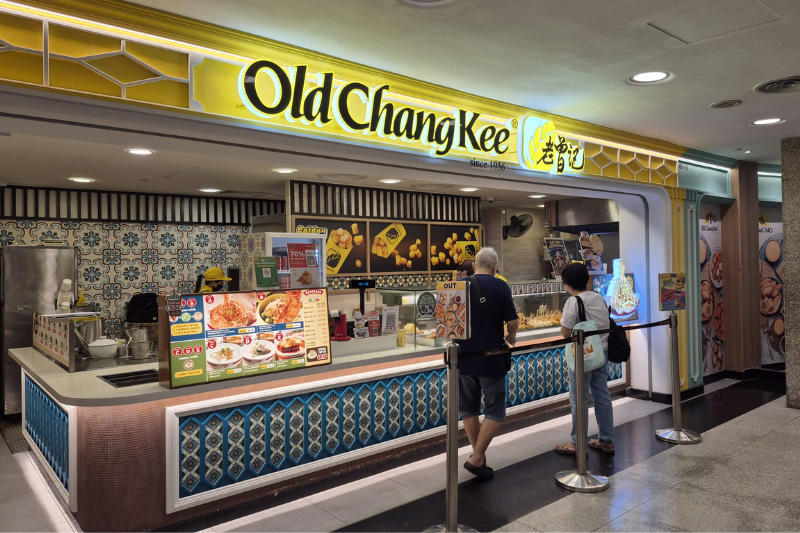
Old Chang Kee (SGX: 5ML), or OCK, the curry puff maker which also sells spring rolls and chicken wings, pays shareholders on 28 August.
For fiscal 2026 ended 31 March 2026 (FY2026), OCK declared an interim dividend of S$0.01 and proposed a final dividend of S$0.01.
It added a special dividend of S$0.01, which made the total FY2026 payout reach S$0.03 per share, against S$0.02 a year ago.
Interim and final alone matched last year’s total, which meant that the whole increase came from the special dividend.
Revenue for FY2026 edged up 1.5% YoY to S$103.5 million, but higher selling and distribution expenses drove net profit attributable to shareholders to fall 15.8% to S$9.6 million.
Wage adjustments lifted staff costs too.
Interest income dropped by roughly S$0.55 million as fixed deposit rates came down.
Despite lower earnings, cash generation remained sturdy.
Free cash flow came in at S$21.0 million for FY2026, down from S$23.2 million a year ago, supported by a rock-solid balance sheet.
As of 31 March 2026, OCK held S$61.6 million of cash and deposits, against S$1.4 million of debt – a deep net cash cushion that gave management the confidence to fund a special dividend even in a down year for profits.
That said, management remains cautious, flagging inflation and manpower shortages as continuing headwinds.
Get Smart: Ask What Paid For It
Having three dividend payment dates land in the exact same week feels great, but it tells you virtually nothing about what next year holds.
Run the same test on every dividend you receive.
Find the cash that paid for it, then ask whether that cash can reliably show up again in twelve months.
Sometimes the financial filings give you a clear warning sign, like an impending project end date.
Other times, the sustainability depends on how much group-level profit actually makes it past minority partners and into the listed parent’s hands.
The cash hits your account either way – but whether you see it again next year depends on the quality of the businesses you choose to hold.
You walk past million-dollar opportunities every single day. Your coffee shop. Your commute. Your grocery run. But these “boring” Singapore companies are quietly building fortunes while everyone chases crypto and overpriced tech stocks. Our latest report reveals 5 small-cap goldmines hiding in plain sight. Click here to download for free now before prices catch up.
Follow us on Facebook, Instagram, Telegram and YouTube for the latest investing news and analyses!
Disclosure: Calvina L. does not own shares of any stocks mentioned. Chin Hui Leong contributed to this article and owns shares of VICOM and CBA.