The SPDR STI ETF (SGX: ES3), an exchange-traded fund that tracks Singapore’s Straits Times Index (SGX: ^STI), delivered a 24% total return for the year to the end of August 2026.
Crucially, that figure accounts for dividends as well as share price appreciation.
Yet three blue chips more than doubled that return over the same period.
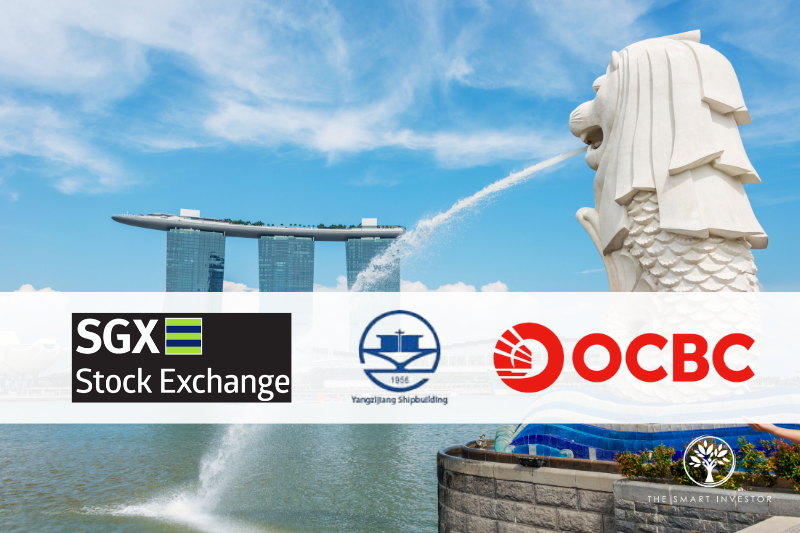
Oversea-Chinese Banking Corporation Limited (SGX: O39), or OCBC, led the pack with a 63.1% total return, while Singapore Exchange Limited (SGX: S68), or SGX, and Yangzijiang Shipbuilding (Holdings) Ltd. (SGX: BS6) followed closely at 51.3% and 48.9%, respectively.
Operating across completely different industries, all three companies delivered double-digit earnings growth.
Three distinct operational drivers explain the performance gap.
What powered OCBC’s record first half?
OCBC’s total income rose 11% year on year (YoY) to S$8 billion for the first half of 2026, driving net profit up 13% to a record S$4.2 billion.
Growth came from beyond the core lending franchise.
Net interest income slipped 3% as net interest margin – the profit margin the bank earns on its loans – narrowed by 25 basis points to 1.73%.
However, customer loans expanded 12% to S$364.5 billion, cushioning most of that margin compression.
Instead, non-interest income surged 36% YoY to S$3.5 billion to lead the expansion.
Fees and commissions rose 26% to S$1.4 billion on stronger wealth management activity, while trading income jumped 46% to S$1.1 billion.
Great Eastern Holdings Limited (SGX: G07) provided further support, with life and general insurance income climbing 49% to S$791 million.
Reflecting these results, the board raised the interim dividend by 15% to S$0.47 per share.
The non-performing loan ratio remained steady at 0.9%, prompting management to upgrade its full-year 2026 guidance with expectations for total income growth.
OCBC’s Common Equity Tier 1 (CET1) ratio stood at 15.7%, down 1.3 percentage points YoY.
The expanding loan book and an ongoing S$2.5 billion capital return programme both draw on this capital buffer.
Why did SGX’s revenue accelerate?
For the fiscal year ending 30 June 2026, SGX’s net revenue rose 13.9% YoY to S$1.5 billion, driven by significantly higher market trading activity.
Securities daily average traded value rose 34.9% to S$1.8 billion, lifting Equities – Cash revenue up 28.1% to S$502.9 million.
Meanwhile, the Fixed Income, Currencies and Commodities division expanded 17% to S$376.2 million on record currency and commodity derivatives volumes.
Headline net profit rose 7.8% YoY to S$698.4 million, weighed down by a S$53.4 million goodwill impairment on Scientific Beta alongside weaker investment gains.
Excluding both items, adjusted net profit grew 24.6% to S$759.5 million.
Free cash flow reached S$788.8 million, up 2% YoY even as capital expenditure increased to S$94.2 million for technology modernisation.
The group maintained a strong balance sheet, holding S$1.8 billion in cash against S$628.2 million in borrowings.
SGX declared total dividends of S$0.57 per share for FY2026, up from S$0.375 a year ago, which includes a one-off additional dividend of S$0.125 per share.
Looking ahead, management guided for quarterly dividend increases of 0.25 cents through FY2028 and signalled plans for full debt repayment in FY2027.
What’s driving YZJ’s shipbuilding revenue?
Yangzijiang Shipbuilding’s (YZJ) revenue rose 36% YoY to RMB 17.5 billion for the first half of 2026.
Gross profit climbed 43% to RMB 6.3 billion as shipbuilding gross margin expanded to 37% from 35% a year ago, lifting profit attributable to equity holders by 28% to RMB 5.4 billion.
The top-line growth was driven by higher contract prices for constructing ultra-large LNG dual-fuel containerships and very large ethane carriers.
The newly operational Hongyuan yard also added momentum, contributing RMB 545 million in shipbuilding revenue during the second quarter.
Free cash flow surged 82% YoY to RMB 675.4 million.
As of 30 June 2026, the group held RMB 15.9 billion in cash against RMB 4.1 billion of borrowings.
Yangzijiang declares dividends on an annual basis, so no distribution was declared for 1H2026.
For FY2025, it paid a final dividend of S$0.20 per share on 14 May 2026.
Its order book stood at US$22.4 billion as of 30 June 2026.
With approximately US$1.96 billion in new orders secured through July 2026, the group continues to work towards its FY2026 order-win target of US$4.5 billion.
On execution, YZJ delivered 27 vessels in 1H2026 against its full-year target of 58.
Get Smart: The Earnings-Growth Test
While these three companies operate in entirely different sectors, their common thread is clear: structural earnings growth.
OCBC has established fee and insurance revenue as a robust second engine alongside traditional lending.
SGX converts heightened market activity directly into exchange revenues.
Yangzijiang Shipbuilding’s US$22.4 billion order book provides multi-year visibility on higher-margin vessel deliveries.
Investors can apply the exact same evaluation framework to any blue chip: where is the earnings growth coming from? And is the driver structural or one-off?
You’ve probably shopped at their malls, banked with them, or bought their products this month. These 6 SGX companies have paid dividends for 20 straight years, GFC and COVID included. Our FREE report shows you which ones, and what has kept their dividends going for 20 years and more. Grab your copy here.
Follow us on Facebook, Instagram, Telegram and YouTube for the latest investing news and analyses!
Disclosure: The Smart Investor owns shares of OCBC and SGX.