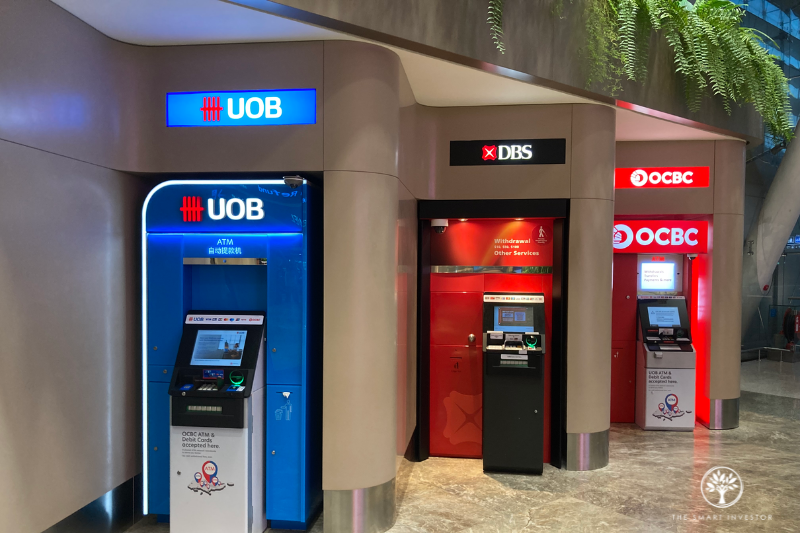
It has been fruitful being an investor in Singapore banks with DBS Group (SGX: D05), OCBC Limited (SGX: O39) and UOB Limited (SGX: U11) climbing sharply over the last five years.
In fact, both DBS and UOB just smashed through to new all-time highs yesterday (9 July 2026), touching S$70.27 and S$44.19 respectively.
The rally, however, has left valuations looking far less compelling than before.
We explore what long-term investors should consider – whether managing their positions or starting a fresh one.
Why Singapore Banks Have Rallied
Here are some reasons anchoring the banks’ stunning multi-year rallies.
Higher interest rates between 2022 and 2024 significantly boosted the banks’ net interest margins (NIMs), driving strong growth in net interest income (NII) and fueling record net profits.
Crucially, even as interest rates have eased, the banks have been posting near-record earnings.
The three banks are still generating sizeable profits as seen in their first quarter report cards. DBS earned S$2.9 billion, ahead of OCBC’s S$2.0 billion and UOB’s S$1.4 billion.
Returns on equity (ROE) remained respectable, led by DBS at 17.0%, ahead of OCBC’s 13.0% and UOB’s 11.5%.
Shareholders have benefited as well, with dividends generally trending higher over the past five years, and, in some cases, boosted by special dividends and share buybacks.
The banks’ dividends are well-supported by strong common equity tier one (CET1) ratios: as of 31 March 2026, DBS has a fully phased-in CET1 ratio of 14.8%, while both UOB and OCBC have CET1 ratios standing at 15.2%.
Why Share Price Alone Doesn’t Tell the Whole Story
Importantly, just because share prices are high, it does not automatically mean overvaluation.
We stress that investors should also consider the earnings growth displayed by the company, alongside record-high prices.
If earnings continue growing, it’s only natural for the share price to follow suit.
Having established that, perhaps the question to ask when you see record high share prices is: have the business fundamentals improved alongside share price appreciation?
What Long-Term Investors Should Focus On
Moving forward, other than growing earnings, investors should also pay attention to the earnings quality displayed by the banks.
Are they making headway in growing their non-interest income streams?
Dividend payout ratios are also worth monitoring: the three banks currently distribute around half to three-fifths of their earnings as dividends.
Given their healthy CET1 ratios and management’s dividend-friendly policies, these dividends are expected to continue.
One last thing to add, all three banks continue to display prudence in their lending, each possessing a high-quality loan portfolio.
This is best seen in their low non-performing loan (NPL) ratios which range from 0.9% to 1.5%.
The Biggest Risk: Falling Interest Rates?
The biggest risk for the banks would be falling interest rates, reducing their NIMs and hampering their NII.
That said, this headwind could be buffered by the growth of fee income from wealth management, treasury income, and even insurance contributions (OCBC).
Additionally, further regional expansion and the corresponding loan volume growth could help soften the blow from tighter NIMs.
Comparing the Three Banks
DBS stands out for its digital banking strength, increasing earnings diversification (particularly from its wealth segment), and its capital return dividends that are expected to last until 2027.
Meanwhile, OCBC continues to display decent momentum in its wealth management business, while its conservative balance sheet stands out, with an NPL ratio of 0.9% – the lowest among the three banks.
The bank also offers diversification from its insurance business through Great Eastern.
Finally, UOB offers investors exposure to the broader ASEAN region as it continues to digest its Citigroup acquisition.
Subject to execution risks, this acquisition could pave the way for future regional banking growth opportunities.
Valuation: Are Banks Still Reasonably Priced?
Valuations for DBS and OCBC have become more demanding following their strong share price performance.
DBS trades at 2.8x book value and 17.6x forward earnings, well above its five-year averages of 1.7x and 10.9x, respectively.
Likewise, OCBC’s current P/B and forward P/E ratios of 1.9x and 15.1x are markedly higher than their historical averages of 1.2x and 9.6x.
The richer valuations are also reflected in dividend yields.
OCBC’s trailing dividend yield stands at 3.6%, while DBS currently offers a trailing yield of around 4.4%.
UOB, however, still looks relatively less stretched.
The bank currently trades at 1.4x book value and 11.8x forward earnings, only modestly above its five-year averages of 1.2x and 9.5x, respectively.
It currently offers a trailing dividend yield of 4.1%.
However, given all three banks’ decent ROEs, which have seen increases compared to years prior, perhaps current valuations could be justified.
Should Investors Wait for a Pullback?
You could wait for more compelling valuation opportunities should the shares pull back, which would provide a better margin of safety.
However, it might be better to build your positions over time, as it’s challenging to time markets. This way, you can reduce missing out on potential further share price appreciation while owning quality businesses like these three banks.
Common Mistakes Investors Make
Let me be clear: it’s a common mistake to avoid owning quality businesses simply because share prices are at record highs.
That said, you should still be mindful of current valuations and avoid solely focusing on dividend yields.
Do not let near-term interest rate movements shake you out of owning these quality banks.
Get Smart: Buy Great Businesses, Not Cheap Headlines
In conclusion, do not let record-high share prices automatically turn you away from strong-performing businesses.
While not cheap, Singapore banks’ current premium valuations are justified by their strong profitability and consistent dividends.
Instead of trying to time your buy and sell decisions, long-term investors are better off focusing on whether these banks can continue delivering earnings growth and dividend payments.
Many Singapore stocks fall behind inflation, which means your money quietly loses strength over time. Dividend stocks have a very different track record. Some continued delivering 6% to 13% every year across the toughest market conditions.
In this FREE report, discover 5 crisis-tested dividend stocks that kept rewarding investors while the market struggled. Download your dividend investing guide now.
Follow us on Facebook, Instagram and Telegram for the latest investing news and analyses!
Disclosure: Wilson H. does not own shares in any of the companies mentioned.